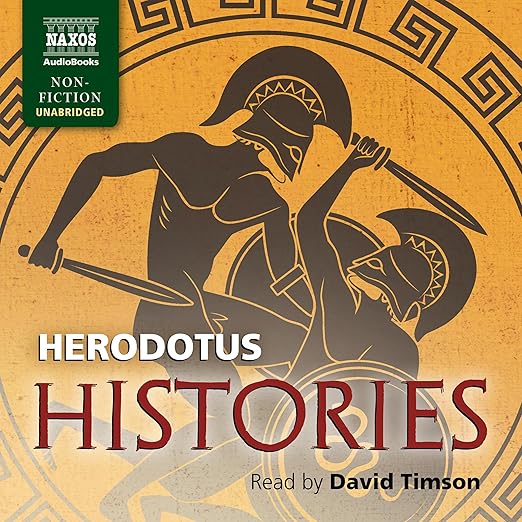
Quick Take
- Narration: David Timson brings measured authority to Herodotus’s vast canvas, his clear diction navigating the digressive structure without losing the listener in geographical asides.
- Themes: East versus West, hubris and divine retribution, the reliability of oral tradition
- Mood: Expansive and episodic, by turns heroic and anthropological
- Verdict: Essential for anyone approaching ancient history seriously, though the digressive structure demands patience and rewards active listening.
I came to this one during a stretch of January evenings when I wanted something that felt genuinely weighty, not in the self-important way that some popular history manages, but in the sense of actual accumulated time. Twenty-seven hours of Herodotus, narrated by David Timson, spread across two weeks of commutes and quiet nights. By the end I had the strange sensation of having traveled both very far and very slowly, which seems right for a book written in the fifth century BCE that still feels, in its best passages, startlingly immediate.
The accompanying PDF, noted in the Audible description, contains supplementary material worth keeping in mind. Donald Lateiner’s introduction, flagged by at least one listener as genuinely useful for newcomers, provides the orienting framework that Herodotus himself cheerfully refuses to supply. If you are coming to this without prior exposure to Greek historiography, that introduction is not optional.
What the Father of History Actually Does
The label “first prose history in European civilization” is technically accurate and also somewhat misleading as a guide to what listening experience awaits you. Herodotus is not Thucydides. He does not stay on topic. He pivots from the Battle of Marathon to a lengthy account of Egyptian embalming practices to a digression on Scythian customs without any obvious apology or transition anxiety. One reviewer captures it fairly: the best parts are the descriptions of peoples and their customs, and the Persian Wars themselves form only one major arc within a much larger investigation into how the ancient world understood itself.
That meandering quality is either the book’s great virtue or its primary frustration depending on your temperament. Herodotus is genuinely curious about everything, and his curiosity is infectious. His method is essentially journalistic: he reports what he was told, frequently noting when accounts conflict, and lets the reader decide. The mixing of fact with legend, as one listener puts it, is not a flaw in his methodology but the methodology itself. He is documenting belief as much as event.
The Persian Wars as the Narrative Spine
Marathon, Thermopylae, Salamis. These names carry such cultural freight that hearing them embedded in their original narrative context is oddly disorienting. Herodotus builds toward the confrontation between Persia and the Greek city-states with a pace that modern readers, trained on tightly structured narrative nonfiction, may find oblique. The sense of epic destiny described in the synopsis is real, but it arrives gradually, earned through hundreds of pages of context about Persian expansion under Cyrus, Cambyses, and Darius before Xerxes even assembles his famous vast force.
The emotional power of the Thermopylae sequence, when it finally comes, is genuine. Herodotus understands drama. He also understands that what makes Thermopylae matter is everything that preceded it, the cultural collision, the Persian imperial logic, the Greek political fragmentation. The heroism is embedded in context rather than extracted from it, which is why it still moves readers more than two millennia later.
David Timson at 27 Hours
Timson is one of the more reliable voices in classical audiobook narration, and this is a serious test of his capabilities. The challenge with Herodotus in audio is the tonal range required: military narrative, ethnographic description, diplomatic speeches, mythological digressions, and occasional dark comedy all appear within the same session. Timson handles the shifts cleanly without over-dramatizing. His voice carries the gravity appropriate to the subject while remaining accessible enough that the ethnographic passages do not become lectures.
At twenty-seven hours, there are stretches where the geography-heavy sections become genuinely challenging. The catalogue of tributaries and subject peoples in the middle books tests any narrator’s ability to maintain listener engagement. Timson does not entirely solve this problem, but he does not make it worse. This is the audiobook equivalent of a long hike: certain sections require you to simply keep moving and trust that the landscape will improve.
Who Should Listen and Who Should Skip
This audiobook rewards listeners who come with some prior context, whether from a course on classical antiquity, a decent secondary history of ancient Greece and Persia, or at minimum Lateiner’s introduction. If your entry point to Greek history is a film or a graphic novel, consider spending an afternoon with a shorter overview first. Herodotus assumes a baseline of geographical and political familiarity that has evaporated over twenty-five centuries.
Skip this if you want a tight, thesis-driven historical argument. Herodotus is not that, and Timson’s narration cannot transform him into it. But if you want the actual experience of reading the foundational text of Western historical writing, in a version that makes it genuinely listenable, this is the one to choose.
Frequently Asked Questions
Does the PDF companion included with the Audible version contain the full text or just supplementary material?
Based on the listing description, the PDF contains supplementary material rather than the full text. Reviewer feedback specifically mentions Donald Lateiner’s introduction as a useful orienting resource for newcomers to Herodotus.
Is this an abridged version of The Histories?
The runtime of 27 hours and 28 minutes suggests this is an unabridged recording. The Histories is a substantial work, and this duration is consistent with complete coverage of all nine books.
How does David Timson handle the frequent digressions and ethnographic passages that interrupt the main narrative?
Timson maintains a consistent, measured register across both the dramatic battle sequences and the more encyclopedic passages. He does not over-dramatize the action or flatten the quieter descriptions, which suits Herodotus’s own non-hierarchical approach to subject matter.
Should I read any secondary source before starting this audiobook?
If you have no prior exposure to Greek history or the Greco-Persian Wars, at minimum read the included PDF introduction and perhaps a brief overview of the Persian Empire before starting. Multiple listeners note that the introduction significantly improves the listening experience for newcomers.