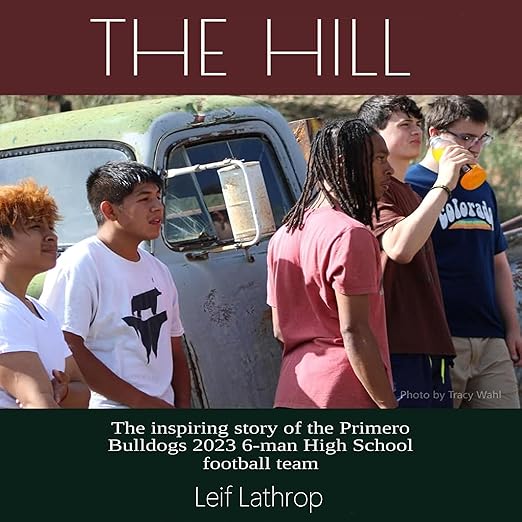
Six-man football barely resembles the sport most listeners picture when they hear the word football, and that gap in general knowledge is exactly where The Hill audiobook does its most useful work. Leif Lathrop tells the story of Primero High School's 2023 season, the first winning season in the program's six-man history, treating the format itself, fewer players, a smaller field, common at small rural Colorado schools, as a fact worth explaining rather than a footnote to skip past.
A Time Capsule for Trinidad, Colorado
Twelve boys and a coach still new enough to the job to be called unconventional anchor the synopsis's version of events, with Primero's athletic director stepping in for one final mentoring push before retirement. What the synopsis does not spell out is Lathrop's own relationship to the team: coach, local reporter, parent, or someone who simply grew up around the program. Nothing in the listing answers that directly, so the narrator's own vantage point on these twelve boys is left for the listener to work out before pressing play.
A literal detail explains the title: to unlock the team's potential, the coach and the retiring athletic director decide they need a hill, presumably for conditioning, though the synopsis leaves the specifics of that plan for the audiobook itself to explain rather than spoiling it upfront. It is a small, concrete image anchoring a book that otherwise deals in the softer currency of mentorship and a program's long losing history, the kind of detail that suggests Lathrop is more interested in a single vivid choice than in a broad inspirational summary.
Reviewer Anita Lobanov calls the book a time capsule for Trinidad, Colorado, and the school's history specifically, which is a useful way to think about scope. This is not positioned as a book about six-man football generally, or about Colorado high school sports as a whole, but about one town, one roster, and one year, with the wider format serving mainly as context for why that year mattered so much to the people living through it.
Zero Words About How Lathrop Actually Sounds
Self-narration is the clearest reason to listen here. Lathrop wrote the book and narrates it too, which usually signals a level of investment in tone and pacing that a hired narrator has to build from scratch. Whether that investment lands as a polished vocal performance is a separate question this listing cannot answer: all five attached reviews describe the book in print-reader language, a page-turner read start to finish in one afternoon, a story that will not let you put it down, without a single word about delivery, pacing, or how Lathrop actually sounds narrating this account. That gap in the record is worth naming plainly rather than glossing over it.
For listeners who want the six-man format explained rather than assumed, the appeal is straightforward: a small program, a retiring mentor, and a season framed as proof that a losing history does not have to stay permanent. The five available reviews line up in one direction, ratings between four and five stars, praising the same handful of qualities: community texture, character over spectacle, and a story more than one reviewer compares to something that belongs on a movie screen. Donna Kolin and J. Clark both raise the idea independently, one saying the story could be made into a movie, the other calling it a tale that begs for a Hollywood retelling, which says something about how visual and scene-driven the material apparently is even before it reaches a screen.
Reviewer bkendall frames the book as being about our home town school, language that suggests at least part of the existing audience has a direct, personal stake in Primero rather than a general interest in sports writing. That local enthusiasm is real and worth factoring in, though it also means the five visible reviews may not represent how the book plays for a listener with zero connection to the town. None of the five reviewers identify themselves as neutral outside critics, which is common for a self-published title this new but still shapes how much weight the ratings alone should carry.
Closer to a Magazine Feature Than a Book
At two hours and seventeen minutes, this sits well below the length of a typical season-spanning sports book, closer to a long magazine feature stretched into audio. That is not automatically a defect, a single six-man program does not need the runtime a multi-decade franchise history would demand, but listeners expecting the scope of a bigger sports memoir should recalibrate against the clock before pressing play.
The self-published, self-narrated combination also means no publisher's editorial layer stands between Lathrop's account and the listener, for better and worse. The reviews on file skew enthusiastic and short, several just a few sentences long, which makes it hard to gauge whether the book's actual payoff, the mentorship arc and the hill itself, lands as more than a feel-good beat stretched across two hours. Neither the synopsis nor the review set resolves that question either way, so it stays an open one going in.
Donna Kolin's review adds one more useful data point: the coaches and players, per that review, treated opposing teams with the same respect they showed each other, a detail that pushes back against the idea that this is a story built entirely around beating a rival. Listeners expecting a conventional us-against-them sports arc should know the emotional center appears to sit elsewhere, closer to mentorship and program-building than to a single rivalry game.
Unfiltered by a Hired Performer's Interpretation
Small-town sports nonfiction in the vein of a local paper's best feature story, expanded to book length, is what this delivers best, particularly for listeners with a personal connection to six-man football or Colorado's rural school system. The true-events framing gives the audiobook a documentary weight a fictional underdog-team story would not carry on its own, and the short runtime makes it an easy addition to a longer listening queue rather than a major commitment.
Anyone after a fully reported, multi-source account of a season, with named opposing coaches, statistical context, or outside journalistic verification, should adjust expectations first: the available material suggests a personal, close-focus telling rather than an investigative one. At just over two hours, it is a low-commitment way to find out which version this actually is, and the self-narration means whatever choices Lathrop made about tone are carried straight from page to recording, unfiltered by a hired performer's separate interpretation, for listeners who value that kind of direct line to an author more than a studio-polished read.
Key Details
- Read by: Leif Lathrop, the book's author, also narrates it, but every attached review describes it in print-reader terms, so pacing and delivery are undocumented territory.
- At its heart: small-town six-man football, mentorship between a retiring athletic director and a first-time coach, a true-events underdog season
- Vibe: Warm, earnest, and community-rooted
- Short version: A short, true-story sports account worth trying for six-man football and small-town-Colorado listeners, even with the performance itself undocumented by reviewers.
Before You Listen
Who narrates the Hill audiobook, and is the performance reviewed anywhere?
Author Leif Lathrop narrates it personally rather than handing it to a hired performer. The five attached reviews stay entirely in print-reader territory, discussing the story rather than its delivery, leaving pacing and vocal quality undocumented beyond the self-narration credit itself.
How long is the Hill audiobook, and is that enough for a full season's story?
It runs two hours and seventeen minutes, short for a season-length sports account. That runtime suits a tightly focused story about one team's turnaround rather than an exhaustive record, so listeners wanting deep statistical or multi-season context should expect a leaner, more personal telling instead.