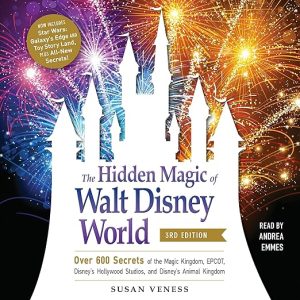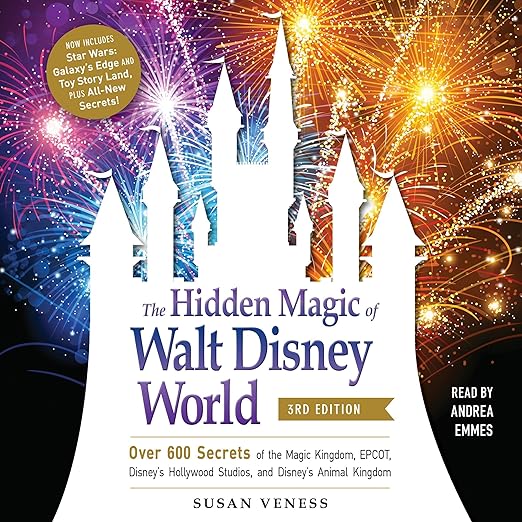
Susan Veness's guide to the hidden details of Walt Disney World covers the kind of park knowledge that separates casual visitors from the guests who notice that the book Belle reads in Beauty and the Beast is a real, identifiable title, that Imagineers embed their own signatures around attractions, and that the parks contain hidden versions of characters beyond the standard Mickey silhouettes that most visitors know to look for. Andrea Emmes narrates this audiobook, and the format turns out to suit the material better than a strictly utilitarian read would suggest.
The Hidden Magic of Walt Disney World, 3rd Edition has been updated to include Star Wars: Galaxy's Edge, Mickey and Minnie's Runaway Railway, and Toy Story Land, which makes this edition relevant to visitors planning trips that will include the major recent additions. Veness has been documenting Disney's hidden details across multiple editions, and the accumulated depth of her research shows in how the book moves between attraction-level specifics and the broader Imagineering philosophy that explains why those details exist.
The Verdict, Briefly
The audiobook succeeds as a listening experience because Veness's writing voice is that of someone who genuinely finds this material delightful rather than someone reciting a trivia database. Each detail comes with enough context to explain why the Imagineers made the choice they did, and that contextual layer transforms the book from a checklist into an argument about how designed environments work. When Veness explains that the book in Maurice's cottage is readable, she follows it with enough background on how Beauty and the Beast's production design was developed that the specific detail becomes illustrative of a broader creative approach rather than an isolated fact.
Andrea Emmes keeps the energy calibrated to discovery rather than performance. She does not oversell each detail with dramatic inflection, which would quickly become exhausting given how many secrets the book documents. Instead she maintains a consistent warmth that makes the material feel like a conversation with a knowledgeable friend rather than a guided tour. Reviewer LogicInMotion, who started reading after a visit and immediately wanted to return and look for the details they had missed, captures the audiobook's primary practical effect: it transforms parks you have already visited into places with new things to find. Reviewer Derrick specifically noted how the book gives great meaning to details that seem insignificant at first glance, and that is precisely what Veness's approach achieves by always connecting individual secrets to the larger Imagineering intention behind them. The Donald Duck and Minnie Mouse hidden figures the book mentions, as alternatives to the more familiar Mickey, reflect the level of attention to detail that rewards the attentive visitor.
Why Listen to The Hidden Magic of Walt Disney World, 3rd Edition
The case for the audiobook format specifically rests partly on Emmes's performance and partly on the most natural use case for this material. Listening while preparing for a trip creates mental anticipation for specific details in a way that silent reading does not quite replicate, because the spoken format activates spatial imagination differently. Reviewer gretchen Baker purchased it as a gift for a first-time Disney World visitor, and the audiobook version is particularly well-suited to that purpose because a new visitor listening in advance will build a mental map of the parks' hidden layers before arriving.
The third edition's coverage of Galaxy's Edge is timely. The Star Wars land involves some of the most elaborate Imagineering work the parks have seen in recent years, with environmental storytelling, functional props, and interconnected narrative systems that reward exactly the kind of close attention Veness teaches. The book's approach of explaining the Imagineering philosophy before cataloguing the specific details means that listeners who absorb the method can extend their own searches beyond what the text explicitly covers. At eight hours and twenty-one minutes, the runtime gives comprehensive coverage of all four parks while remaining listenable in a series of commute-length sessions over several days of trip planning.
Points to Consider
The reference structure of the book, organized by park and attraction, means the audiobook format has inherent limitations for on-the-ground use. You cannot efficiently navigate to a specific attraction's section while standing in a queue the way you could with a physical book or searchable e-book. The audiobook is best treated as preparation material rather than a real-time companion. Listeners who want to use it in the park itself should consider a print or digital companion for in-park reference alongside the audio version for pre-trip listening.
The eight-hour-and-twenty-one-minute runtime reflects the comprehensiveness of Veness's coverage. This is not a highlights reel but a thorough treatment of each area of the parks, and the density of detail is a feature for dedicated Disney enthusiasts and a potential drag for casual visitors who want a lighter overview.
The Right Listener for The Hidden Magic of Walt Disney World, 3rd Edition
Disney World visitors planning an upcoming trip will get the most immediate value from this audiobook, particularly those who have been to the parks before and want to find new things to notice. Families where the adults want a deeper engagement with the parks' design while managing the child-focused experience will find the Imagineering context useful for planning how they navigate. The audiobook also works well for people who have recently returned from a trip and want to understand what they missed. Casual visitors looking for basic park navigation guidance should look for a more logistical guide rather than this lore-focused treatment.
Does the Hidden Magic of Walt Disney World audiobook include information about the newest attractions like Galaxy's Edge?
Yes. This third edition has been updated to cover Star Wars: Galaxy's Edge, Mickey and Minnie's Runaway Railway, and Toy Story Land, making it current for visitors planning trips that include these major additions.
Does the audiobook require prior knowledge of Walt Disney World, or can first-time visitors benefit?
First-time visitors benefit significantly from listening in advance since it teaches them what to look for before arriving. Prior visitors benefit equally because the book reveals details that are easy to miss without knowing they exist. No technical knowledge of the parks is assumed.
How does Andrea Emmes's narration handle the dense reference material in the Hidden Magic audiobook?
Emmes maintains an engaged, conversational quality throughout rather than reading the details as a dry list. Reviewers who have used the audiobook note that her delivery makes the material feel like listening to an enthusiastic expert rather than processing a fact sheet.