Quick Take
- Narration: Assaf Cohen delivers the analytical and political material with clarity and commitment – a performance that serves an important book well.
- Themes: Democracy’s fragility at the intersection of race and religion, economic predation and inequality, the limits of international optimism
- Mood: Urgent and clear-eyed, carrying the weight of an insider who watched hope collapse
- Verdict: Thant Myint-U’s diagnosis of Burma’s democratic failure is the essential single-volume account of Myanmar’s crisis, and at under ten hours it is rigorously efficient.
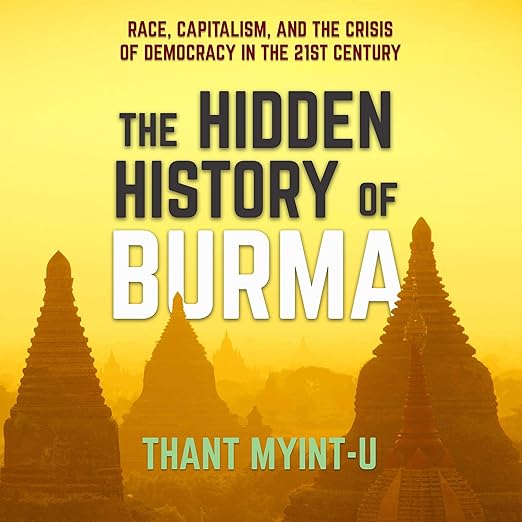
I listened to The Hidden History of Burma over two evenings, and both evenings I finished a session with the particular discomfort that comes from reading a book whose prognoses have already been proven correct. Thant Myint-U completed this book before the February 2021 military coup that ended Burma’s brief democratic experiment and returned the country to full military rule. But every structural condition he identifies – the predatory economic system, the rising inequality, the social media-accelerated sectarianism, the unresolved questions of race and religion, the military’s determination to retain power – is precisely what enabled that coup. Reading it now is an education in how an insightful analyst sees a crisis forming before it arrives.
Thant Myint-U is not a typical commentator on Burma. He is a Burmese-born historian whose family left the country, who returned as a diplomat and presidential advisor during the democratic transition under Thein Sein, and who worked directly with the Aung San Suu Kyi government. His insider position shapes the book in ways that both strengthen and complicate it – he has access to the texture of Naypyidaw’s political culture that no outsider could replicate, and he is honest about the failures of the international community whose optimism he did not share.
The Crack Forming Beneath the Hope
The book’s central argument is that the democratic transition – hailed internationally as an inspiring story, an affirmation that sanctions and isolation can produce reform – was built on structural foundations that could not support the weight being placed on them. The economic system Myint-U describes is predatory in a specific sense: dominated by military-connected cronies who extracted wealth through monopolies and land seizures, while a reforming government tried to attract foreign investment without dismantling the machinery that had made poverty endemic for generations. Inequality accelerated during the transition, not despite the liberalization but partly because of it – new opportunities were captured by those already positioned to capture them.
The social media dimension of the analysis is the most prescient. Myint-U describes how a country that went from almost no internet access to smartphone saturation within a few years, without any of the media literacy infrastructure that might have modulated the speed of misinformation spread, became a laboratory for ethnically and religiously targeted hate content. Facebook was the internet for most Burmese users, and Facebook’s algorithms optimized for engagement in a context where engagement meant rage. The Rohingya crisis – the mass violence and refugee exodus that became the internationally visible face of Burma’s troubles – was not simply the product of ancient prejudice. It was accelerated and organized through platforms that had no meaningful presence in the country two years earlier.
The Rohingya and the Limits of International Understanding
Myint-U is careful and candid about the Rohingya crisis in ways that complicate the international narrative. He does not minimize the atrocities – he is unambiguous about the suffering and the responsibility of the Burmese military for what happened in Rakhine State. But he also insists on the complexity of the political dynamics within Burma that shaped the response of civilian leaders including Aung San Suu Kyi, whose silence became internationally notorious. His account of why the democratic government handled the crisis as it did is not an apologia; it is an attempt to explain a genuine political constraint that international observers largely refused to acknowledge because it complicated the morality play they needed the story to be.
This is where Myint-U’s insider perspective is most valuable and most uncomfortable. He knows what the pressures were. He also knows what the consequences were. The book holds both without resolving them, which is the honest approach to a situation that did not resolve. One reviewer described the book as ‘a war no one notices,’ which captures both its subject and its purpose: to make legible a crisis that the international community consistently misunderstood because they were seeing the story they wanted rather than the one that was actually unfolding.
Cohen’s Narration and the Book’s Register
This is not a book that benefits from dramatic narration – it is argument-driven rather than narrative-driven, and Cohen’s pacing allows the structural analysis to land without being rushed or theatricalized. The shift between Myint-U’s more personal passages – his family history, his returns to a country he knew partly from exile – and the sustained policy analysis is managed well, with enough tonal variation to signal the register changes without overplaying them. At under ten hours, the book is dense but never padded, and the narration supports that efficiency throughout.
Who Should Listen / Who Should Skip
Listen if you want to understand Myanmar’s crisis from the perspective of someone who was inside it, with the analytical framework of a serious historian and the knowledge of a former diplomat. This is the essential starting point for anyone trying to understand what happened to Burma’s democratic transition and why. Skip it if you want a comprehensive history of Burma from its origins – Myint-U has written that elsewhere, in The River of Lost Footsteps – or if you want a human rights documentary account of the Rohingya crisis specifically. This is a political and economic diagnosis, and it is most valuable when treated as that.
Frequently Asked Questions
Was this book written before or after the 2021 military coup, and does that affect its relevance?
The book was published in 2019, before the February 2021 coup that returned Burma to full military rule. Its relevance has only increased since then – every structural condition Myint-U identifies as destabilizing the democratic experiment was precisely what enabled the coup. Reading it now functions as a post-mortem as much as a diagnosis, and the prognosis he offers is even more sobering in retrospect.
Does Myint-U defend Aung San Suu Kyi’s handling of the Rohingya crisis?
He does not defend it, but he contextualizes it in ways that complicate the straightforward international narrative of betrayal. He is honest about the atrocities in Rakhine State and about Suu Kyi’s failure to speak clearly about them, while also explaining the domestic political constraints she faced. It is not a comfortable account for those who want either to rehabilitate or simply condemn her.
Does Thant Myint-U address the role of China in Burma’s political situation?
Yes – China’s rise as a neighboring power and its deep economic investments in Burma are central to his analysis. The geopolitical dimension – Burma positioned between China and India, with the military cultivating Chinese relationships as a hedge against Western pressure – is one of the book’s most important structural frames.
Is this book accessible to listeners with no prior knowledge of Burma’s history?
Largely yes. Myint-U does not assume extensive background knowledge and provides enough historical context to orient a first-time reader. Listeners who want deeper historical grounding may want to pair it with his earlier book The River of Lost Footsteps, which covers Burma’s modern history from a longer perspective.