Quick Take
- Narration: The narrator field in this edition contains erroneous text rather than a name, and the audiobook’s cast is not clearly documented in the metadata. The Princeton University Press release is worth verifying before purchase if narration quality is a priority.
- Themes: the monomyth and hero’s journey, world mythology and the universal unconscious, identity and transformation
- Mood: Dense and scholarly with moments of genuine revelatory clarity
- Verdict: One of the most influential works of twentieth-century comparative mythology, demanding in audio format but rewarding for listeners who approach it as a sustained intellectual project rather than background listening.
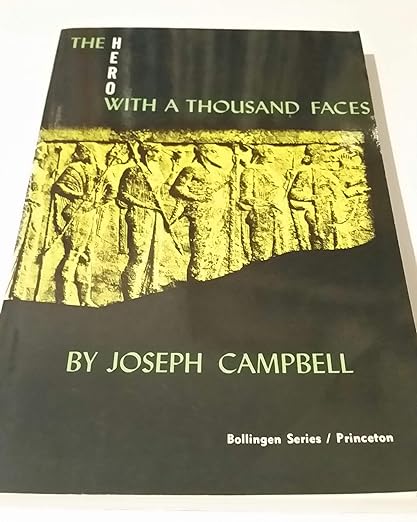
I first encountered Joseph Campbell in an undergraduate course on comparative religion where the professor used The Hero with a Thousand Faces as a kind of organizing lens for everything else we read that semester. My copy was heavily annotated. I came back to it in audio format recently, partly out of curiosity about how the material translates to the listening experience, and partly because I wanted to test my memory of what Campbell actually argues against what I’d absorbed from twenty-plus years of the book’s cultural influence. Those are not always the same thing.
The book was first published in 1949 and has since been used to analyze everything from Tolkien’s Middle-earth to George Lucas’s Star Wars, where the influence is direct and acknowledged. Campbell’s monomyth theory, the argument that myths from radically different cultures across human history share a fundamental structural pattern, became one of those ideas that escaped its academic container and entered the general cultural vocabulary. The risk of returning to the source after decades of diluted versions is discovering that the original has been flattened. The experience of listening to Campbell’s actual argument is a useful corrective to that flattening.
Our Take on The Hero with a Thousand Faces
The hero’s journey as most people have encountered it is a plot template. Campbell’s actual argument is something considerably more ambitious and philosophically strange. He is making claims about the structure of human consciousness, drawing on Jungian psychology, folklore, world religion, and comparative mythology to argue that the journey of the hero, the call, the threshold crossing, the descent into the underworld, the transformative encounter, and the return, maps onto the psyche’s movement toward individuation and self-knowledge. The surface story is a vehicle. What it carries is a theory of how human beings grow into themselves.
That argument is genuinely interesting and genuinely demanding. Campbell ranges across Greek, Roman, Egyptian, Hindu, Buddhist, Native American, African, and Celtic sources without slowing down for readers who aren’t already tracking the references. One reviewer describes it accurately as eye-opening in its evidence that mythology, far from being useless and outdated, describes the life journey of all human beings. Another suggests pairing it with The Power of Myth, Campbell’s interview series with Bill Moyers, which translates the scholarly argument into a more accessible conversational form.
Why Listen to The Hero with a Thousand Faces
The audio format presents real challenges for this particular book. Campbell writes with density and precision, and the mythological examples accumulate in ways that reward re-reading a passage rather than hearing it once. The ideal listener for this audiobook is one who either already knows the book well and wants to hear it anew, or who is willing to move slowly and return to difficult sections rather than treating it as linear listening. That’s a specific kind of attention that not all audiobook listeners bring to dense scholarly work.
What audio does offer is the opportunity to hear Campbell’s prose at the pace it was intended to be received. His sentences are long and architecturally complex, and a capable narrator can render that architecture in ways that clarify the argument’s structure. The 1973 Princeton University Press edition represented here carries the weight of the work that made Campbell’s ideas foundational for a generation of writers, filmmakers, and mythologists. Hearing it in full rather than through the excerpts and summaries that tend to circulate is worth the fourteen-plus hours for listeners with the patience for it.
What to Watch For in The Hero with a Thousand Faces
The book’s Jungian framework is both its organizing principle and its most contested aspect. Campbell’s use of the collective unconscious and the archetype is central to how he reads his mythological sources, and readers with reservations about Jungian psychology as a theoretical framework will find those reservations activated throughout. This doesn’t mean the argument fails, but it means the evidence should be read as interpretation rather than demonstration. The cross-cultural parallels Campbell identifies are genuinely striking. Whether they prove what Campbell says they prove is a question the book does not fully settle, and contemporary mythology and anthropology scholarship has pushed back on several of his universalizing claims.
The sections on the goddess, the father, and the atonement draw most heavily on Freudian and Jungian concepts that have aged unevenly. Listeners with contemporary gender studies backgrounds will find these sections require the most critical distance. The core structural argument about narrative patterning holds up considerably better than the psychological machinery Campbell uses to explain it.
Who Should Listen to The Hero with a Thousand Faces
Writers who have worked with the hero’s journey as a plotting tool and want to understand what Campbell actually said versus the simplified templates that circulate in screenwriting courses will find the original argument both richer and stranger than those templates suggest. Students of comparative mythology, religion, and Jungian psychology will find it essential primary reading. Listeners who came to Campbell through the Bill Moyers interviews and want the full scholarly text will find this the right next step. Those looking for accessible popular mythology, along the lines of Edith Hamilton or Stephen Fry’s Greek myths retellings, should know this is a different kind of enterprise entirely. Dense, theoretical, and demanding, it rewards the listeners who bring scholarly patience to it.
Frequently Asked Questions
How difficult is The Hero with a Thousand Faces to follow in audio format versus reading it in print?
Considerably more demanding in audio. Campbell’s prose is dense and the mythological examples accumulate in ways that reward re-reading. Listeners without prior familiarity with the book will benefit from a print copy alongside the audio, or from pausing frequently to absorb the argument before continuing.
Is the monomyth theory still considered valid in contemporary mythology and anthropology scholarship?
Campbell’s universalizing claims have been contested. Contemporary scholars point out that his cross-cultural parallels sometimes require selective reading of sources and that his Jungian framework imposes a particular interpretive lens. The structural pattern he identifies is genuinely widely present; whether it proves the conclusions he draws from it is debated.
Should a first-time reader start with The Power of Myth or with The Hero with a Thousand Faces?
The Power of Myth, Campbell’s conversation series with Bill Moyers, is significantly more accessible and provides a good orientation to Campbell’s thinking. Starting there and then moving to The Hero with a Thousand Faces is a reasonable approach, especially for listeners who find scholarly monographs demanding in audio form.
How much does familiarity with Jungian psychology affect the listening experience?
Substantially. Campbell’s argument is organized around Jungian concepts of the archetype, the collective unconscious, and individuation. Listeners without that background can follow the mythological evidence, but the theoretical claims that tie it together will be harder to assess without some orientation to Jung’s framework.