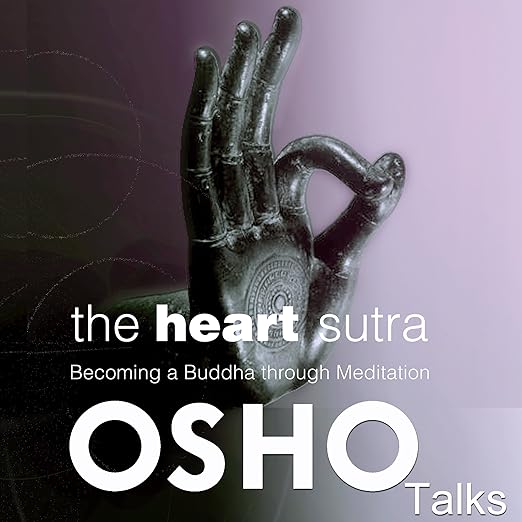
Quick Take
- Narration: Osho narrates his own talks, and the effect is unlike anything you will find with a professional narrator, his pauses, inflections, and occasional silence carry as much weight as his words.
- Themes: Buddhist philosophy, self-discovery through meditation, chakras and consciousness
- Mood: Contemplative, unhurried, occasionally challenging
- Verdict: If you approach this with genuine curiosity about meditation and Buddhist thought, Osho’s ten talks on the Heart Sutra will reward your patience in ways that purely academic treatments cannot.
I came to this one on a Tuesday afternoon when I had cleared three hours and was looking for something that would ask something of me rather than simply carry me along. The Heart Sutra, those spare, ancient verses addressed by the Buddha to his disciple Sariputra, has always struck me as one of the most demanding texts in any spiritual tradition. I had read scholarly commentaries, and I had listened to dry academic lectures. What Osho does with the same material across sixteen hours and ten talks is something quite different, and I want to be honest about both what works and what requires a certain disposition to receive.
Osho narrating his own talks is, for the purposes of this audiobook, both the central argument for listening and the main caveat. This is not a polished studio narrator performing a written text. It is a recording of a man speaking to a room, thinking out loud in real time, circling back, going on tangents that eventually land somewhere unexpected. There are stretches where you feel genuinely present at something being worked out rather than delivered. There are also stretches that will test your patience if you came expecting efficiency.
Our Take on The Heart Sutra
What sets this apart from most commentaries on Buddhist texts is Osho’s insistence that the Heart Sutra is not a historical document to be studied but a living instruction to be practiced. He is not interested in the Buddha as a historical figure. He is interested in what the words mean for someone sitting in a room right now, trying to understand the nature of their own consciousness. Reviewers who have praised the clarity of his wisdom are responding to this quality, his ability to bring 2,500-year-old teachings into direct contact with present experience without making them feel retrofitted or simplified.
The sections on the seven chakras, roughly the second half of the audiobook, shift the register considerably. What begins as a philosophical commentary on a Buddhist text becomes a detailed map of human consciousness from the physical to the transcendental. This is rich territory, but it is also the section where a listener without some background in this framework will need to give themselves permission to sit with uncertainty. Osho does not define terms as he goes. He expects you to stay with him.
Why Listen to The Heart Sutra
You should listen to this because of what it does to your relationship with the word meditation. Most popular treatments of meditation are essentially guides to stress reduction dressed in spiritual language. Osho is doing something considerably more ambitious. He is arguing that meditation is not a technique or a practice but a state of being, the only state worth orienting your life around. Rely only on your meditation and nothing else, he says at one point, and the simplicity of that line lands differently after sixteen hours of context than it would on its own.
The audio quality is consistent enough not to distract, and the recording preserves enough of the room, the ambient sense of a gathered audience, that you never forget these were spoken events rather than written chapters. That context matters. It helps explain why Osho repeats himself, why he pauses, and why some talks feel more electric than others. One reviewer compared his lack of contemporary equals in clarity and wisdom. I would put it more cautiously: within his particular tradition and method, there is a coherence to these talks that rewards returning to specific sections rather than moving straight through.
What to Watch For in The Heart Sutra
The main adjustment required is temporal. Sixteen hours is a substantial investment for ten talks on a short text, and the density varies considerably. The early talks on sunyata, emptiness, are the most philosophically rigorous and will likely be the sections listeners return to. The later talks on the chakras, while valuable, sometimes feel like a separate project that has been folded into this commentary rather than growing directly from it. Be prepared for that tonal shift around the midpoint.
Also worth noting: Osho is a controversial figure in ways that have nothing to do with the quality of these specific talks. One reviewer mentions that critics tend to be reacting to media portrayals rather than the work itself. That is a fair observation. Whatever your prior position, the talks here are self-contained and make no demands beyond your attention.
Who Should Listen to The Heart Sutra
Listeners who will find the most here are those already drawn to Buddhist philosophy and open to an experiential rather than academic approach. If you have read the Diamond Sutra or spent time with Pali Canon teachings, Osho’s commentary will feel like a productive counterpoint, more personal, more direct, more willing to make claims. If you are new to Buddhist thought and looking for an introduction, this is not the easiest entry point; a straightforward translation with a more structured commentary might serve you better first. Those who prefer their audiobooks to have clear structures and efficient delivery will find the conversational format taxing. Those who can surrender to a mind thinking aloud across sixteen hours will find passages here that stay with them.
Frequently Asked Questions
Is Osho narrating these talks himself, or is this a professional narrator reading a written book?
Osho narrates his own talks. These are recordings of ten live speaking sessions, so the delivery has the quality of a live address, pauses, repetitions, and the ambient sense of an audience, rather than a studio production.
Do I need prior knowledge of Buddhism or the Heart Sutra to follow these talks?
Some familiarity with Buddhist concepts helps significantly, particularly around emptiness (sunyata) and the bodhisattva ideal. Osho does not provide foundational definitions and moves quickly into interpretive territory.
How does this compare to Osho’s commentary on The Diamond Sutra, which some reviewers mention?
Several listeners rate the Diamond Sutra commentary as the stronger of the two works. The Heart Sutra talks are excellent but shift midway into chakra teachings that feel somewhat separate from the core commentary, which some find less cohesive.
At 16 hours, is the full runtime necessary, or are certain talks more essential than others?
The early talks covering sunyata and the nature of buddhahood are the most philosophically dense and rewarding. The later talks on the seven chakras are valuable but stand somewhat independently, so listeners short on time might prioritize the first half.