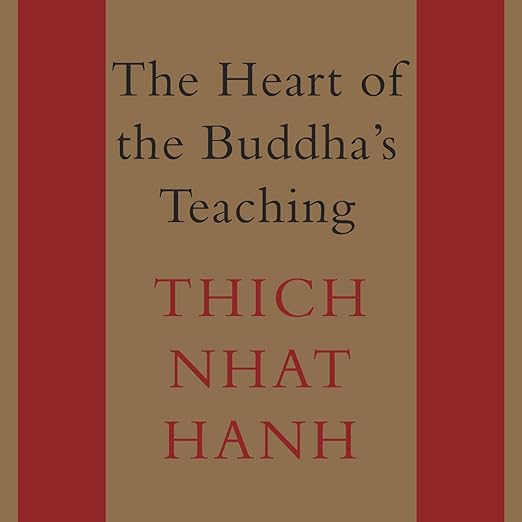
Quick Take
- Narration: Rene Ruiz reads with quiet authority and deliberate pacing – a rare match between narrator temperament and the material’s demands.
- Themes: Suffering and liberation, daily practice, interconnection of inner peace and the world
- Mood: Calm, grounding, occasionally dense
- Verdict: The most accessible serious introduction to Buddhist thought available in audio form, best listened to slowly and returned to often.
I have tried to read several introductions to Buddhist thought over the years, and most of them left me either glazed over with doctrine or frustrated by vagueness. The Heart of the Buddha’s Teaching sat on my reading list for over a year before I finally listened to it during a particularly difficult stretch in early spring. I was walking in the mornings and needed something that would slow my thinking down rather than speed it up. Nine hours with Thich Nhat Hanh and Rene Ruiz turned out to be exactly the right prescription.
What I did not expect was how practically the book would land, even in audio form, even on a morning commute.
Our Take on The Heart of the Buddha’s Teaching
Thich Nhat Hanh – known as Thay to his students – covers the essential architecture of Buddhist thought with a clarity that never condescends. The Four Noble Truths, the Noble Eightfold Path, the Three Doors of Liberation, the Three Dharma Seals, the Seven Factors of Awakening: these are the pillars of his presentation, and he moves through them with both scholarly rigor and the kind of lived understanding that only comes from decades of practice. The Dalai Lama’s endorsement, cited in the synopsis, is not decorative: Thay has a gift for connecting interior practice to the wider world in ways that feel neither sentimental nor abstract. This is a book that has been revised and expanded over time, and the accumulated weight of those revisions shows in its density and generosity.
Why Listen to The Heart of the Buddha’s Teaching
Rene Ruiz narrates with a calm, measured cadence that genuinely suits the material. This is one of those rare cases where the narration does not fight the text but amplifies it – Ruiz’s pacing invites the kind of reflection the book demands. One reviewer described intentionally taking a slow pace through the audiobook because the measured rhythm allowed deeper absorption, and that is exactly right as a listening strategy. This is not a book to speed through at 1.5x. The audio format works particularly well here because Thay’s writing has an oral quality – his sentences are structured to be heard, not scanned, and Ruiz honors that. Listeners who came to Buddhism through travel or cultural curiosity, like the reviewer who picked this up after visiting northern Thailand, will find it a grounding companion.
What to Watch For in The Heart of the Buddha’s Teaching
The book is dense. Not impenetrably so, but it covers a great deal of doctrinal ground, and some sections – particularly those dealing with the more technical aspects of the Abhidharma or the detailed breakdowns of the Eightfold Path – require active engagement rather than passive listening. If you are driving or doing something that requires concentration, you may miss important threads. This is also a book that rewards return visits; reviewers consistently note they find new things on subsequent readings. A single listen will give you a solid foundation, but it will not give you the full architecture. Manage expectations accordingly: this is an introduction in the deepest sense – a door, not a survey.
Who Should Listen to The Heart of the Buddha’s Teaching
Both newcomers to Buddhism and practitioners looking to consolidate their understanding will find value here, which is unusual for a single text. The Dalai Lama’s endorsement signals its legitimacy for serious students; the clarity of Thay’s writing makes it accessible to someone who has never opened a dharma text. Listeners who found other introductory Buddhist books either too academic or too pop-spiritual will likely find this hits the right note. Those who are looking for meditation instruction specifically should note this is primarily a teaching text, not a practice guide – it explains the territory without necessarily leading guided sits. The Dalai Lama’s quoted endorsement – that Thay shows us the connection between personal peace and peace on earth – is a useful compass for understanding what this book is really for.
Frequently Asked Questions
Is this audiobook suitable for someone with no background in Buddhism?
Yes. Multiple reviewers with no prior Buddhist study found it accessible and well-organized. Thich Nhat Hanh builds his explanations from first principles without assuming prior knowledge, though some passages on doctrinal detail are dense enough to warrant re-listening.
Does Rene Ruiz’s narration work for this kind of spiritual text?
Very well. His pacing is calm and unhurried, which suits the contemplative quality of the writing. Several listeners found the narration itself conducive to the kind of reflection the material demands, describing it as a reason to listen at normal or slower playback speed.
Is this book better for beginners or for people who already practice?
Both, which is unusual. The Dalai Lama’s endorsement and the book’s scholarly rigor make it credible for serious practitioners, while the clarity of Thay’s explanations keeps it accessible to beginners. It functions more as a comprehensive map of Buddhist thought than as either an introductory primer or an advanced text.
How does this compare to other Thich Nhat Hanh audiobooks?
The Heart of the Buddha’s Teaching is more systematic and comprehensive than Thay’s shorter, more poetic works like The Miracle of Mindfulness. Those books are more accessible as quick reads; this one rewards sustained engagement and is better suited to listeners who want conceptual depth alongside practical application.