At a Glance
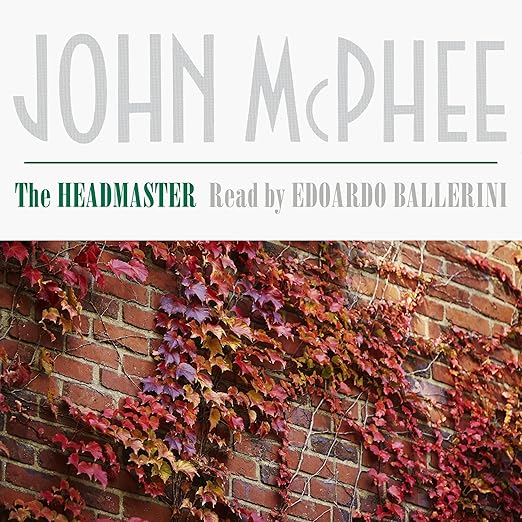
- Narrator: Edoardo Ballerini attended Deerfield Academy himself, which gives his reading a quality that no amount of professional preparation could manufacture, an intimacy with the institution that surfaces in every measured sentence.
- Subjects: Educational leadership, private school culture, the institution as extension of one man's will
- Tone: Quiet and admiring, with an undercurrent of critical distance
- Bottom line: McPhee's profile of Frank Boyden is as precise as his best long-form work, and Ballerini's personal connection to Deerfield makes this audiobook version something richer than a straightforward reading.
John McPhee published The Headmaster in 1966, one of his earliest book-length works, and it already shows the exacting observational habits that would define his career across the following six decades. This audiobook, narrated by Edoardo Ballerini and running 2 hours and 19 minutes, profiles Frank Boyden, who ran Deerfield Academy from 1902 until 1968, sixty-six consecutive years, transforming an enrollment of fourteen students into a school that earned comparison with Andover and Exeter. The subject is genuinely unusual, and McPhee's method here, close study of an institution through its founder, anticipates the structure he would use again and again in his best-known long-form work.
Magnanimous Despots and McPhee's Refusal to Judge
McPhee describes Boyden as existing at "the near end of a skein of magnanimous despots who created enduring schools through their own individual energies, maintained them under their own absolute rule, and left them forever imprinted with their own personalities." That phrase, "magnanimous despots," is the book's essential tension, held throughout the profile without being resolved. Boyden ran Deerfield on the strength of his personal authority, a man whose will and warmth were so intertwined that the institution became impossible to separate from the person.
McPhee neither celebrates nor dismantles that model; he records it, which is its own form of judgment. One reviewer noted that the book portrays "a simple but brilliant headmaster, written by a man who may call himself simple, but who is brilliant as well." There is something in that symmetry worth sitting with. McPhee's own method, dogged attention and radical patience with the surface of things, shares something structural with Boyden's reported approach to boys and to discipline. The portrait is not hagiography, but it is clearly written by someone who found the subject worth very close attention over an extended period. Another reviewer noted McPhee's ability to capture "winning the hearts and minds of boys," beginning with the discipline of sports but not ending there, and that expansion of what Boyden's project actually was gives the short book more moral weight than its length might suggest.
Ballerini's Own Deerfield Days Inform the Reading
Ballerini's connection to Deerfield is not incidental. He has described recording the book as a return to his own school days, noting that "my Deerfield days came back to me in a great rush." That specificity of memory inflects his performance in ways that are difficult to manufacture. He brings a particular steadiness to the passages about Boyden's relationship with boys who struggled, the ones Boyden refused to give up on, that a narrator without personal connection to the institution might render more clinically.
At just over two hours, this is one of the shorter listening experiences McPhee's catalog offers in audio form, but it earns its brevity. The audio format suits McPhee's compressed, heavily observed prose; each sentence carries weight, and Ballerini delivers them with enough space for that weight to register. One reviewer with a long relationship with McPhee's writing called this "fun, educational, as are all of his books," which undersells it slightly. The McPhee hallmark, making a narrow subject feel universal, is in full operation here. Boyden's sixty-six years at the head of one school becomes a study in what it means to build anything over a lifetime, and Ballerini understands that the scale of that accomplishment requires the same patience in the narration that Boyden exercised in the living of it.
Reading the Silences in a 1966 Portrait
McPhee is writing in 1966, and his framing of elite private school education reflects that moment's assumptions about boys, formation, and institutional authority. Boyden's model required absolute personal control over an enclosed world; what produced Deerfield's outcomes was also what made the institution vulnerable to the particular pathologies of concentrated power in educational settings. McPhee does not address those vulnerabilities directly, but attentive listeners will notice them in the architecture of the story.
The reviewer who called Boyden's teaching focused on "what boys needed to grow up to be adults in society, with a particular emphasis on giving back to the community" is describing a genuinely influential educational philosophy. That it is also a philosophy that concentrated enormous discretionary power in a single person is something the book implies without stating explicitly. Listeners bringing a twenty-first century awareness of how educational institutions have historically misused that kind of power will read the silences in McPhee's portrait with more attention than his original audience likely did, and that added layer of reading is part of what makes the book worth returning to. The short audiobook format actually aids this reading; because the text is dense and close, and because Ballerini's pace never lets attention wander, listeners catch things in a single sitting that a reader might skim past across multiple sessions spread over a week.
McPhee Newcomers Should Start Here First
Listeners who appreciate McPhee's long-form journalism in any form will want this audiobook, both for the quality of the writing and for Ballerini's personal narration. Listeners interested in the history of American private education, in the architecture of institutional authority, or in how strong personalities shape organizations over decades will find it directly relevant. The brevity makes it an ideal entry point for McPhee newcomers who want to understand his method before committing to one of his longer works. Listeners wanting a longer narrative or a more critical treatment of elite schooling culture should supplement with other sources; this is a portrait, not an argument.