
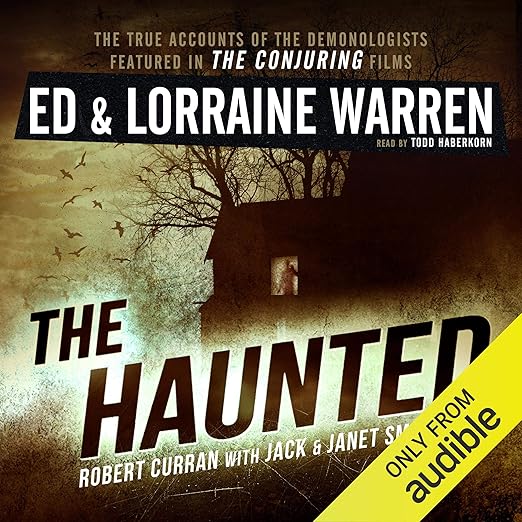
- Voice: Todd Haberkorn delivers the Smurl haunting with controlled tension, keeping the documentary tone Ed Warren's accounts require while sustaining the dread that makes these cases compelling on audio.
- Big ideas: demonic possession and exorcism, family faith under siege, the Warren investigation methodology
- Atmosphere: Slow-building dread that escalates into genuine unease; the true-crime register of paranormal investigation
- Worth it?: A foundational Warren case study that holds up as an audiobook for listeners who came to the Conjuring universe and want the documentary source material.
Ed and Lorraine Warren built their reputation as demonologists across decades of case investigations, and The Haunted: One Family's Nightmare documents one of the most extensively witnessed hauntings in their career. The Smurl family of West Pittston, Pennsylvania, experienced phenomena documented not just by the Warrens but by neighbors, priests, police, journalists, and researchers. That breadth of witness testimony is what makes the Warren cases function as something more than personal testimony, and this audiobook presents the Smurl haunting with the full weight of that documentation.
The Verdict, Briefly
Journalist Robert Curran wrote the book from the Smurls' account and the Warrens' investigation files, and the result reads with the documentary rigor that distinguishes this from purely sensationalist haunting literature. Todd Haberkorn's narration maintains that register throughout: the tone is investigative rather than theatrical, which is the right choice for material that markets itself on the claim of being a true story supported by dozens of eyewitnesses.
The phenomena described in the book span a range that escalates methodically. The grim odors, the deafening pounding, the physical attacks including a strangling, the appearance of a hoofed half-man figure in the hallway, and the failed exorcisms that form the structural climax of the investigation: the Smurl case builds with the kind of incremental horror that is far more effective in audio than a single dramatic revelation would be. Haberkorn understands this and doesn't rush the pacing.
The comparison to The Amityville Horror, which the book itself makes, is useful context. Both cases were investigated by the Warrens, both involve family units under sustained assault from forces the investigators characterize as demonic, and both have attracted significant skepticism alongside their devoted audiences. Listeners who came to the Warren files through the Conjuring film universe will recognize the framework and find The Haunted operating in the same documentary mode as those films' source materials.
The audio format serves paranormal case documentation particularly well when the material is as atmospheric as this. Haberkorn's controlled delivery turns the written descriptions of phenomena into something experiential: the slow escalation from disquieting sounds to full physical confrontation plays across the six-and-a-half-hour runtime with a pacing that a reader might rush through on the page but that audio forces you to sit with. The unshakeable family bonds that enabled the Smurls to survive what the book presents as a sustained demonic assault are rendered with particular care; Haberkorn gives the family's Catholic faith a gravity that the narrative needs to function.
The Warren methodology, their assessment of the phenomena, their engagement with the Church for exorcism authorization, and the institutional resistance they encountered, adds a procedural layer that keeps the audiobook from feeling like pure horror fiction. The succession of priests, police officers, and neighbors who confirm what the Smurls experienced functions as cumulative testimony, and hearing each account delivered aloud gives the documentation structure a weight it earns through accumulation rather than through any single dramatic moment.
Things to Know Before Starting The Haunted: One Family's Nightmare
The rating count of one review reflects this audiobook's limited listener footprint, though the 4.6 score suggests the single reviewer found it convincing. The book has a longer print life and a more established reputation in that format; the audiobook version is reaching a newer audience through the renewed interest in Warren cases generated by the Conjuring franchise.
Skeptics of paranormal claims will find the book makes no accommodation for alternative explanations. Curran and the Warrens operate within a framework that accepts demonic activity as the explanation for the Smurl phenomena, and the book doesn't engage seriously with psychological or naturalistic counter-readings. This is not a weakness within the genre, but it is a feature that determines who will find the audiobook compelling versus who will find it frustrating. Listeners who approach Warren cases as documented encounters rather than as folklore will get the most from the experience.
The succubus account and the more explicitly disturbing physical phenomena are presented in terms that are more clinical than lurid, which is consistent with Curran's journalistic approach, but the content is genuinely unsettling for listeners who take the claims at face value. One reviewer specifically noted they were scared reading it; that is an accurate prediction of what the audiobook delivers for the right audience.
Curran's journalistic framing keeps the Smurl case from sliding into the purely anecdotal register of personal haunting accounts. Rather than presenting the phenomena through the Smurls' experience alone, he layers testimony from neighbors, priests, police, and journalists who witnessed events independently. That corroborating structure gives the investigation a breadth that Haberkorn's narration handles cleanly, giving each source enough distinct weight that the accumulation feels like assembled evidence rather than repetition of the same claim.
Best Suited For
Listeners who found the Conjuring films compelling and want the documentary source material for Warren case investigations will find this audiobook a natural next listen. Paranormal true-crime readers who appreciate the investigative register of Warren accounts, the accumulation of witness testimony, the procedural elements of the Church's involvement, and the family's sustained resistance, will find the runtime well-spent.
Listeners who engage with haunting accounts purely for horror entertainment may find the documentary tone slightly more restrained than they hoped, though the accumulation of phenomena is genuinely disturbing. Complete skeptics who cannot engage with the investigative framework as though the claims might be real will struggle to find purchase in the material. This audiobook rewards listeners who bring at least a provisional openness to the Warren cases' premises.
A Few Questions About The Haunted: One Family's Nightmare
Is this audiobook connected to the Conjuring film universe, and does it matter if you haven't seen the films?
The films drew on Warren case materials including the Smurl haunting, but the audiobook stands independently. No prior familiarity with the Conjuring franchise is required; the book is the documentary source rather than a tie-in.
How does Todd Haberkorn's narration handle the paranormal elements without tipping into camp?
Haberkorn maintains a controlled, documentary tone throughout, matching Curran's journalistic approach. The phenomena are delivered with the gravity of eyewitness testimony rather than theatrical horror performance, which makes the accumulation of accounts more effective.
Is this audiobook appropriate for listeners who are skeptical of paranormal claims?
The book operates entirely within a framework that treats demonic activity as the explanation for the Smurl phenomena. It doesn't engage with naturalistic counter-explanations. Skeptics who can't provisionally accept the premise will find the audiobook frustrating rather than compelling.
How does The Haunted compare to The Amityville Horror as an audiobook experience?
Both are Warren-investigated haunting accounts with family units at the center. The Haunted is notable for the range of independent witnesses beyond the family, including police, priests, and neighbors. The documentary breadth gives it a different texture than Amityville's more intimate account.







