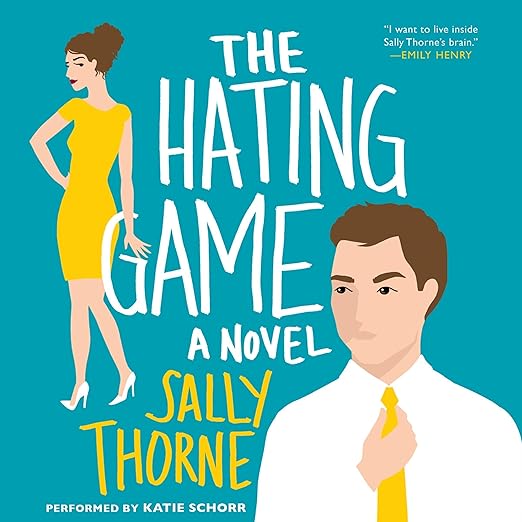
I was somewhat late to The Hating Game. By the time I finally listened to it, a large portion of my reading circle had already read it at least once, and I had absorbed so many breathless summaries that I was mildly suspicious it could live up to what I had been told. It did. Sally Thorne's debut is the rare genre novel that has earned its reputation rather than simply accumulated it through social media momentum, and the audiobook format suits it particularly well because so much of what the book does lives in Lucy Hutton's interior voice.
The setup is a specific kind of workplace comedy that has since become ubiquitous: two executive assistants to recently merged publishers share an office and have developed an elaborate, codified war of petty escalations. The Staring Game. The Mirror Game. The HR Game. Lucy and Joshua have turned their mutual antagonism into a full-time occupation alongside their actual jobs. When a major promotion opens up that would make the winner the boss of the loser, the stakes formalize something that has always been personal. Then comes an elevator kiss that neither of them planned, and the whole structure starts to collapse in ways that feel inevitable and still somehow surprising.
What Thorne gets right that later imitators often miss is that Lucy's animosity toward Joshua is a defense mechanism with a specific shape rather than a generic character trait. Lucy is charming, accommodating, and takes pride in being loved by everyone at Bexley and Gamin. She has built an identity around being liked, and Joshua's refusal to like her is a structural threat to that identity. Her aggression toward him is not the behavior of someone who dislikes him; it is the behavior of someone who has decided that the only way to survive his indifference is to convert it into a contest she controls.
One reviewer described the feuding as initially superficial and juvenile, and in the literal sense that is true. The games they play are petty and sometimes elaborate to a degree that strains plausibility. But Thorne is using that pettiness to build a character study about how intelligent people with emotional histories handle vulnerability, and when that study becomes explicit in the book's second half, the groundwork the early games have laid makes the payoff feel earned rather than convenient. The pettiness is the argument, not the obstacle to it.
What Sally Thorne Gets Right
One of the novel's structural pleasures is that Joshua is experienced entirely through Lucy's perception, which is a distorting lens. He is cold, impeccable, and physically intimidating in the way she describes him, but the reader has access to the same evidence Lucy does and can see things she is working hard not to see. The reveal of who Joshua actually is happens gradually and through accumulating small details rather than through a single big disclosure, and Thorne's management of that reveal pacing is technically accomplished for a debut novelist working in a genre that often reaches for shortcuts.
The office setting is specific enough to feel real: the merged publisher Bexley and Gamin, the specific personalities on each floor, the ways that corporate hierarchy becomes a game board for private obsessions. Several reviewers noted that Thorne captures something true about how competition in shared spaces takes on emotional weight that has nothing to do with the actual professional stakes involved. That accuracy is part of what makes the comedy land and what makes the romance feel earned rather than installed.
Where Sally Thorne Loses Some Ground
This is a first-person novel that lives or dies on the quality of its narrative voice, and Katie Schorr delivers one of the more impressive performances I have heard in contemporary romance audio. She handles Lucy's comic timing with precision, landing the self-aware wit without tipping it into arch detachment. The moments where Lucy's defenses crack and the emotional reality underneath shows through, which are the moments the whole novel has been building toward, are handled with real vulnerability rather than performed emotion. Schorr also manages Joshua's dialogue in Lucy's telling with a restraint that preserves the mystery around his character rather than giving it away through vocal inflection.
At twelve hours, this is a generous runtime for a romance, and some readers have noted that the first third's game-playing can try patience before the story fully opens up. Schorr's performance is one of the main reasons the early sections hold without losing listeners who might otherwise disengage during the setup phase.
Who Should Pick Up The Hating Game
The Hating Game is for listeners who want an enemies-to-lovers romance with genuine wit and characters who feel like people rather than archetypes. If you came to contemporary romance via the social media recommendation pipeline and have not yet read the book that effectively defined the current era of the genre, this is the place to start. Listeners who found the genre's recent output formulaic should try this one before giving up, because Thorne is doing things with the formula rather than just executing it. Skip it if workplace romantic tension is a setup you find inherently implausible; no amount of craft will get past that starting skepticism. The spicy scenes that reviewers mention are real, and listeners managing content preferences should take that into account before starting.
The Hating Game has been adapted into a film. Does knowing the film's ending affect the audiobook experience?
The film follows the book's major plot points closely. If you have seen the film, the broad story beats will not surprise you. That said, the novel's pleasures are primarily in Lucy's interior voice and the slow accumulation of character detail, both of which the film cannot fully replicate, so the audiobook still offers something distinct.
How does Sally Thorne's debut compare to her later work, particularly 99 Percent Mine?
Most readers rate The Hating Game significantly higher. 99 Percent Mine received more mixed reception; the central conflict was seen as less satisfyingly constructed and the hero less compelling than Joshua Templeman. The Hating Game remains Thorne's most successful novel by most measures.