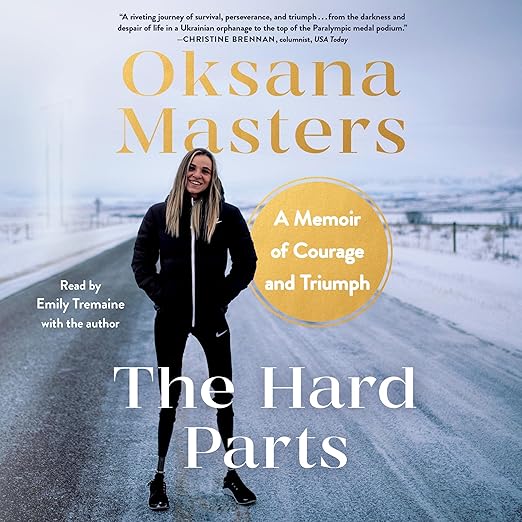
Quick Take
- Narration: Emily Tremaine shifts registers cleanly across abuse, medical, athletic, and relational material without letting any one tone dominate.
- Themes: disability and adaptive athletics, international adoption, resilience after institutional trauma.
- Mood: Unflinching but ultimately hopeful, more raw than a typical inspirational sports memoir.
- Verdict: A genuinely difficult, genuinely earned memoir for listeners ready for the hard parts the title promises, not just the medal count.
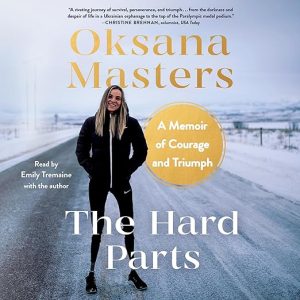
Born near Chernobyl with one kidney, a partial stomach, six toes on each foot, webbed fingers, no right bicep, no thumbs, and two legs of mismatched length missing both tibias, what odds would you have given Oksana Masters of becoming the most decorated winter Paralympic or Olympic athlete in United States history? This audiobook, The Hard Parts, is Masters's own account of that exact distance, and it does not soften the middle of the story to make the ending land easier.
Relinquished to Ukraine's orphanage system by birth parents who could not afford her medical care, Masters endured what the synopsis calls numerous abuses before Gay Masters, an unmarried American professor moved by a single photograph, waged a two-year fight against adoption authorities to bring her home at age seven. What follows in America is not an instant recovery either: years of operations, a double leg amputation, and the ordinary cruelty of simply looking different from everyone else in the room.
Tremaine Finds a Distinct Register for Each Phase
Narrator Emily Tremaine's central achievement across this audiobook is control. Masters's material invites sentimentality at nearly every turn, an inspirational-athlete arc with a genuinely wrenching childhood attached, and Tremaine resists that pull consistently, finding a distinct, correct register for each phase of the story rather than one blanket tone of uplift. The orphanage chapters land differently than the medical chapters, which land differently again from the competition chapters, and that discipline is precisely what keeps nearly eleven hours of hard material from blurring into a single extended note of triumph.
Jeannette Walls, author of The Glass Castle, calls it 'a gut-wrenching, wildly inspiring story about overcoming the most daunting obstacles through steely tenacity, sheer will, and a great big dose of motherly love,' and Angela Duckworth adds that it reads as 'true a tale of grit as I've ever heard, with a message filled with triumph and beauty, that what doesn't kill us makes us stronger, if we are loved.' Both blurbs point at the same structural truth: Gay Masters's love is not a footnote to Oksana's athletic career; it is the hinge the entire book turns on.
Orphanage Chapters Get the Same Weight as Medals
The book's own title is a tell worth pausing on. A more conventional sports memoir might have led with the medal count or a triumphant single word, but this book is titled The Hard Parts specifically, a choice that refuses to let the eventual seventeen medals overshadow what actually happened along the way to earning them. That choice of emphasis carries through the whole structure: chapters on operations and orphanage hardship get the same narrative weight and detail as chapters on competition, functioning as fully realized material rather than a brief, grim preamble to the real story.
The Deliberate Reinvention Behind Each New Discipline
Masters did not succeed in one sport, she medaled across four: rowing, biathlon, cross-country skiing, and road cycling, accumulating seventeen Paralympic medals, more than any other United States athlete across the Winter Games in either Paralympic or Olympic competition. Hearing that range narrated as a continuous first-person account, rather than summarized in a highlight reel, makes clear how much deliberate reinvention each sport switch actually required, not just raw talent carrying across disciplines.
Reviewer natasha writes that the book asks readers to 'stop whining about you don't have' and describes the 'challenges that you went through that built your self-confidence, resilience and determination in a hard way,' while reviewer Lori D'Amico titles her review 'Solid GOLD!' and says it has 'touched my heart in so many ways' that she is already hoping for a sequel. Both reactions point to the same audio advantage: hearing the emotional beats land in something closer to Masters's own cadence than a purely textual read would allow.
The book's 2024 Christopher Award recognition places it inside a specific tradition, an award built on the idea that a single work can affirm human dignity and resilience in a way that changes how a reader or listener sees their own capacity to endure hardship, rather than simply documenting achievement for its own sake. That framing fits The Hard Parts closely: the book is less interested in Masters's medal count as a final scoreboard than in what the accumulated evidence of her specific choices, in the orphanage, in the hospital, on the water and snow and road, actually demonstrates about resilience as a practiced skill rather than an innate trait.
Real Abuse the Christopher Award Doesn't Soften
This is not a light listen, and it should not be marketed as one. The orphanage chapters describe real abuse, and the medical chapters describe a childhood spent largely in operating rooms, content that a 2024 Christopher Award win does not soften. Listeners choosing this specifically for the sports story should know the early-life material takes up substantial real estate and is treated with the same unflinching honesty as the athletic triumphs, not glossed past to get to the medals faster.
The book's scope, four separate sports plus a full childhood arc, means listeners expecting a single tight competitive narrative, one Games, one event, one rivalry, should recalibrate expectations. Reviewer Amazon Customer CZ Reviews sums up the appeal plainly as a book for 'if you enjoy hard work and success stories,' which is accurate but undersells how much of the runtime is devoted to the childhood that precedes any hard work at all.
Switching between four entirely different adaptive sports is not simply a matter of raw fitness carrying across disciplines. Each sport demands its own specific equipment adaptation, technique relearning, and coaching relationship built essentially from scratch, and Masters accomplishing this across four separate competitive careers, not just four events within one sport, is a detail easy to skim past in a plot summary but worth sitting with directly. This is closer to four separate athletic educations than one continuous one, and the audiobook gives each its own distinct texture rather than treating the later sports as simple repeats of the first.
Gay Masters's Persistence, a Compelling Thread on Its Own
Memoir readers who gravitate toward resilience narratives, adoption-story readers, and fans of Paralympic and disability sports will find a genuinely rare combination here: a subject whose achievements are extraordinary by any measure, telling her own story with real specificity about both the worst and best parts of getting there. Parents interested in international adoption accounts will also find Gay Masters's persistence a compelling thread in its own right.
Readers hoping for a single-sport competitive arc will find something broader and, at times, considerably heavier here. Anyone picking this up purely for inspirational sports-highlight content should know the Chernobyl-era orphanage material is graphic enough to warrant real preparation before pressing play, not a quick skim past the hard parts on the way to the finish line.
Frequently Asked Questions
Does the Hard Parts audiobook focus mainly on Oksana Masters's Paralympic career?
No. While her medals across rowing, biathlon, cross-country skiing, and road cycling are covered, a significant portion of the audiobook is devoted to her early childhood in Ukraine's orphanage system and her adoption, which the narration treats with equal weight.
Is this audiobook appropriate for listeners sensitive to descriptions of childhood abuse?
Listeners should know going in that the orphanage chapters describe real abuse and hardship in unflinching terms. The book does not minimize this material to reach the athletic story faster, so sensitive listeners may want to prepare accordingly.
Who narrates the Hard Parts audiobook, and is it read by Oksana Masters herself?
The audiobook is narrated by Emily Tremaine rather than by Masters, and her performance is built around finding a distinct register for each section of the memoir, from the orphanage material to the athletic competition chapters.
How many sports did Oksana Masters actually compete in, based on this audiobook?
Four: rowing, biathlon, cross-country skiing, and road cycling, across which she earned seventeen Paralympic medals, the most of any United States athlete in Winter Games history, Paralympic or Olympic.