Quick Take
- Narration: Charlie Anson brings the appropriate detachment and observational remove to Theroux’s voice, a perspective that the author himself describes as solitary and often abrasive.
- Themes: Post-colonialism in the Pacific, the ethics of the outsider traveler, solitude as both method and limitation
- Mood: Immersive and sometimes uncomfortable, the work of a traveler who notices everything and withholds very little of what he thinks about it
- Verdict: Theroux at his most adventuresome and his most difficult, eighteen months of solo kayak travel through fifty-one islands with an observer who is as much of an acquired taste as the places he describes.
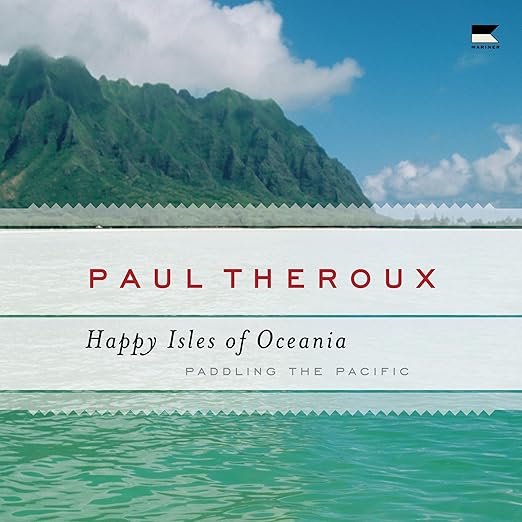
I came to The Happy Isles of Oceania as someone who had read The Great Railway Bazaar and knew Theroux’s particular brand of travel writing, which is to say I arrived prepared for a narrator who is deeply interested in where he is and far less interested in whether his company approves of him. I was not disappointed on either count. Paul Theroux spent eighteen months kayaking through fifty-one islands in the South Pacific, beginning in New Zealand and ending in Hawaii, and the resulting book is the kind of travel writing that rewards and occasionally punishes you for paying close attention.
Charlie Anson’s narration over twenty-four hours accommodates Theroux’s voice well. Theroux is an author who demands a certain kind of reading, attentive and willing to spend time in the company of someone who will describe what he sees about a place or a culture without softening it for palatability. Anson delivers that directness without amplifying the abrasiveness that some readers find off-putting. The detached observational register suits the material and keeps the journey moving through an enormous amount of geographic and cultural territory.
The Kayak as Both Method and Metaphor
Theroux’s choice of a collapsible kayak as his primary mode of transport through the Pacific is not incidental. Traveling alone over isolated atolls, through dirty harbors and shark-filled waters, along treacherous coastlines, is different in kind from any form of travel that puts you in relationship with other travelers or with the infrastructure designed to receive visitors. The kayak means arriving unannounced, approaching places from the water rather than the airport, and being responsible for your own survival in ways that package travel doesn’t approximate.
This produces the specific quality of observation that makes Theroux’s best travel writing unlike most of the genre. He is not a tourist discovering what the tourist infrastructure has decided he should find. He is a solo traveler who has already survived one of the more sustained stretches of independent kayaking anyone has attempted in the Pacific, and his encounters with the king of Tonga, with street gangs in Auckland, with a cargo cult in Vanuatu, all carry the texture of genuine rather than curated encounter. Publishers Weekly called this an exhilarating epic, and while Theroux’s self-sufficiency can shade into isolation, the exhilaration is real.
The Post-Colonial Lens That Some Readers Find Essential and Others Find Heavy
One of the more illuminating reviews of this book came from a reader who described it as full of info and observations about what colonization did and the damage it inflicted, calling it really worth reading despite being depressing at times. This is the honest accounting of what Theroux is doing throughout the Pacific journey. The islands he visits are not pristine paradises. They are places whose cultures, economies, and social structures were disrupted by colonialism in ways that remain visible and that Theroux documents with the same directness he applies to everything else he observes.
The reviewer who noted that Theroux tends to form a negative view and focuses on the negatives of each culture he encounters is pointing at something that runs through all of his travel work and which some readers find honest and others find tiresome. Theroux does not perform enthusiasm for places or cultures. He reports what he finds. When what he finds is devastation or dysfunction or the particular sadness of communities still living in colonialism’s wake, he describes that. If you’ve read Dark Star Safari, which multiple reviewers mentioned as their gateway to Theroux, you know exactly what register this operates in and whether it works for you.
Fifty-One Islands and the Scale of What Theroux Covered
The geographic range of this book is genuinely extraordinary. From New Zealand’s rain forests to Australia, Tahiti, Fiji, Easter Island, Tonga, Vanuatu, and eventually Hawaii, Theroux covered a stretch of ocean and island culture that few travel writers have attempted at comparable depth. At twenty-four hours, the audiobook has room for the accumulated specificity that makes this kind of ambitious travel writing work rather than simply cataloging destinations.
The reviewers who described being lost in the details of the trip, feeling like they were there witnessing everything with him, are identifying what Theroux does with sustained physical description that shorter, more curated travel books can’t achieve. The scale of the journey creates something that functions almost as a total immersion in a part of the world that most readers have very limited direct knowledge of, and the discomfort of Theroux’s perspective is, for many readers, part of what makes the immersion feel real rather than promotional.
Twenty-Four Hours and the Reader Who Will Use Every One of Them
Readers who’ve already found Theroux’s voice in The Great Railway Bazaar or Dark Star Safari will know whether this is for them. The length and the Pacific geography are specific commitments, but for anyone with genuine interest in Oceania’s cultural and post-colonial landscape, this remains the most sustained first-person account available in audio.
If you need your travel writing to be hospitable to the places it describes, or if solo travel narratives where the narrator’s self-sufficiency verges on misanthropy don’t work for you, Theroux is a difficult companion for twenty-four hours. The reader who said this one doesn’t compare to Dark Star Safari and struggled to pick it up is a legitimate counterpoint. Theroux’s Pacific is harder and more ambivalent than his Africa, and that’s both its strength and its limitation.
Frequently Asked Questions
Do you need to have read The Great Railway Bazaar before The Happy Isles of Oceania?
No. Each of Theroux’s major travel books is a standalone work. However, readers who have already encountered Theroux’s voice and observational approach in his other books will arrive with calibrated expectations. Dark Star Safari and The Great Railway Bazaar are both frequently mentioned by readers as their gateway to his work.
How does Theroux’s solo kayaking work as a travel method across fifty-one islands?
Theroux used a collapsible kayak that could be packed and transported on commercial flights between regions, then assembled for water travel at each location. This allowed him to approach islands from the water rather than through airport infrastructure, creating the kind of unmediated encounter his travel writing depends on. The method also meant prolonged physical isolation and genuine navigational risk.
Does the book address the post-colonial history of Pacific islands directly?
Throughout. Theroux documents what he finds in each location without softening the evidence of colonialism’s continuing effects on Pacific cultures, economies, and communities. Readers who find this framing essential will find this one of the more honest travel accounts of the region. Readers who find Theroux’s tendency to focus on dysfunction exhausting will have that experience confirmed here.
Why does the metadata tag this as Asia when the book covers Oceania?
The Asia tag likely reflects a metadata categorization decision by the publisher or platform rather than the book’s actual geographic content. The Happy Isles of Oceania covers the South Pacific exclusively, including New Zealand, Australia, Fiji, Tonga, Vanuatu, Easter Island, Tahiti, and Hawaii, with no significant Asian content.