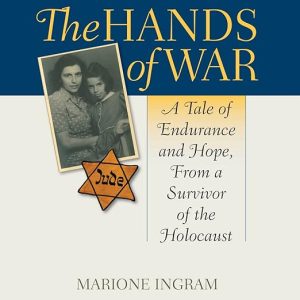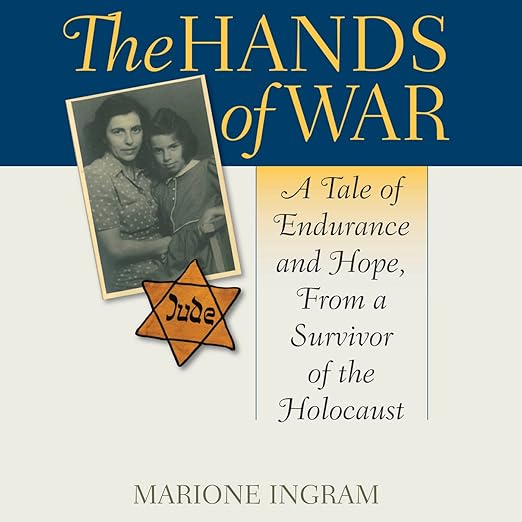
I came to The Hands of War on a quiet evening, having recently finished two other WWII memoirs, one by an American soldier, one by a French civilian. Marione Ingram's account occupies different ground than either. She is German. She is Jewish. She survived the eight-day Allied firebombing of Hamburg in 1943 that killed more than forty thousand people. The paradox at the heart of her story, that the bombs dropped by the forces fighting Nazism also saved her life by creating the chaos under which she could escape, is not one you encounter often in the literature of this period.
Ingram grew up in a Hamburg apartment building where, as she describes it, neighbors were actively willing to report Jews to the Gestapo. Her mother's suicide attempt following a deportation notice, which Ingram as a child reversed, arrives early in the narrative and sets the register for everything that follows: this is not a story of abstract historical forces but of a specific family, in a specific building, making desperate decisions in real time.
Survival Here Owes Nothing to Heroism
The Hamburg firebombing sequence is the moral center of the book, and Ingram writes about it with a clarity that reviewers have singled out. One called the mental image of the firestorm incredible and noted the paradox, that the bombing which killed tens of thousands also created the conditions under which Ingram's family could escape. Another reviewer described the book as an excellent window not only into the Holocaust, but the fire bombing of Hamburg. That dual focus is what distinguishes this memoir from more familiar accounts. Most Holocaust testimony is not also a record of what it meant to be a German civilian under Allied bombardment.
The account of hiding in a shed in the countryside for more than a year, sheltered by a contact who agreed grudgingly, carries its own unbearable quality. Ingram and her family were not saved by heroism. They were saved by contingency, moral minimalism, and survival instincts. The book does not pretend otherwise. This honesty about the accidental nature of survival is one of the things that makes Ingram's account feel genuinely different from memoirs in which survival is framed as testament to personal resilience.
Uri's Camps and Ingram's Streets, Two Kinds of Terror
The second half of the memoir introduces Uri, a troubled orphan Ingram meets at a children's home in a mansion once owned by wealthy Jewish bankers. His story of life in the concentration camps occupies a different register than Ingram's own, where her account is one of narrow escapes and urban survival, his is of systematic terror. The juxtaposition of these two experiences of Nazi Germany, each extreme in its own way, gives the second half of the book a different weight than the first.
One reviewer noted that the narrative is a bit unclear and not as well written as many other survivor stories in places, and that observation is fair. Ingram is not a professional writer, and the prose occasionally loses its footing, particularly in the sections that shift between timelines. But the same reviewer acknowledged that the story itself is remarkable, and that acknowledgment gets at something important: there are memoirs where the craft carries the content, and there are memoirs where the content carries everything. The Hands of War is the second kind.
Teresa DeBerry Reads It, Never Performs It
Teresa DeBerry's performance is appropriately restrained. She does not perform the tragedy. She reads it, clearly and steadily, which is the right decision for material of this weight. One reviewer described it as eloquent and noted that it elicited compassion without feeling manipulative. That is a harder calibration than it sounds, and DeBerry achieves it consistently across the six-hour runtime.
Six Compact Hours That Read as Testimony
Most WWII testimony reaches English-language readers through a limited set of filters: the liberators, the liberated, the most famous survivors. Ingram's account is filtered by none of these. She is a Jewish child in Germany who survived not through escape to another country, not through the camps (she was not taken), but through the specific geography of Hamburg under Allied bombardment and the grudging mercy of a stranger with a shed. That particular pathway through the war is largely undocumented in the memoir literature available to English readers, and it is a gap that Ingram's account fills in a way that no other existing text does. The writing is not always polished. The structure is not always clear. But the specificity of what she witnessed, the firestorms, the years in hiding, the strange aftermath of liberation that left Jews as second-class citizens under reinstated ex-Nazi local government, is irreplaceable as historical testimony.
At six hours and eight minutes, this is a relatively compact listen for the amount of history it covers. It is also the kind of audiobook that benefits from being treated as a primary source rather than entertainment, listened to in shorter sessions, with time to absorb what has been heard. Listeners who approach it as they might approach a novel will find it demands more of them than that. Those who approach it as testimony, which is what it is, will find it essential. The account of one Jewish girl who survived Hamburg by a combination of desperate choices and extraordinary luck belongs in the same shelf space as the essential literature of this period, and the free audiobook edition makes it accessible to listeners who might not have sought it out otherwise.