Quick Take
- Narration: Pico Iyer reads his own work with the unhurried authority of someone who has genuinely made peace with uncertainty; his voice suits the contemplative register of every page.
- Themes: Paradise, pilgrimage, the politics of sacred space
- Mood: Still and searching, occasionally melancholy, always beautifully observed
- Verdict: A genuinely literary travel essay in audio form, best listened to in the kind of quiet that most lives rarely allow.
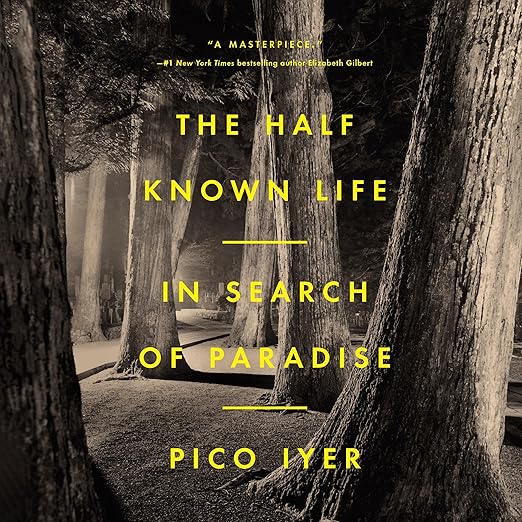
I came to The Half Known Life in the wrong mood the first time. I had put it on during a busy afternoon with half my attention somewhere else, and fifteen minutes in I realized I had retained almost nothing. I went back to the beginning the following morning, early, with coffee and no phone nearby, and everything shifted. Pico Iyer’s prose requires a particular kind of attention, the kind his subject matter, which is paradise, also demands.
The book grew from a question Iyer has been asking across a lifetime of travel: where is paradise, and does it actually exist in the world or only in the imagination? His route through the question takes him to Iran, North Korea, the Dalai Lama’s Himalayas, the ghost temples of Japan, Sri Lanka during and after civil war, and a number of other places where the concept of a sacred or ideal world has left its marks on the landscape and the people who inhabit it. The result is not a conventional travel narrative. It does not move sequentially through a journey. It accumulates observations, memories, and conversations into something closer to a sustained philosophical essay that uses place as its primary evidence.
The Spiritual Geography of Contested Places
What distinguishes Iyer from most travel writers working in this territory is that he is equally attentive to beauty and to violence. The Dalai Lama’s Himalayas are also a geopolitical flashpoint. Iran is simultaneously a country of extraordinary historical depth and a theocratic state where the distance between official paradise and lived reality is a subject of constant negotiation. North Korea presents a vision of earthly paradise that functions as a form of mass control. Iyer does not flinch from these contradictions, and he is honest about how profoundly they complicate the romanticized ideas of sacred places that many Western pilgrimage narratives carry without examination.
The Washington Post called the book masterful, describing it as a book of inner journeys told through extraordinary exteriors. That is an accurate account of what Iyer is doing. The outward travel is always in service of an inward question, and he moves between the two registers with a fluency that comes from decades of practice. Time magazine named it one of the best books of 2023, which reflects the critical reception accurately. What readers’ reviews add is a more personal dimension: one describes the writing as poetically descriptive, bringing people and places to life in ways that made her feel present in those spaces; another describes it as a quiet book that genuinely broadens your view of how people in other cultures see the world and each other.
What Self-Narration Does Here, for Better and Occasionally Worse
Iyer reads his own book, as he has for several of his audiobook releases, and the results are largely excellent. His voice carries the quality of his prose: measured, unshowy, interested. He does not perform the text so much as inhabit it, which is the correct approach for writing this personal and this carefully made. At five hours and fifty-five minutes, this is a short audiobook for the ambition of its subject, and Iyer’s pace keeps it moving without rushing past passages that deserve to settle.
The limitation of self-narration in this case is a mild one: Iyer is not a trained voice actor, and there are occasional moments where the pacing in complex sentences could benefit from a professional’s sense of how to handle subordinate clauses in audio. This is a minor issue and unlikely to trouble most listeners, but it is worth noting for those who are sensitive to narration mechanics.
The Dissenting View, Which Is Not Without Merit
One reviewer gave the book three stars on the basis that Iyer never peels away the differences between religious traditions to reveal what might be a common core beneath the colorings. That is a legitimate literary criticism. The book describes and observes without arriving at a unified theory of paradise, and if you read it hoping for resolution, you may find the ending deliberately inconclusive in a way that frustrates. Iyer’s project is more phenomenological than argumentative: he wants to show you what paradise looks like from inside various traditions and geographies, not to synthesize those views into a single answer.
Whether you find that approach satisfying or evasive will depend on what you brought to the listening. If you want a book that shakes your assumptions about where peace might be found and then leaves you with the question open, this delivers that. If you want a destination, you should look elsewhere.
The Ideal Conditions for This Audiobook
This is morning or late-evening listening. It suits long train journeys, the kind of travel Iyer himself has spent a lifetime taking, or the particular stillness of a rainy afternoon indoors. It does not suit commutes or workouts. The prose rewards the attention you would give to poetry, and the audio format captures Iyer’s rhythm well enough that the best passages genuinely function as something close to spoken verse.
Frequently Asked Questions
Is The Half Known Life a narrative travel memoir or something closer to an essay collection?
It sits closer to the essay than to the memoir. The book does not move sequentially through a single journey but accumulates observations from decades of travel into a meditation on paradise. Readers expecting a conventional travel narrative will find the structure more philosophical than they anticipated.
Does Pico Iyer’s self-narration serve this particular book, given how literary the prose is?
Largely yes. His voice suits the contemplative register of the writing, and his familiarity with the text means the pacing feels natural rather than performed. Listeners who are sensitive to narration mechanics may occasionally notice minor pacing issues in complex sentences, but these are minor.
How does the book handle politically sensitive destinations like Iran and North Korea without becoming either a political polemic or a naive travelogue?
Carefully and honestly. Iyer is attentive to the gap between official paradise narratives and lived reality in both countries, and he treats the contradictions of sacred-but-contested places as central to his argument rather than inconvenient complications to be smoothed over.
The book is named a Best Book of 2023 by multiple major outlets. Does it live up to the critical reception for general audiobook listeners, or primarily for literary readers?
The critical acclaim reflects a genuinely literary achievement, and general listeners will find it accessible and often beautiful. But this is a book that rewards patience and a certain meditative attention. Listeners who primarily want plot-driven narratives or practical travel information will likely find it a slow match for their habits.