Quick Take
- Read by: Spencer Pratt reads his own story with the same unfiltered energy the book itself describes, which suits confessional memoir better than a hired narrator could.
- At its heart: reality TV villainy, public reinvention, marriage as the one stable anchor
- Vibe: darkly comedic, self-aware, occasionally raw
- Short version: a genuinely entertaining listen even for people who never watched The Hills, and close to essential for anyone who followed Speidi in real time.
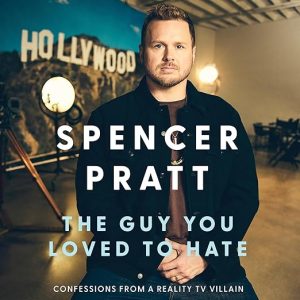
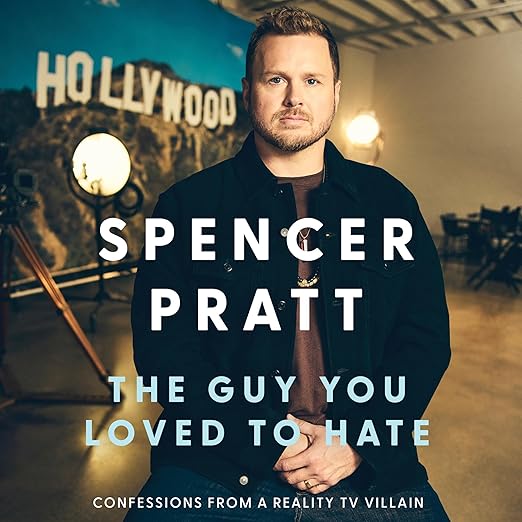
By twenty-one, Spencer Pratt had already created his own reality show and become, in his own telling, the youngest executive producer in network television history, and within a few years he'd rebuilt himself entirely around becoming MTV's most notorious villain on The Hills, the role that made him famous and nearly ended him. The Guy You Loved to Hate is his memoir of that entire arc, an instant New York Times bestseller and this audiobook, narrated by Pratt himself across nine hours and twenty-three minutes, tracing the engineered chaos of “Speidi,” his and Heidi Montag's two-million-dollar-a-year tabloid identity as a couple, through a genuine mental health collapse, exile from Hollywood, and an unlikely rebuilding of his life and public image after the 2025 Palisades wildfires destroyed his home. Self-narrated celebrity memoirs live or die on whether the person reading actually sounds like themselves, and Pratt does.
Weaponizing His Own Toxicity, On Purpose
What separates this from a fairly standard reality-TV tell-all is how much Pratt is willing to implicate himself rather than simply relitigate old feuds. The book is blunt about the mechanics: he describes weaponizing what the description calls “Simon Cowell-style villainy” deliberately, turning toxicity into ratings gold as a conscious strategy rather than something that merely happened to him, and then tracking the real cost once that manufactured persona stopped being something he could switch off between takes. The book doesn't ask for sympathy so much as it asks to be believed, hoarding weapons, spending a fortune on crystals, alienating nearly everyone except Heidi during his lowest point, and that specificity about the collapse is what keeps it from reading as just another rehabilitated-villain redemption arc with the hard parts smoothed over.
Listener reviews describe a book that earns real emotional investment even from people who came in as skeptics. Angie B.'s review is the most candid about that trajectory. “A purchase made from empathy, not expectation,” she writes, going on to call it “a souvenir from a moment rather than a story I’d actually open” instead, after Pratt's family had just survived the wildfire, and finding the actual content surprised her. Popawheelie's review describes getting pulled in immediately, noting that “Spencer engages his audience from page one” and the book became hard to put down once started. DonnaG's review adds a longtime fan's perspective, having followed Pratt since his earlier show Princes of Malibu aired, and calling him “genuine, charismatic, lovable, honest, determined, and so funny.”
The mental health material deserves its own mention, since the book doesn't treat Pratt's unraveling, the weapons stockpiling, the fixation on crystals, the alienation of nearly everyone around him, as a colorful anecdote to be laughed off in hindsight. He narrates those chapters with a rawness that stands apart from the book's overall comedic register, and that tonal shift is deliberate rather than accidental; reality television built an entire economy around packaging real instability as entertainment, and Pratt naming that mechanism from the inside, in his own voice, is where the memoir moves past a typical redemption-arc structure into something closer to genuine reckoning.
Only His Own Voice Could Close That Gap
Pratt narrating his own story is close to essential here, not just a nice-to-have production choice. This is a book explicitly about the gap between a manufactured public persona and whoever he actually is underneath it, and having his real voice, with its real cadence, real self-deprecation, real discomfort in the harder chapters, deliver that account carries a weight a professional narrator reading the same words simply couldn't replicate. The book's own closing claim, that he emerges not as a manufactured persona but as exactly who he was, is the kind of statement a memoir can assert in text but that only self-narration can actually demonstrate to a listener in real time.
The comedic timing throughout is a genuine asset rather than incidental; DonnaG's “so funny” assessment tracks with how the book is described as darkly comedic even in its most difficult stretches, and hearing Pratt time his own punchlines against material this personal, his own paranoia, his own financial ruin, adds a self-awareness that reads differently coming from the person who actually lived it. TikTok is a meaningful presence in the book's back half too, the platform where Pratt and Montag's post-fire comeback took shape, and something fits about a memoir this online-native being narrated by the person whose voice built that following in the first place.
A 4.8 From Listeners Who Already Know Speidi
This is not a balanced or particularly reflective account of everyone else involved, Heidi Montag included, and readers hoping for a more critical, arm's-length examination of reality television as an industry rather than one insider's personal reckoning with his own choices should adjust expectations accordingly. The book is unapologetically about Pratt's own experience and interior life; other cast members, producers, and even his family appear mostly in service of his own arc rather than as fully drawn figures in their own right across the runtime.
Some familiarity with The Hills, Speidi-era tabloid culture, and the general shape of Pratt's public rise and fall genuinely helps here; the book doesn't spend much time re-explaining who everyone is for a listener with zero context, moving fast on the assumption you already know roughly who Heidi Montag is and what The Hills was. At a 4.8 rating from 406 listeners, the audience that already has that context is responding to it strongly, worth weighing if you're coming to this with no prior interest in the reality TV era it's rooted in.
Worth being clear about scope too: this covers roughly two decades, from his first reality show at twenty-one through the 2025 wildfire recovery, moving quickly across some stretches (particularly the years between The Hills ending and the couple's slower rebuilding period) that a more conventional, chronological biography might have lingered on longer. The pacing favors emotional and narrative peaks over comprehensive year-by-year coverage, consistent with how memoir generally works but worth knowing if you're expecting a detailed timeline of every year in between.
No Joint Memoir, Just Pratt's Own View
Anyone who watched The Hills in real time, followed the Speidi tabloid saga, or has any nostalgia for 2000s reality television will get the most out of this, and so will readers generally drawn to self-aware celebrity memoirs that dig into the psychological cost of fame rather than just cataloging its highlights. It also lands well for anyone who has ever rebuilt a public identity from scratch after a very public low point.
Anyone still nursing a grudge from the Speidi era and expecting an unrepentant villain rather than a genuinely reflective account should recalibrate before starting, since the book's whole project is Pratt accounting for that persona rather than reperforming it. It's a thinner pick, too, for listeners who want substantial insight into Heidi Montag's own perspective specifically, since this stays close to Pratt's own point of view throughout rather than functioning as a joint memoir.
Why does Spencer Pratt's self-narration matter for this particular audiobook?
Because the book's whole subject is the gap between his manufactured reality-TV persona and who he actually is underneath it, and hearing that account in his own real voice demonstrates the point a hired narrator's reading couldn't.
Does this audiobook cover the 2025 Palisades wildfires and Spencer and Heidi's comeback?
Yes, extensively. The back half covers losing their home in the fires and the rapid, TikTok-driven comeback that followed, which the book frames as central to Pratt finally being ready for his redemption arc.