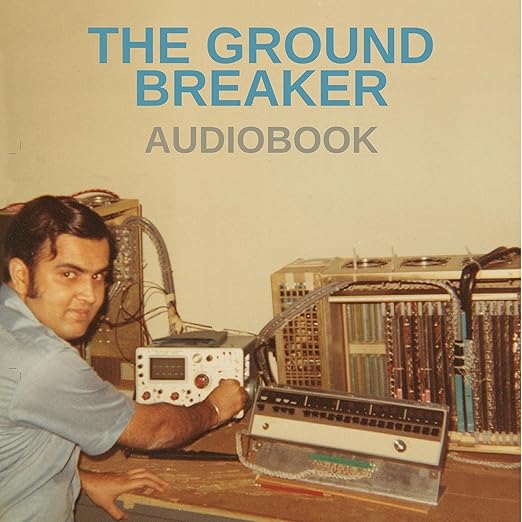
- Performance: Vipin Sharma narrates with measured authority that fits the Indian-American Silicon Valley professional register; culturally fluent and keeps the pacing confident across nearly 8 hours.
- What it covers: Immigration and entrepreneurship, Silicon Valley's founding generation, US-India relations, leadership earned through adversity, building ecosystems rather than just companies.
- Feel: Authoritative and forward-looking; a business memoir that earns its prescriptive sections through the specificity of its biographical ones.
- Our call: An essential account of Indian-American entrepreneurial history told by someone who helped make it, with enough specific detail to keep even skeptical readers up past midnight.
Craft and memoir intersect sharply in The Groundbreaker, an audiobook that structures its argument the way Kanwal Rekhi built his career: by earning each step rather than assuming it. Rekhi's story, from immigrant engineer in the 1970s to the figure Fortune Magazine would eventually dub the 'Godfather of the Silicon Valley's Indian Mafia,' is told with enough specificity to function as genuine biography and enough retrospective clarity to function as a leadership framework. The fact that these two registers coexist without awkwardness is the book's primary craft achievement, and Vipin Sharma's narration carries the weight of both.
Waking at Night to Return to 1987
Rekhi's memoir works on several simultaneous levels. At the individual level, it is a story about an immigrant who arrived in an America that had not yet made room for what he represented, and who made room anyway. The specific inflection point stories matter here: the moment of the 1987 IPO that one reader found themselves waking in the night to return to, the early Silicon Valley encounters with the figures who would become Gates, Jobs, and Ellison, the period of learning the rules of a system not designed with him in mind. These episodes are narrated with restraint rather than retrospective grandeur, which makes them more convincing.
Rekhi's Career Proves Immigrants Employ Americans
At the structural level, Rekhi's account functions as an argument about immigration that is grounded in evidence rather than abstraction. The claim that immigrants do not merely contribute to the American economy but actively employ Americans is not novel, but Rekhi has the career to demonstrate it rather than assert it. The entrepreneurial ecosystem he helped build in Silicon Valley, the careers he launched, the policies he advised on, constitute a case study for the argument. Readers who came to the memoir skeptical of its scope left persuaded by its substance.
The call for US-India cooperation, framed as a relationship between the world's oldest democracy and the world's largest democracy, gives the memoir a contemporary political dimension that extends its relevance beyond technology history. Rekhi is making a case about geopolitics through the lens of personal experience, which is both more persuasive and more readable than policy argument for its own sake.
Sharma's Register Is Culturally Fluent
Vipin Sharma's narration is well-suited to this material. For a memoir of Indian-American experience in Silicon Valley, having a narrator whose vocal register is culturally fluent with the Indian-American professional world Rekhi inhabited adds a layer of authenticity that broader-cast narrators sometimes miss. Sharma's delivery is measured and authoritative without being dry, which matches the tone Rekhi's writing establishes: serious about what it achieved, honest about what it cost.
At seven hours and forty-five minutes, The Groundbreaker moves at a confident pace. This is not a memoir that lingers in sentiment or uses emotional moments for extended effect. Rekhi keeps the narrative moving, which suits the audiobook format well. Listeners who prefer business memoirs that stay focused on career narrative over personal disclosure will find the balance well-calibrated. Those who want deeper personal interiority may find the book more public than private.
The reader who described waking in the middle of the night to continue listening is describing a reading experience that centers on suspense about historical outcome, which is a particular pleasure of memoir when it is well-paced. You know Rekhi succeeded; the suspense is in how, and specifically when the next obstacle will resolve, which Sharma's pacing manages effectively.
A Perspective That Invites Political Pushback
The book's framing as a call to action for the next generation of entrepreneurs is sincere but somewhat broad in its prescriptive sections. The memoir sections are specific and vivid; the lesson-drawing passages occasionally shift to a more generic motivational register. Readers who prefer the biographical material to the leadership framework sections will want to know that the memoir elements dominate and the prescriptive sections are relatively brief.
The US-India geopolitical argument, while substantive, reflects Rekhi's particular position and period. Readers who approach the cooperation argument with different political commitments or more recent geopolitical context will find places where the framing invites pushback. This is a perspective, richly earned and clearly articulated, rather than a comprehensive analysis.
For listeners who want significant personal disclosure, emotional interiority, or domestic narrative alongside the career arc, The Groundbreaker is lighter on those elements than some comparable business memoirs. Rekhi's primary register is professional and forward-looking.
An Outward Turn Toward Mentorship Is Unusual
Entrepreneurs at any stage of their career, and specifically first-generation immigrants navigating systems not built with them in mind, will find Rekhi's account both practical and personally resonant. Readers interested in the history of Silicon Valley's Indian-American entrepreneurial community will find The Groundbreaker essential context for understanding how that community formed and what it built. Business school students and professionals in technology who want biographies that ground their industry's mythology in specific, documented human experience will appreciate the restraint and rigor of Rekhi's account.
For anyone who has wondered how a single generation of engineers could alter the economic relationship between two countries, The Groundbreaker is the kind of memoir that answers that question from the inside, with the specificity and honesty that only a participant narrator can bring.
What distinguishes The Groundbreaker from similarly positioned Silicon Valley memoirs is that Rekhi's account of mentorship is as central as his account of personal achievement. The book spends considerable time on the ecosystems he helped build, the Indus Entrepreneurs network, the policy advocacy, the individual founders he backed and advised, rather than remaining focused only on his own ascent. That outward turn is unusual in the memoir genre, where the self tends to remain the primary subject. For readers who find the genre's self-focus limiting, Rekhi's attention to what he built for others makes The Groundbreaker a more generous and consequently more interesting book.
Who is Kanwal Rekhi and why does this audiobook matter for Silicon Valley history?
Rekhi is a pioneering Indian-American engineer and entrepreneur who became one of the most influential mentors in Silicon Valley, helping launch thousands of immigrant entrepreneurs. Fortune Magazine called him the 'Godfather of the Silicon Valley's Indian Mafia.' The memoir documents how the Indian-American tech community formed around figures like Rekhi.
What makes this audiobook relevant beyond the tech world?
Rekhi's argument about immigration, entrepreneurship, and US-India cooperation has contemporary policy relevance. The memoir functions as evidence for specific claims about how immigrant communities build economies, which makes it useful reading for anyone interested in immigration, geopolitics, or economic history beyond the technology sector specifically.