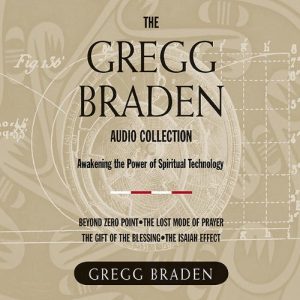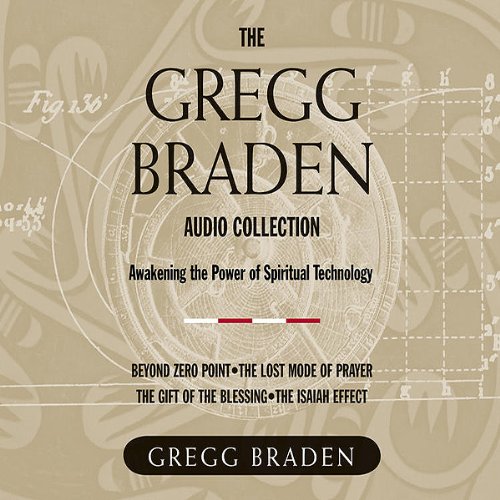
The Gregg Braden Audio Collection arrives as something genuinely rare in the spiritual self-help category: a compiled package where the author's voice, literally, is the throughline. Braden narrates each of the three included works himself, Beyond Zero Point, The Isaiah Effect, and The Lost Mode of Prayer, and this audiobook also adds sixty minutes of new teachings on prayer and blessing available nowhere else in audio form. For listeners already familiar with Braden's wider catalog, this collection offers the opportunity to hear the development of his thinking across three related works in a single eight-hour-and-fifty-minute listening session. For newcomers, it functions as an unusually thorough introduction to a body of ideas that has generated a substantial and loyal following.
The Review
Braden's central project, connecting ancient wisdom traditions with contemporary scientific frameworks, is established in Beyond Zero Point, which draws on Essene, Hopi, and Egyptian prophetic traditions to argue for what he calls a universal set of sacred technologies. The Isaiah Effect extends this into the physics of time, reading the Dead Sea Scrolls alongside modern interpretations of quantum possibility to describe what Braden calls a transformative tool for healing ourselves and the planet. The Lost Mode of Prayer completes the arc by grounding these ideas in practical application, explaining the mechanics of what Braden identifies as an ancient form of prayer encoded in freshly translated Dead Sea Scroll texts.
Listeners already acquainted with Braden's work on the science-spirituality interface will recognize the conceptual scaffolding here. The collection predates some of his later, more scientifically detailed output, which means the scientific framing is somewhat lighter than in his more recent books. Braden himself is candid in placing these early recordings as foundational explorations rather than finished arguments. That honesty about the developmental nature of his thinking gives the collection an interesting dimension for anyone tracing his intellectual journey across decades of work.
The Best Parts of The Gregg Braden Audio Collection
Self-narrated spiritual audiobooks succeed or fail on the author's ability to convey genuine conviction without becoming didactic. Braden manages this unusually well. One reviewer describes him as "always a delightful and engaging storyteller" who "further explodes and expands your vision of REAL history by his faith-filled pilgrimages to far-away monasteries, sacred cities, synchronistic encounters." Another notes that he "backs up theory with scientific facts and historically researched data" and "never offends." That last quality is worth dwelling on: Braden's synthesis of ancient prophecy and scientific language is contentious in both directions, too spiritual for strict materialists and too scientifically framed for traditional religious listeners. His delivery, calm, curious, and non-confrontational, keeps the material accessible across a wider range of starting positions than the content alone might suggest.
The exclusive sixty-minute final section on prayer and the Gift of Blessing, including a guided blessing exercise, gives the collection genuine additional value beyond what could be assembled from the three standalone titles. For listeners investing in this format, that material is the most compelling argument for the compilation over individual purchases. The guided exercise in particular is only available in this collected format.
The Caveats
The collection is best approached with some awareness of its intellectual framework. Braden synthesizes ancient prophetic texts, quantum physics language, and personal pilgrimage experiences in a way that is generative rather than academically rigorous. Listeners who arrive from conventional scientific backgrounds looking for peer-reviewed arguments will find the framework unsatisfying. Listeners who engage with the material as a bridge between contemplative tradition and scientific curiosity, holding the synthesis lightly rather than literally, will find it considerably more rewarding.
The earlier recordings that comprise Beyond Zero Point show Braden's thinking in a more exploratory register than his later work, which gives the collection an interesting historical dimension for anyone tracing his intellectual development. The production quality across the three works may vary slightly, as is common in compiled collections spanning different recording periods. Overall, however, the cohesion of Braden's narrating voice smooths these transitions more effectively than a varied cast of narrators would.
For listeners new to the science-spirituality synthesis genre, Braden is a particularly useful entry point because he is consistently specific about the traditions and texts he draws on. He does not speak in generalized spiritual language. He names the Essenes, cites specific Dead Sea Scroll passages, and references particular scientific concepts by name. That specificity makes his work more evaluable than most writing in this space, even for listeners who ultimately disagree with his interpretive framework. The guided blessing exercise that closes the collection is the most practically oriented section of the entire package and represents the kind of material that typically requires a retreat or workshop to access. Getting it in audio form alongside the three foundational texts is the most compelling practical argument for choosing this collected edition.
Who Should Pick Up The Gregg Braden Audio Collection
This audiobook is built for Braden's existing readership and for listeners exploring the intersection of ancient wisdom traditions with speculative science. It is also genuinely useful as an introduction for newcomers, since the three-work structure covers the foundational arc of his thinking in a single package. Listeners committed to strict scientific materialism will find the synthesis frustrating. Those drawn to writers like Deepak Chopra, Joe Dispenza, or Bruce Lipton, who occupy a similar space between spiritual and scientific claims, will find Braden's approach comparable in tone, perhaps a shade more historically grounded in its references to specific ancient texts and traditions.
Questions Listeners Ask
Do you need to have read Gregg Braden's other books before listening to this audiobook collection?
No. The collection includes Beyond Zero Point, The Isaiah Effect, and The Lost Mode of Prayer, which were among his foundational works. They function as an introduction to his thinking rather than a continuation of something more advanced.
What makes this audiobook collection different from buying the three titles individually?
The collection includes an exclusive sixty-minute recording on prayer and the Gift of Blessing, including a guided blessing exercise, that was not available in any other format at the time of release. That exclusive content is the primary added value of the compiled package.
How does Gregg Braden perform as a narrator of his own audiobook work?
Braden is an experienced speaker and the narration reflects that. He maintains a calm, engaged pace that suits the meditative nature of the material, and his personal investment in the ideas gives the recordings a quality of direct communication rather than formal performance.