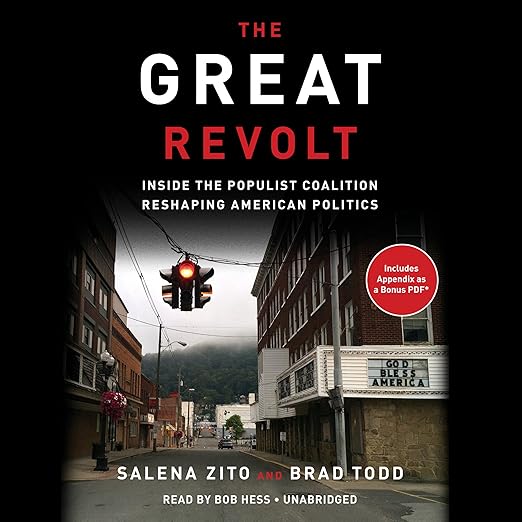
Quick Take
- Narration: Bob Hess reads with journalistic steadiness that suits the book’s reportorial ambitions, though the eleven-hour runtime asks a lot of a voice without much tonal range.
- Themes: Electoral populism, the rural-urban political divide, voter motivation versus media interpretation
- Mood: Methodical and ground-level, with an urgency that comes from the material rather than the prose
- Verdict: One of the more serious attempts to understand the 2016 electoral coalition from the inside, though its value has grown more historical than predictive with time.
I picked up The Great Revolt during a quiet Wednesday evening, expecting a political book in the usual sense: arguments organized by premise, evidence marshaled in service of a thesis, a conclusion that arrives where the introduction promised it would. What I got was something closer to oral history, to the kind of reporting that happens when journalists actually drive to the places they are writing about instead of analyzing them from a studio desk. Salena Zito and Brad Todd traveled over 27,000 miles across five swing states and interviewed more than 300 Trump voters in ten swing counties. Whatever you think of the subject, that is serious fieldwork, and the result reads accordingly.
The political landscape this book describes has continued to evolve since its 2018 publication, and reading it now carries the slightly melancholy quality of looking at a photograph taken just before something changed. The specific mechanisms of the 2016 electoral coalition have been rearranged by subsequent elections and events. But the underlying sociology that Zito and Todd document is still recognizable, and in some ways the distance of time makes the reporting clearer rather than cloudier. The book has become a historical document in ways its authors could not entirely have anticipated.
What the Reporters Found in the Swing Counties
The book’s central argument is that the 2016 Trump coalition could not be adequately described by the shorthand labels that dominated media coverage. Zito and Todd identify voter profiles that cut across expected demographic lines: college-educated women, lifelong Democrats, small business owners who had previously voted for Obama twice. The granular portraits that emerge from their interviews resist easy typology, which is precisely the point. One of the most-cited observations in the book, Zito’s original insight that the press takes Trump literally but not seriously while his supporters take him seriously but not literally, originated in reporting that predates this volume but finds its fullest development and elaboration here.
The methodological ambition is real, and the international readership this book attracted tells you something about its reach. A Spanish reviewer called it a serious study that explains in black and white why certain voter groups moved from Democrat to Republican in sufficient numbers to deliver key counties. A German reviewer quoted the book’s conceptual framework at length and found it illuminating. A UK reviewer suggested it should be required reading in major newsrooms. This kind of international engagement is unusual for American electoral reporting, and it reflects the book’s genuine attempt to explain something rather than simply argue for a position that its readers already hold.
Bob Hess and the Demands of Long-Form Political Audio
At eleven hours, The Great Revolt is a substantial commitment, and Bob Hess’s narration is competent without being particularly distinctive. He brings a journalistic register to the material that works well for the interview-based sections, where the reporting speaks for itself and the narrator’s job is primarily to stay out of the way. The analytical passages, where Zito and Todd synthesize what they have found, are handled with appropriate gravity. What Hess does not offer is much variation in energy or tone over the full runtime, which means the book’s emotional texture is flatter in audio than it might be in print.
The structural choice to organize the book around voter archetypes rather than chronological narrative is well-suited to audio listening. Each profile functions as a self-contained portrait, and the cumulative effect of those portraits is powerful in a format where they arrive without visual interruption. Hess sustains a tone that treats each voter’s voice as worth attending to, which is consistent with the book’s underlying argument about the failure to listen that defined the political establishment’s relationship to these communities before 2016.
A Document of Its Era and What Remains Useful in It
This book rewards listeners who want to understand how journalists operating outside the mainstream media framework approached the story of 2016, and who are interested in the actual sociology of American populism rather than its caricature. Skip it if you are looking for either a celebration or a condemnation of the Trump phenomenon; this book is neither. It is an attempt at documentation, and it succeeds more fully than most comparable efforts. Readers who want a more adversarial account will find it too generous; readers who want a celebratory one will find it too analytical. Listeners willing to sit with the complexity and contradiction of American political identity, with communities that resist the labels both parties have tried to apply to them, will find it one of the more durable documents to emerge from that strange political moment.
Frequently Asked Questions
How has The Great Revolt aged since its 2018 publication, given subsequent elections?
The specific electoral predictions have been tested and partly confirmed, partly complicated by later cycles. The underlying sociological documentation remains useful and has arguably grown more historically significant as the coalition it describes has continued to shape American politics.
Is the book balanced in its treatment of Trump voters, or does it have an editorial slant?
Zito and Todd approach the material as reporters rather than advocates, and the book is notable for letting voters speak at length in their own voices. Critics have called the framing sympathetic rather than neutral, but the reporting methodology is more rigorous than most comparable books on the subject.
Does Bob Hess’s narration suit the journalistic tone of the book?
Reasonably well. Hess is steady and clear, which fits the reportorial register. At eleven hours, the narration can feel flat in places, but it does not undermine the material in any significant way and handles the voter profile sections with appropriate respect.
Do you need to follow American politics closely to get value from this book?
Familiarity with the 2016 election and the basic fault lines of American political geography helps, but the book’s voter portraits are accessible enough that international listeners have found it illuminating without deep prior knowledge of US electoral mechanics.