Quick Take
- Narration: Adam Baratta narrates his own book with the storytelling instincts of his Hollywood background; he is persuasive and engaging, which works well for the thesis but also means the delivery amplifies conviction in ways that occasionally substitute for analytical rigor.
- Themes: Currency devaluation and sovereign debt, gold as monetary anchor, Federal Reserve policy and financial inequality
- Mood: Urgent and alarm-raising, with the cadence of someone who believes the window for action is closing
- Verdict: A readable and genuinely alarming account of government debt and monetary policy for general audiences, strongest as a narrative framework and weakest when it moves toward specific predictions.
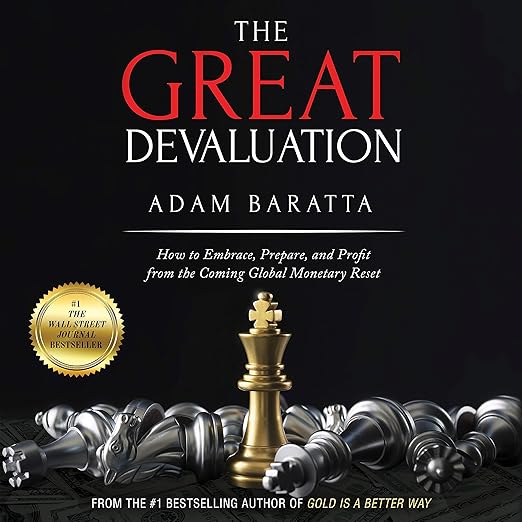
I came to The Great Devaluation already knowing that Adam Baratta’s previous book, Gold Is a Better Way, had built a devoted following among precious metals enthusiasts. What I was less prepared for was how genuinely well-constructed this one is as a piece of financial storytelling. Baratta spent years in Hollywood before entering the investment world, and his ability to build a narrative arc through material that in other hands becomes a wall of macroeconomic data is the book’s most distinctive quality. Financial advocacy writing rarely sounds like this; it usually sounds like a lecture, and Baratta sounds like he is telling you a story you should have been told years ago.
The central argument is stated plainly from the opening: the real crisis facing the global economy is not any individual crisis, pandemic, recession, or geopolitical shock, but rather the structural condition of explosive government debt and the mechanisms by which central banks have historically responded to it. That response, according to Baratta, inevitably involves currency devaluation: spending more than is earned, borrowing beyond the capacity to repay, and inflating away the gap. The book was written before and published during the pandemic period, which gave its arguments an unusually immediate resonance and helped drive it to number one on the Wall Street Journal, Amazon, and USA Today business bestseller lists.
The Historical Case for Monetary Skepticism
Baratta’s argument rests on a historical sweep of the relationship between gold, the dollar, and monetary policy from Bretton Woods through the Nixon shock and beyond. He is at his strongest in these passages, where he is tracing cause and effect through documented events rather than projecting forward. The chapters on how the Federal Reserve’s policy framework evolved, and on how financial inequality correlates with monetary policy decisions, draw on genuine understanding of monetary history rather than simply rehearsing gold-advocate talking points.
Reviewer Leon compared the book favorably to The Creature from Jekyll Island, Fed Up, and Lords of Finance, three touchstones of financial-skeptic literature that represent different points on the spectrum from historical narrative to explicit advocacy. That comparison is useful because it locates Baratta’s work in a specific tradition: he is writing within a framework that fundamentally questions the legitimacy of central bank authority and the long-term sustainability of fiat currency systems. Readers who share that framework will find this a rigorous and satisfying elaboration of it. Readers who approach monetary policy from conventional economic perspectives will find it a well-argued case for a position they may not accept, and the book makes no significant effort to persuade them otherwise.
Where Conviction Outruns Evidence
The book’s most honest endorsement came from a money manager who works with investment accounts professionally. That reviewer placed a sign above their desk that reads: if you are correct but too early, you are still wrong. That caveat does real work here. Baratta’s argument for gold as a hedge against devaluation is historical and structural, but the book also leans toward predictions that carry specific timeframes and levels of urgency that the underlying evidence doesn’t fully support.
This is the persistent tension in financial advocacy writing: the historical case can be made carefully, but the projection forward requires assumptions about timing, government behavior, and market response that no one can reliably supply. Baratta is more careful than many writers in this space, but the book’s overall argumentative energy is toward urgent action rather than calibrated assessment of multiple scenarios. Reviewer dmmedda, a newcomer to precious metals investing, found it convincing enough to add gold to a diversified portfolio, which is probably close to the book’s ideal outcome: expanded allocation informed by historical awareness, not wholesale portfolio overhaul based on prediction.
Baratta’s Narration and the Hollywood Connection
Baratta’s self-narration is consistently cited as a strength, and it is. He has the voice and pacing of someone comfortable making a case to a room, and the financial material is presented with storytelling momentum rather than the deadening recitation that technical content often receives. When he is in his stride, the book moves like a financial thriller. Reviewer Eric Mohler described it as strangely actually fun to read, which is about the highest compliment a book about sovereign debt and monetary policy can receive from someone who picked it up reluctantly.
At eight hours, the runtime is appropriate for the material. The book does not waste words, and Baratta’s discipline in keeping the argument moving rather than accumulating evidence beyond the point of persuasion is a virtue. The chapters build on each other logically, and the final sections that pivot toward practical implications for individual investors are clearly signposted. Reviewer Dale R. noted moving from skepticism to genuine engagement as the book’s historical narrative deepened, which suggests Baratta’s storytelling instincts are doing the persuasive work that data alone would not accomplish.
The Right Frame for This Listen
Listen if you are interested in understanding the structural arguments for currency devaluation risk and want them presented as narrative rather than technical analysis. Listen also if you are already curious about precious metals allocation and want the historical case made carefully before making any decisions. Approach with analytical distance if you are the kind of listener who wants competing scenarios presented alongside the central thesis, because The Great Devaluation is advocacy rather than balanced assessment. That is not a flaw so much as a category declaration, and knowing it going in will help you get the most from what the book actually does well.
Frequently Asked Questions
Do you need a financial background to follow The Great Devaluation?
No. Baratta’s Hollywood background specifically equipped him to translate complex monetary concepts for general audiences, and the book is written for engaged but non-specialist readers. The historical narrative approach means listeners absorb the framework through story rather than technical exposition.
How does The Great Devaluation relate to Baratta’s first book, Gold Is a Better Way?
The Great Devaluation is a follow-up that builds on the thesis of Gold Is a Better Way, providing more extensive historical and macroeconomic context for why gold functions as a monetary hedge. Familiarity with the first book is useful but not required; Baratta recaps the core argument with enough context for new listeners.
Given that this book was written in 2020, do its predictions still hold relevance in the current financial environment?
The structural arguments about government debt and central bank policy have if anything become more visible since publication, as inflation cycles and sovereign debt levels have dominated financial debate. Specific near-term predictions should be treated as informed speculation rather than reliable forecast, as the professional money manager reviewer explicitly noted.
Is Baratta’s self-narration a distraction, or does it enhance the material?
It is generally cited as an asset. Baratta narrates with the confidence of someone who has given this presentation many times and believes it deeply, which is persuasive. The risk is that his conviction can read as certainty in places where calibrated uncertainty might be more accurate; listeners should hold the argumentative energy lightly while engaging with the historical framework seriously.