Quick Take
- Narration: Rich Miller reads with measured authority, the right register for a biography of a great orator, though occasionally the delivery smooths over moments that might benefit from more rhetorical fire.
- Themes: secularism and American identity, the cost of intellectual honesty, forgotten radical history
- Mood: Engaged and argumentative, with an unmistakable sense of urgency
- Verdict: Essential listening for anyone who thinks the clash between religion and public life is a modern invention, Ingersoll proves it has always been America’s defining argument.
I came to Susan Jacoby’s biography of Robert Green Ingersoll without knowing much about him beyond a name I’d encountered in footnotes to other histories. That ignorance, it turns out, is exactly Jacoby’s subject. She opens with the observation that Ingersoll was, at his death in 1899, among the most famous people in America, a man whose lecture halls sold out for hours, whose opinions on religion, evolution, and women’s rights moved large crowds to genuine feeling, and yet by the mid-twentieth century he had been almost entirely erased from popular historical consciousness.
I listened to this one over three evenings, and there was a quality to the experience that felt genuinely revelatory. Not because the ideas are exotic, Ingersoll’s secularism is entirely legible to modern ears, but because the historical continuity Jacoby draws is so precise. The arguments America is having right now about church and state, about whether the founders intended a Christian nation, about the political cost of admitted nonbelief: Ingersoll was having all of them in the 1870s and 1880s, and losing the same ground to the same forces.
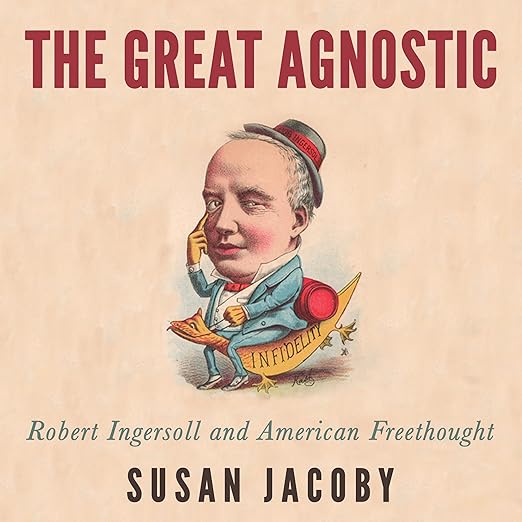
Our Take on The Great Agnostic
Jacoby, author of Freethinkers: A History of American Secularism, is an advocate rather than a neutral historian, and that advocacy shapes the book’s structure. She organizes the biography thematically rather than chronologically, a choice one reviewer praises as exactly right, it allows her to illuminate Ingersoll’s significance across issues (evolution, women’s rights, separation of church and state) without getting lost in the linear narrative of his career. The result is a portrait of a thinker rather than a timeline of a life.
Ingersoll as Jacoby renders him was remarkable for his combination of intellectual courage and genuine warmth. He wasn’t a cold skeptic performing superiority, he believed passionately in what he called “liberty of conscience,” a principle that encompassed both the religious and the nonreligious. The line one reviewer quotes is representative: no one truly knows whether God exists; believers believe it, nonbelievers don’t. His agnosticism was an epistemological position as much as a personal one, and Jacoby is right to see it as more rigorous, not less, than simple atheism.
Why Listen to The Great Agnostic
The biographical case is compelling on its own, but Jacoby spends nearly as much time on the historiographical puzzle: why was Ingersoll forgotten? Her answer involves the same cultural machinery that has always made acknowledged secularism politically fatal in America. He might have been president, she argues, had he been willing to attend church and stay quiet about what he actually thought. He refused. That refusal cost him the historical memory he deserved.
There’s also an open letter embedded in the text, addressed to the “New Atheists” of the early 2000s, Harris, Dawkins, and their circle, calling them to account for failing to claim Ingersoll as a forerunner. It’s a pointed argument about intellectual genealogy, and it lands with real sharpness in the audio format, where Jacoby’s prose gets the room it deserves to breathe.
What to Watch For in The Great Agnostic
Rich Miller’s narration serves the material adequately, though listeners who have encountered recordings of Ingersoll’s actual oratory will notice a gap between the fiery delivery described in Jacoby’s text and the temperate academic register Miller employs. This is not a significant flaw in a five-hour book, the argument carries itself, but don’t expect the narration to replicate the atmosphere of Ingersoll’s packed lecture halls.
The book is also more polemical than its scholarly apparatus suggests. Jacoby is writing with a clear contemporary purpose, to restore Ingersoll to the public conversation she believes he belongs in, and some passages tip toward the editorial. Readers who want detached biography will find the book pushing them toward conclusions. Those who share Jacoby’s premises will find it exhilarating. Be clear about which kind of listener you are before you start.
Who Should Listen to The Great Agnostic
This is ideal listening for anyone interested in American intellectual history, the history of secularism and freethought, or the long genealogy of the church-state debate. At five hours it’s accessible enough for listeners who don’t typically gravitate toward intellectual biography. Those who study the Gilded Age, who follow contemporary debates about religion in public life, or who are simply curious about why a once-famous man was systematically forgotten will find this one of the more rewarding short histories available in audio. Listeners who are practicing believers and sensitive to sustained critique of religious institutions should know the book’s orientation before committing.
Frequently Asked Questions
Does Susan Jacoby’s biography cover Ingersoll’s personal life as well as his public career?
The biography is structured thematically rather than chronologically, so it emphasizes Ingersoll’s ideas and historical significance more than the arc of his private life. Jacoby covers enough biographical context to understand the man, but this is primarily an intellectual and cultural history.
Is prior knowledge of Gilded Age American history required to follow this book?
No. Jacoby writes accessibly for general readers, and the book works as both an introduction to Ingersoll and a primer on the cultural battles of the late 19th century. Familiarity with figures like Thomas Paine or Thomas Jefferson enriches the reading but is not a prerequisite.
What is the ‘open letter to the New Atheists’ included in the book about?
Jacoby addresses contemporary atheist writers including Sam Harris and Richard Dawkins, arguing that they have failed to acknowledge Ingersoll as a forerunner of their tradition and thereby contributed to his erasure from public consciousness. It’s a pointed piece of intellectual genealogy embedded in the biographical narrative.
How does this audiobook compare to reading Ingersoll’s speeches directly?
They serve different purposes. Jacoby’s biography provides context, historical significance, and an argument about why Ingersoll matters today. Reading Ingersoll’s actual speeches, still widely available, offers a more direct encounter with his rhetorical power. The biography is the better starting point for those new to the subject.