- Narration: Grover Gardner is one of the most respected narrators in American nonfiction; his authoritative, unhurried delivery suits a biography of Bobby Jones that is equally about a man and an era, and he keeps the historical passages as engaging as the tournament sequences.
- Themes: Athletic genius and its psychological costs, the amateur ideal in a professionalizing sports culture, the mythology of sporting retirement
- Mood: Elegiac and richly contextual, the Golden Age of American sports rendered in full period texture
- Verdict: Mark Frost's portrait of Bobby Jones's 1930 Grand Slam is the finest single-subject golf biography in audio, and Grover Gardner's narration gives it the gravitas the subject deserves.
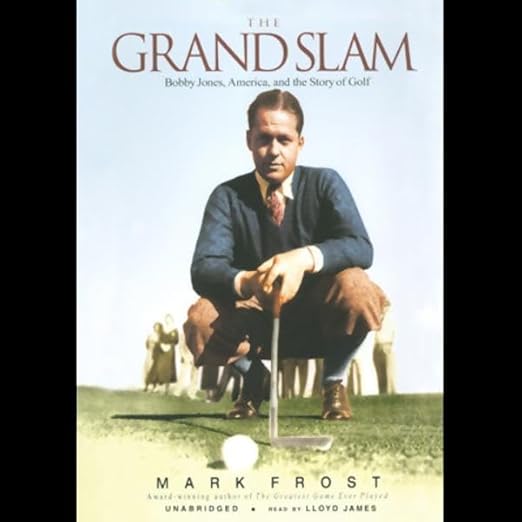
Bobby Jones won four major championships in four months during the summer of 1930 and then quit competitive golf forever at twenty-eight. No one has repeated the Grand Slam since, and the reasons Jones walked away remain one of sport's most compelling open questions. Mark Frost's The Grand Slam audiobook, narrated by Grover Gardner, arrives at both the achievement and its aftermath with the benefit of original archival research and the narrative discipline of a writer who understands that the most interesting part of a sporting life is often what surrounds the sport rather than what happens within it. Gardner's narration brings the interwar period to life with a voice that carries the weight of genuine historical storytelling.
A Hero to Project Onto Without Complication
Frost's approach distinguishes itself from conventional sports biography by situating Jones's 1930 campaign within the specific historical moment it occupied. The stock market crash had just destroyed the financial architecture of the Gilded Age. The Great Depression was beginning to reshape American public life. Into that context walked a twenty-eight-year-old amateur - self-taught, by Frost's account, which sets him apart from every peer in his era - who spent four months playing the best golf of a generation. The contrast between national economic collapse and individual sporting brilliance is not merely atmospheric; Frost uses it to explain why Jones became mythological in a way that a champion in a different era might not have. America needed a hero it could project onto without complication, and Jones, with his amateur status, his Georgia courtliness, and his eventual retirement, offered that projection perfectly.
The research is thorough. One reviewer noted that Frost provides a detailed historical setting for the events in Jones's life, and that accuracy is evident throughout the audiobook. The British Amateur Championship sequence is given the full ceremonial weight it held at the time. The British Open, the US Open, the US Amateur: each leg of the Slam gets its own contextual narrative, its own competitive cast, its own assessment of what Jones was fighting against technically and psychologically. Gardner reads these passages with the attention they deserve, neither rushing the procedural detail nor lingering in it beyond what the rhythm of the narrative requires.
Gardner's Rarest Quality Among Biography Narrators
At nineteen hours and six minutes, The Grand Slam is a commitment, and Grover Gardner's narration is a significant part of what makes that commitment worthwhile. Gardner has the rarest quality in biography narrators: he reads historical documentation, letters, and period journalism with the same level of engagement he brings to the dramatic tournament sequences, so the contextual sections never feel like interruptions. The portrait of Jones that emerges is intimate rather than reverential - a man who liked a drink, who refused to modernize his hickory shafts when steel became standard, who suffered physical ailments in later life with a stoicism that seems consistent with his competitive temperament throughout his playing career. These specific details, noted by multiple reviewers, are what keep Jones human across a narrative that has every structural incentive to turn him into a monument.
Frost's book belongs to the lineage of Golden Age sports biography that takes the period seriously as history, not nostalgia. The parallels between the 1930 cultural moment and the sporting mythologies that moment produced are explicit rather than implied, which makes The Grand Slam useful for anyone interested in the relationship between social crisis and athletic hero-making. The fact that Jones's achievement has never been repeated gives the narrative a genuine singularity - this is not the story of a record that has been broken and forgotten but of a feat that still stands as an absolute limit.
Frost also gives due weight to the role that Bobby Jones's personality played in making the Grand Slam culturally legible to a mass audience. Jones was not a remote, intimidating champion; he was a lawyer who played golf on weekends, a family man, a person who reportedly struggled with his nerves before every major championship and managed that struggle in ways that made him relatable to audiences who had never held a golf club. That combination of exceptional talent and visible human frailty is exactly what sports heroes require to cross from athletic fame into cultural mythology, and Gardner reads the passages about Jones's temperament with particular care, allowing the complexity to register without editorializing.
What Jones Achieved Matters More Than Why
Frost's focus is primarily on the 1930 season and its immediate context rather than on the full arc of Jones's playing career, so listeners expecting a cradle-to-grave biography will find the scope narrower than anticipated. The book does place 1930 within a biographical frame, but its energy is concentrated on those four tournaments and the forces that made them remarkable. Listeners who want deep coverage of Jones's earlier amateur career, his law practice, or his later role in founding Augusta National Golf Club will find that material present but not the focus. The retirement announcement and its aftermath are addressed, but Frost is ultimately more interested in what Jones achieved than in why he walked away, even though that question haunts the book's emotional final chapters. Golfers and non-golfers alike will find the narrative accessible; Frost does not assume technical golf knowledge and explains the relevant strategic elements clearly. The historical depth is an asset for general readers as much as for sports enthusiasts.
Nineteen Hours Well Spent With Gardner's Caliber
Golf enthusiasts who want the full historical and biographical context of the sport's greatest single-season achievement will find this the definitive audiobook on the subject. History listeners drawn to the Golden Age of American sports - the era of Babe Ruth, Jack Dempsey, and the confluence of mass media and athletic celebrity - will find Frost's account a strong entry point into Jones's world. General listeners who want intelligent, research-heavy biography with a clear narrative drive and a narrator of Gardner's caliber will find nineteen hours well spent. Listeners who want a fast-moving, anecdote-driven sports book without historical scaffolding will find Frost's contextual ambitions more than they bargained for.