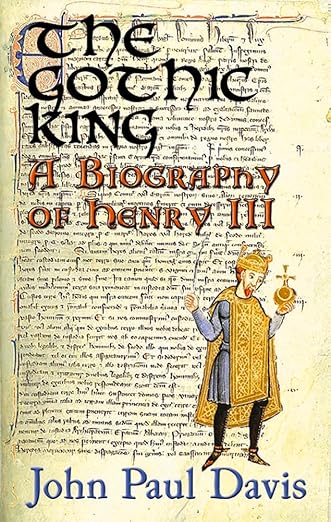
The publisher copy closes by calling this the only biography in print of a most remarkable monarch, which is an odd sentence to meet on an audiobook listing. Everything else on the record agrees with it. A page count of 240 sits in a field that should be empty. The product identifier is a ten-digit number of the kind printed on a book jacket, with a thirteen-digit version of the same number filed separately beneath it. The runtime is written as eight hrs and twelve mins, abbreviated in a way nothing else in this catalog uses. Whatever gets delivered when you buy this, the page describing it was assembled for a hardback, and nobody has finished converting it.
One of the Least Known English Monarchs
The subject deserves the attention. Henry III took the throne in 1216 as the first child king England had seen in two hundred years, the son and successor of the man the copy calls Bad King John, and then reigned for fifty-six years while the country prospered around him. Westminster Abbey is his monument, and he made it the seat of his government. He was the first English king to summon a parliament. He built castles and monumental tombs compulsively, faced down the De Montfort rebellion, fought Wales and France, and, more than his father ever did, hammered out the actual terms of Magna Carta with the barons. A 2015 five-star on the page makes the point that he remains one of the least known of all English monarchs, with almost nothing written about him.
John Paul Davis is credited in the copy with bringing forensic skills to the reconstruction, and that word is a fair description of what a biography of this reign requires: the record is thin, the chronicles are partisan, and fifty-six years of governing produce administrative traces rather than dramatic scenes. What a listener gets is a long argument for reassessment rather than a narrative with a shape. The same 2015 response reports reading the book almost straight through after it arrived in the mail, and singles out its eleventh chapter, which tells you something about the structure: this is a book with parts distinct enough that a reader remembers their numbers.
A King Usually Portrayed as Totally Inept
Rehabilitation is the reason to come. A 2013 four-star puts it plainly, saying the book gives a different picture of a king usually portrayed as totally inept, and praising how well the architectural achievements are emphasized. That is the argument in miniature. Henry III has survived in popular history mostly as his father's shadow, and Davis pushes back by pointing at what the man actually built and what he actually convened. For a listener with any interest in medieval England, hearing a familiar dismissal taken apart is more engaging than another retelling of a reign everyone already agrees was important.
Scarcity is the other draw. Biographies of Henry III barely exist, which the copy states outright and nothing in the column disputes, so this is close to the only way to spend eight hours with the reign at all. That changes the standard a buyer should apply. The question is not whether a better Henry III biography is available in audio, because the page effectively claims none is; the question is whether an accessible, argumentative, medium-length treatment of a neglected fifty-six-year reign is worth your evening. For most listeners curious about thirteenth-century England, the answer is yes.
Nothing Fills the Narrator Field on This Record
Nothing fills the narrator field on this record. No reader is credited, no studio is named as producer, and the publisher line belongs to a house that makes printed books. On a product sold by its runtime, the identity of the voice is not a minor omission; it decides whether eight hours is pleasant or punishing, and this page gives you nothing to research. Sampling before purchase moves from advisable to necessary here, and if the sample turns out to be machine-generated rather than human, that is exactly the kind of thing an uncredited slot tends to be concealing.
Sharpest of the criticisms belongs to the 2016 two-star, and it carries an audio dimension the reviewer could not have intended. The complaint is that the history is simplistic, that it desperately needed a competent editor, and that the author's use of pronouns is very confusing. Pronoun confusion in a book about a court where the same handful of names keeps recurring is survivable on paper, because you can look back up the page and work out who is meant. A listener cannot. Any ambiguity the print edition carries gets worse in audio, not better, and that single complaint is the most practically useful thing in the column.
Tolerate an Uncredited Voice or Look Elsewhere
A 2017 four-star gives the shortest accurate summary anybody has managed: a good history of a little-known king. That is the audience. Medieval enthusiasts who have already read around this period and want the gap filled, listeners who enjoy architectural and institutional history more than battlefield history, and anyone whose interest in Magna Carta extends past 1215 into the decades when its terms were actually settled. Five grades sit in the column and forty-five ratings sit above them, so expectations should be set by the texts rather than by the 4.0 badge.
One reader arrives from a direction worth mentioning: a 2018 five-star reports being a descendant of Henry III, which is its own kind of endorsement and its own kind of bias. Genealogy hobbyists will find plenty here. Taken as a print history that has been moved into audio without its production details following, this suits patient listeners who want an argument about a neglected reign and can tolerate an uncredited voice; anyone who needs narrative propulsion, a named reader, or a clean modern audio production should treat the missing fields as the warning they are.
- At its heart: A neglected fifty-six-year reign, Westminster Abbey, the first English parliament, Magna Carta after 1215.
- Vibe: Patient, corrective and institutional.
- Short version: Close to the only route into Henry III in audio, on a record that still reads like a hardback listing.
Questions Listeners Ask
Who narrates The Gothic King audiobook?
The record does not say. The narrator field is empty, no studio is credited, and the publisher named is a print house. That makes the sample the only way to find out who or what is reading, and it is the single most important check to run before buying this particular listing.
Why does this audiobook listing show a page count and an ISBN?
Because the page was built from the print edition and never fully converted. It carries 240 pages, a ten-digit identifier of the sort stamped on a book jacket, a thirteen-digit ISBN beside it, and a runtime written in an abbreviated style the rest of the catalog does not use.