Quick Take
- Narration: Clay Lomakayu reads with measured reverence that suits the sacred dialogue format – the pacing is deliberate and meditative, which some listeners will find perfectly calibrated and others may find slow.
- Themes: direct experience of the divine, religious universalism, the teacher-disciple relationship
- Mood: Contemplative and devotional, like sitting at the edge of a conversation you were not expecting to witness
- Verdict: An essential audio text for listeners serious about Hindu philosophy and Vedanta tradition, and a remarkable document for anyone curious about what sainthood looks like in practice rather than in retrospect.
There are books that reward a specific listening context and resist every other. The Gospel of Ramakrishna is one of those. I spent several early mornings with it, before the day had properly organized itself, and found it most coherent then – that particular state of wakefulness before the practical concerns of the day have fully arrived. Attempting it during a commute, I found the texture different: the dialogue’s rhythm was harder to enter, the meditative quality more resistant to interruption. I mention this not as a criticism but as practical orientation.
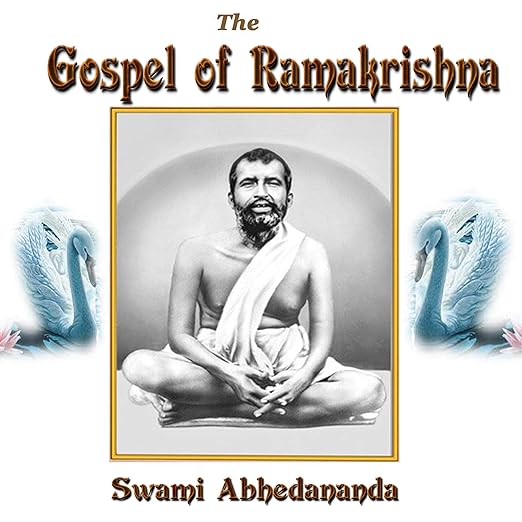
This audiobook presents Swami Abhedananda’s English rendering of the conversations of the great Bengali mystic Sri Ramakrishna, who lived from 1836 to 1886 and whose influence extended from his immediate circle of disciples – which included the young Narendranath Datta, who would become Swami Vivekananda – to English and German scholars of the Victorian period and, eventually, to serious spiritual practitioners across the Western world. The original conversations were recorded by Mahendranath Gupta, known as M, who sat with Ramakrishna through the last years of his life and documented what he witnessed with striking faithfulness.
Our Take on The Gospel of Ramakrishna
What makes this text unusual in the landscape of spiritual literature is its format. This is not a composed philosophical treatise or a hagiographic narrative written at a distance from its subject. It is a record of conversations – Ramakrishna speaking with disciples, devotees, and visitors about God, self, the nature of reality, the compatibility of religious paths, the meaning of devotion. The dialogue form gives it an intimacy that formal theological writing cannot achieve. You are, as one reviewer put it with some precision, at the feet of the master rather than reading a summary of what he believed.
Ramakrishna’s universalism is the aspect of his teaching most likely to strike contemporary listeners as remarkable. He practised multiple religious traditions – Vaishnavism, Shaktism, Tantra, Sufism, Christianity – not as a syncretic intellectual exercise but as lived devotional experience, and he came out of each practice convinced of the same underlying reality by different routes. His insistence that all genuine paths lead to the same goal was not diplomatic relativism; it was a report from direct experience, and it gives his dialogues a peculiar authority that is difficult to replicate.
Why Listen to The Gospel of Ramakrishna
Clay Lomakayu’s narration is well-suited to the material. The pacing is slower than the contemporary audiobook average, which will feel right to listeners already oriented toward contemplative practice and potentially trying to those expecting something more kinetic. The reverence in the delivery is appropriate – this is sacred dialogue, and treating it with the casual briskness of a business audiobook would be a genuine mismatch. Lomakayu reads as if the words matter, which is precisely the correct approach.
Reviewer Peter W. noted that the book transports the reader to another space and time, at the feet of this great Indian master – that the words function as nectar for the soul. That is the quality the recording successfully preserves. Another reviewer, who came to the text at what they described as the end rather than the beginning of a spiritual adventure, called it a classic that no devotee of the spirit should deny themselves. Both framings are accurate, which suggests this is one of those texts that meets listeners wherever they are in their understanding.
What to Watch For in The Gospel of Ramakrishna
The dialogues are dense with specific references to Hindu theological concepts, particular deities, and the Bengali social and religious context of the 1880s. Listeners without prior exposure to Vedanta or Hindu devotional practice will find some passages requiring patience and possibly supplementary reading. The conversations assume a certain shared vocabulary that Western listeners may need to build as they go.
At 9 hours and 45 minutes, this is not a light listen. The format – conversation after conversation, each building on and refining previous exchanges – works cumulatively rather than dramatically. There is no narrative arc in the conventional sense. The rewards are real but they come from sustained attention rather than plot momentum.
Who Should Listen to The Gospel of Ramakrishna
Practitioners and students of Vedanta, yoga philosophy, or Hindu devotional traditions will find this essential. Those with broader interests in world mysticism or the phenomenology of religious experience will encounter a document that has no real equivalent in Western spiritual literature – a primary source record of a living saint’s conversations, preserved with unusual care and now accessible in audio for contemplative listening.
Secularists and skeptics who approach the text as intellectual history will also find it worthwhile. Ramakrishna’s influence on Vivekananda, and through Vivekananda on the West’s understanding of Indian philosophy, is historically significant, and this text is the primary evidence for what that teaching actually sounded like.
Frequently Asked Questions
Do you need a background in Hindu philosophy to follow The Gospel of Ramakrishna?
Prior familiarity helps considerably. The conversations reference specific deities, philosophical concepts (Brahman, Maya, the nature of Atman), and devotional practices that assume shared context. Complete newcomers can follow the general spirit of the dialogues, but a basic introduction to Vedanta or Hindu devotional practice will make the specifics significantly more accessible.
How does Clay Lomakayu’s narration pace the material – is it slow or is that the right speed for this text?
The narration is deliberately slow and reverent, which fits the sacred dialogue format but may require adjustment from listeners accustomed to faster-paced audiobooks. For contemplative listening – early mornings, quiet time – the pacing feels correctly calibrated. For commute or background listening, it is harder to enter. This is one of those audiobooks that rewards a specific context.
Is this the full Gospel of Ramakrishna or an abridged version?
This is Swami Abhedananda’s English rendering, which is a particular adaptation of the material. The original Sri Sri Ramakrishna Kathamrita (recorded by M, Mahendranath Gupta) is considerably longer in its complete form. This audiobook presents a substantial portion of the teachings in organized dialogue form, making it accessible while preserving the essential character of the conversations.
What is the relationship between this text and Vivekananda’s teachings?
Sri Ramakrishna was Swami Vivekananda’s teacher, and Vivekananda’s interpretation and dissemination of Vedanta in the West – most famously through his 1893 appearance at the Parliament of World’s Religions in Chicago – grew directly from his years with Ramakrishna. Reading this text gives you the source material that formed Vivekananda’s foundational understanding, which makes it historically as well as spiritually significant.