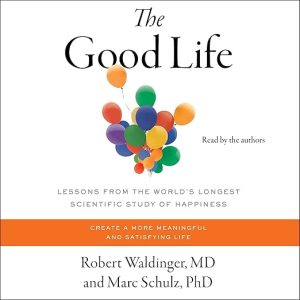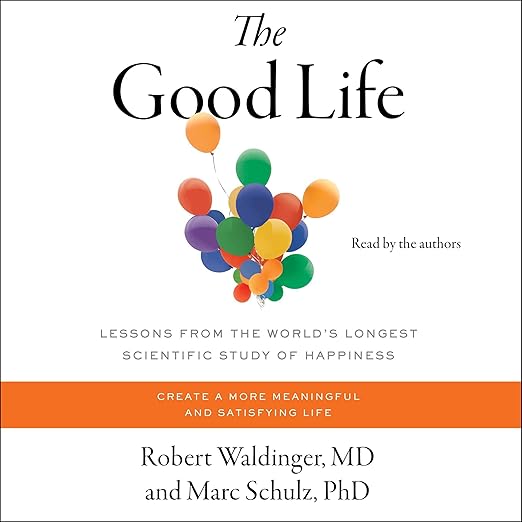
Eighty years of Harvard men, tracked from their sophomore dorm rooms into old age and, in later decades, joined by their spouses and children, form the spine of this audiobook, and I queued it up during a week spent reconnecting with a college roommate I hadn't properly spoken to in almost a decade, which turned out to be the ideal week for it. The book comes from Robert Waldinger and Marc Schulz, the current and former directors of the Harvard Study of Adult Development, confirmed directly by name in more than one attached review, and it draws on what the study itself calls the longest-running scientific investigation of happiness ever conducted. One quick note before anything else: the byline attached to this particular listing does not match the actual authorship described throughout the synopsis and reviews, so confirm the edition carefully if that matters to your purchase.
Althens's Steady Voice Matches Decades of Data
The central finding, that the strength of our relationships predicts long-term health and happiness better than wealth, achievement, or fame, isn't new exactly, but Waldinger and Schulz earn it through sheer accumulated evidence rather than assertion. Reviewer J.M. Ryan called the book 'substantive but not in any way arcane and academic,' distinctive specifically because it draws on both the decades-long longitudinal data and the authors' own extensive clinical experience treating real patients. That combination, hard data plus lived clinical practice, keeps the book from ever feeling like a dry summary of a research paper, even when it's explaining methodology.
Suzie Althens narrates with the same clear, measured steadiness she's brought to other dense nonfiction, and that restraint suits material built from decades of case histories rather than a single narrative arc. Reviewer Douglass Andrew Morrison, writing at real length about the underlying research, noted the Grant Study has occupied roughly the same position in the study of healthy adaptation that other landmark longitudinal health studies hold for cardiovascular research, a comparison that underscores just how foundational this particular body of work has become within its field. Hearing that scope explained aloud, case after case across eight decades, lands with more weight than skimming a summary ever could.
That pairing of hard data and clinical practice deserves a closer look, since it's easy to state and easy to undersell. Waldinger and Schulz aren't only summarizing decades of survey data from a distance; both have spent careers as practicing psychiatrists sitting across from real patients navigating loneliness, grief, and disconnection, and that clinical vantage point shapes which findings from the Harvard Study they choose to emphasize. A purely statistical researcher might foreground correlation coefficients; a practicing clinician foregrounds what actually helps someone sitting across from them today. The audiobook benefits from that dual perspective throughout, translating what could have been a dry summary of survey data into something that reads as genuinely, immediately usable.
Expanding a Forty-Two-Million-View TED Talk
Robert Waldinger's TED talk on this same research, titled 'What Makes a Good Life,' has been viewed more than 42 million times and ranks among the ten most-watched TED talks ever recorded, and this audiobook is effectively the full-length version of that argument, expanded with dozens of individual participant stories the eighteen-minute talk never had room for. Blurbs from Jay Shetty, Angela Duckworth, and happiness researcher Laurie Santos all point to the same thing: a popular, accessible treatment of genuinely rigorous research, not a diluted self-help gloss on real science. Duckworth's own blurb makes the distinction explicit, writing that 'in a crowded field of life advice...Schulz and Waldinger stand apart,' a claim the book backs up with actual longitudinal evidence rather than anecdote alone.
What the audiobook format adds specifically is pacing control over material that could otherwise read as repetitive on the page. Each participant's story gets room to land as its own small narrative before the book pulls back to the broader pattern, and Althens' even delivery keeps that rhythm from feeling monotonous across the full runtime. For listeners who've already watched the TED talk and wondered what a full-length treatment would add, the answer is depth: more participants, more nuance about which specific kinds of relationships matter most, and more of the authors' own clinical perspective on applying the findings.
Confirm the Edition Before You Buy
One reviewer, identified only as L.M., offered the most useful caution here: 'if you read part of the book, you've read all the book.' Their point is that once the central thesis lands, roughly a third of the way in, the rest of the material largely reinforces rather than complicates it. That's a fair critique of a book built around one well-supported finding rather than several competing arguments, and listeners wanting a wide-ranging survey of happiness research generally, rather than a deep dive into one specific, relationship-focused conclusion, should adjust expectations accordingly.
The byline mismatch on this specific listing is worth flagging again directly in this section: reviews unambiguously describe Robert Waldinger and Marc Schulz as the authors, tied explicitly to the Harvard Study of Adult Development and Waldinger's well-known TED talk, so anyone relying on the credited author field alone before purchasing should verify the actual edition first.
Worth knowing too: 'The Good Life' is a fairly common title in publishing generally, so if you're browsing by name alone rather than checking the specific description, confirm you've landed on this particular Harvard Study book rather than an unrelated title sharing the same three words. The synopsis itself, along with its direct reviewer citations of Waldinger, Schulz, and the Grant Study, is the most reliable way to confirm you have the right edition before committing to the full runtime.
Best for Fans of the Original TED Talk
Readers already interested in positive psychology and happiness research, especially anyone who found Waldinger's TED talk compelling and wanted the fuller argument, are the clearest audience. People navigating a relationship transition of their own, reconnecting with an old friend, working through a difficult marriage, or simply taking stock of who's actually in their corner, will likely find the case-study format resonates on a personal level beyond the research itself. Anyone drawn to the Harvard Study specifically, given how often it gets cited secondhand in other books and articles, will appreciate hearing the actual source material explained by the people who run it.
A rigorous statistical breakdown of the underlying research methodology is not what this audiobook offers, so readers wanting that level of technical detail should look toward the study's own published academic papers instead. Listeners wanting a wide survey of competing happiness theories, rather than one well-supported argument explored in depth, may also find the back half repetitive, per at least one reviewer's direct experience. Neither caveat undercuts the central argument's value, but both are worth knowing going in.