Quick Take
- Narration: Gordon Griffin reads with appropriate gravity – the biblical cadence of Grayling’s prose requires a narrator comfortable with measured, formal delivery, and Griffin delivers.
- Themes: Secular humanism, the nature of a good life, wisdom across civilizations
- Mood: Contemplative and formally grand – designed for slow, reflective listening
- Verdict: A remarkable intellectual achievement that works best as a dipping-in companion rather than a cover-to-cover listen – at 32 hours, that is not a criticism of the work, only a practical note about how to approach it.
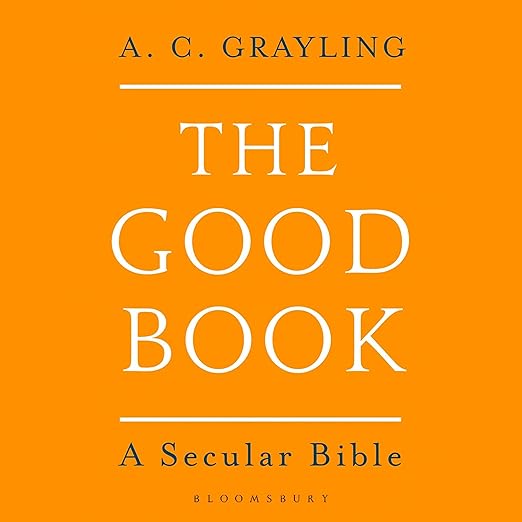
A few years ago I spent a weekend in a rented cottage with no reliable internet access and a small pile of audiobooks. One of them was a recording I had downloaded almost experimentally – a secular equivalent to sacred text, assembled from 2,500 years of non-religious philosophical writing. I had not expected it to work as audio. I expected something cold and academic, a checklist of Western thought presented in scholarly paraphrase. What I found instead was something genuinely surprising: A. C. Grayling has written a book that sounds like scripture, in the best sense of that word. Gordon Griffin reads it as if he knows that too.
The Good Book is structured, consciously and explicitly, as a secular Bible. Grayling drew from Greek philosophical tradition, Confucian and Mencian schools, classical Rome, the Arab and Indian intellectual worlds, the European Enlightenment, and the scientific discoveries of the nineteenth and twentieth centuries. He did not compile quotations. He absorbed, rearranged, and rewrote – producing prose in the register of the King James Bible that carries the substance of secular humanism across thirty-two hours of listening. The ambition of this is almost comical. The execution is not.
Our Take on The Good Book
The most important thing to understand about this audiobook is what it is not. One reviewer who came in with wrong expectations describes being pleasantly surprised: this book is not a compilation of work with passages called out by author. It is truly written in the style of the Bible – Grayling has taken the collected wisdom of hundreds of secular philosophers and melded it together in the flowery prose form typical of that tradition. That is the crucial distinction. This is not an anthology. Grayling synthesized his sources into original prose, and that prose has a genuine internal music.
The structure parallels biblical organization: there are books within the book, covering origins, wisdom, beauty, good and evil, friendship, love, and the conduct of life. The Genesis equivalent is, according to one reviewer, realistic, amazing, and awesome. That may sound hyperbolic for a secular text, but Grayling’s version of human origins – grounded in what cosmology and evolutionary biology actually suggest – is genuinely absorbing when rendered in heightened literary prose. The contrast between what sacred texts claim and what Grayling offers in their place is made through example rather than argument.
Why Listen to The Good Book
Gordon Griffin’s narration is the right choice for this material. The prose demands a certain gravity – it is not conversational, and an intimate, confessional narrator would undermine the formal register Grayling has established. Griffin reads with the measured pace appropriate to text designed to be contemplated rather than consumed. At thirty-two hours, this is one of the longer audiobooks in the nonfiction space, and the production’s quality needs to justify that commitment. It does.
For atheists, agnostics, and secular humanists who have occasionally felt the absence of a text that performs what sacred writing performs – consolation, inspiration, practical wisdom on love and death and friendship – The Good Book is the most serious attempt anyone has made to fill that space. One reviewer describes it as everything religious text should have been and is not. That enthusiasm is understandable when you encounter what Grayling has assembled.
What to Watch For in The Good Book
The most consistent criticism across reviewers is that the section called Histories is disproportionately long and less engaging than the surrounding material. One reviewer docks the book a point specifically because that section dominates about half the pages and is the most boring part. In audio form, this middle passage will test commitment. Knowing it is coming, and treating it as the document it is rather than the narrative it occasionally pretends to be, helps.
The book is also explicitly not designed for cover-to-cover consumption in a single sustained run. Grayling writes in the introduction that it is designed to be dipped into for inspiration, encouragement and consolation. At thirty-two hours, treating it as a companion text – returning to specific sections when the content is relevant to your life – is probably the most productive relationship to establish with it. One reviewer calls it gripping all the same and all true, noting she cannot read it all at once. That is the honest relationship most listeners will develop with it.
Who Should Listen to The Good Book
Secular readers who want the experiential quality of a sacred text – the formal prose, the moral seriousness, the organization around life’s central concerns – without the theological claims will find nothing else quite like this. Philosophy readers who are comfortable with synthesis rather than strict attribution will appreciate Grayling’s method. Listeners who prefer strict citation and academic sourcing may find the approach frustrating. Those who want a thirty-two-hour commitment to pay off in sustained narrative momentum should look elsewhere – The Good Book is not that kind of listen. What it offers instead is a shelf companion that will remain useful across years of occasional returns.
Frequently Asked Questions
Is The Good Book structured so that individual sections can be listened to independently, or does it need to be heard in order?
It is designed to be dipped into, as Grayling states explicitly. Individual sections on friendship, love, good and evil, and the conduct of life stand independently. Listening straight through is possible but not the intended or most rewarding approach.
Does The Good Book quote directly from philosophers like Plato, Confucius, or Montaigne, or is it something else?
It is something else. Grayling synthesized and rewrote his sources into original prose in a biblical register. You will not find attributed quotations; you will find Grayling’s distillation of 2,500 years of secular thought rendered in unified literary prose.
Is this an appropriate audiobook for someone who is not an atheist or agnostic?
The book is oriented toward secular humanism but is not hostile to religious belief. Several reviewers from religious backgrounds found value in it. It is best approached as a philosophical text rather than as an anti-religious polemic.
How does Gordon Griffin’s narration handle the 32-hour runtime without becoming monotonous?
Griffin varies his pacing across the different sections, leaning into the formal cadence of the prose throughout. Reviewers do not flag monotony as a concern – the measured delivery seems to suit the material rather than flatten it.