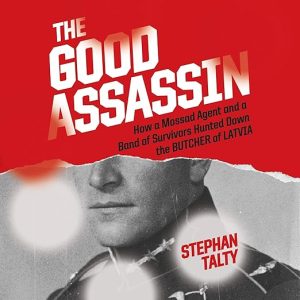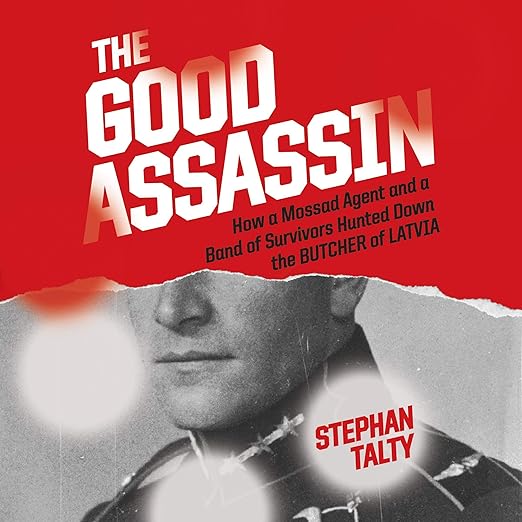
Before Herbert Cukurs fled to South America after the Second World War, he was celebrated in Latvia as his country's equivalent of Charles Lindbergh - a national aviation hero whose public image bore no visible trace of the man who would help murder thirty thousand Latvian Jews during the German occupation. Stephan Talty's The Good Assassin begins in that gap, between the beloved pioneer and the Butcher of Latvia, and spends nine hours tracking both the history of Cukurs's crimes and the Mossad operation that eventually brought him to justice. This is the audiobook for listeners who came across the story in a documentary and found the historical record incomplete.
Meidad's Cover Story Closes In on Cukurs
Talty's structural choice is to treat the Mossad operation against Cukurs as genuine spy narrative rather than dry historical summary, and the research supports that treatment. The agent Yaakov Meidad, who had previously been involved in the kidnapping of Adolf Eichmann, traveled to Brazil under an elaborate cover identity, befriended Cukurs over time, built trust through sustained contact, and ultimately carried out the assassination just as a looming statute of limitations threatened to extinguish the legal and moral accountability of ex-Nazis across West Germany. Talty works with the primary materials of that undercover operation - the meetings, the disguises, the negotiations over the Nazi pardon nearing its deadline - and presents them with the scene-setting detail of narrative nonfiction rather than academic reconstruction.
Reviewer Dave S highlighted that Talty describes Cukurs's megalomania as the factor that ultimately doomed him: even after fleeing to Brazil and establishing a new life in relative obscurity, Cukurs consented to a widely read business magazine profile that reminded the world he still existed. That detail tells you something important about how Talty works as a writer. He's interested in the human particulars - the vanity, the miscalculation, the way perpetrators of atrocity manage to maintain elaborate self-justifications - as much as in the larger historical and legal mechanisms. The man is never just a symbol in this book; he remains specific.
Reviewer SL60, who came to the book after watching a documentary, made a point worth noting: the historical documentation makes clear that the responsibility for Nazi atrocities cannot be laid only at the feet of a handful of high-ranking individuals. Cukurs was a local figure, a nationally celebrated one, who chose to participate in mass murder. The audiobook doesn't make that argument polemically, but it documents it with enough specificity that the conclusion is unavoidable. The banality at the center of collaboration is one of the book's most unsettling historical contributions.
Rudnicki Balances Latvian Horror and Brazilian Tension
Stefan Rudnicki is one of the most experienced narrators in the audiobook space, and his voice carries the particular quality this story requires: gravity without melodrama. The subject matter demands that steady, unflinching register. Talty's writing moves between the horrors of the Latvian mass killings and the cat-and-mouse tension of the undercover operation in Brazil, and Rudnicki holds both registers without letting either flatten into the other. The nine-hour runtime feels appropriately paced rather than padded; the slower central sections, where Meidad builds his cover and his relationship with Cukurs, accumulate the tension that the operation's conclusion requires.
Reviewer Carl Hopkins emphasized the book's careful documentation and noted particularly that Talty follows up with the main characters after the central events, tracking what happened to the key figures in the years that followed. That follow-through is one of the aspects that distinguishes rigorously reported nonfiction from dramatized history, and the audiobook version preserves that careful sourcing and long view in full. You leave the book knowing not just what happened in Brazil in 1965 but what the operation meant for the broader effort to hold Nazi collaborators accountable before the amnesty clock ran out.
The Directness This Subject Requires
The book covers the murder of thirty thousand Latvian Jews with the directness the subject requires, and some sections describe specific acts of violence that are genuinely difficult to process. Reviewer Hopkins wrote that it is impossible for sane people to comprehend such cruelty, and that incomprehensibility is part of what Talty is grappling with throughout. He doesn't resolve it into something manageable but keeps it present as the moral weight that the Mossad operation is responding to. Listeners should approach those sections with full awareness of what they contain.
Prior knowledge of the Holocaust in the Baltic states specifically - where local collaboration played a particularly significant and well-documented role - will enrich the listening considerably. Talty provides historical context within the narrative, but understanding the scale and specific mechanics of what happened in Latvia before the war's end gives additional weight to what he documents about Cukurs. The audiobook stands alone as a narrative but rewards the listener who arrives with that background already in place.
A Story Not Well Known Outside Specialists
Listeners drawn to the intersection of Holocaust history, intelligence operations, and narrative nonfiction will find this audiobook operating at a high level across all three categories. The story of the Mossad operation against Cukurs is not well known outside specialist circles, and Talty's treatment makes a compelling case that it should be - both for its historical significance and for what it reveals about the mechanics and real limits of postwar accountability for Nazi war crimes.
Readers who prefer their WWII history more conventionally structured and comprehensive may find the narrative-nonfiction approach less comfortable than a straightforward historical account. The book is emphatically not a light listen, and the emotional weight it carries is appropriate to its subject. Those with limited prior knowledge of the Holocaust in Latvia may want some background context before starting, in order to fully appreciate the specific dimensions of Cukurs's crimes and the operational stakes that Talty documents with such care.
The Short Version
- Narration: Stefan Rudnicki brings the appropriate gravity to Talty's account of the Mossad operation, with a measured pacing that suits the slow-burn undercover narrative.
- Themes: Holocaust accountability, espionage and identity, the limits of international justice
- Mood: Tense and morally weighty, sitting at the crossroads of investigative history and spy narrative
- Verdict: Stephan Talty reconstructs a nearly forgotten chapter of Holocaust history with enough primary research and narrative intelligence to make the nine-hour listening experience feel necessary.