Quick Take
- Narration: Michael Page’s precise, scholarly delivery suits Fauvelle’s fragmentary evidence approach, lending authority to a book built on gaps as much as discoveries.
- Themes: Medieval African civilizations, the archaeology of absence, trade networks across the Sahara and Indian Ocean
- Mood: Meditative and detective-like, each chapter a small act of historical reconstruction
- Verdict: Fauvelle’s episodic approach to medieval Africa is unlike anything else in the genre, short enough to finish in a single sitting but dense enough to stay with you long after.
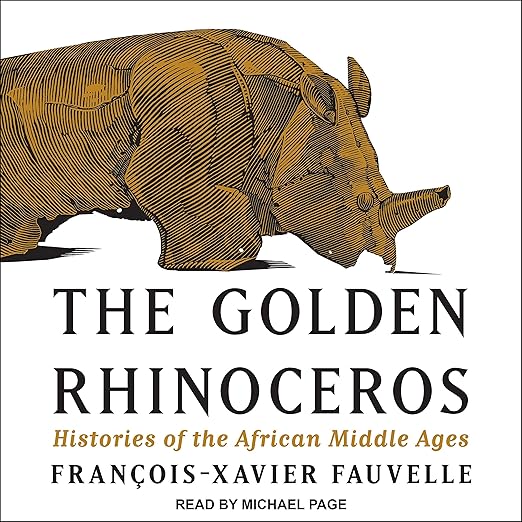
I came to The Golden Rhinoceros knowing almost nothing about medieval Africa beyond the broad outlines most Western education provides, the Mali Empire, Mansa Musa, perhaps Timbuktu as a word rather than a place. What I did not expect was the form the book would take. François-Xavier Fauvelle is a French archaeologist and historian, and he has organized this book not as a conventional narrative but as a series of short chapters, each built around a single fragment of evidence: a piece of gold jewelry, a ruin in the mangroves, a sentence in a medieval Arabic travel account, the famous rhinoceros of Mapungubwe rendered in hammered gold foil.
This structural choice, which I initially found disorienting, becomes the book’s greatest strength by the third or fourth chapter. Fauvelle is honest about what he does not know. He will describe what archaeologists found at a particular site, tell you what the objects suggest and what they cannot confirm, and then sit in the uncertainty without forcing a false resolution. This is unusual intellectual honesty in popular history, and it produces a kind of reading experience closer to good archaeology writing than to the triumphalist narratives that sometimes accompany African history.
What a Golden Rhinoceros Can and Cannot Tell You
The object at the center of the book’s title was found at Mapungubwe, a site in what is now South Africa near the borders of Zimbabwe and Botswana. The rhinoceros, a small, exquisite figure made of hammered gold foil wrapped around a wooden core, was buried in a royal grave around 1250 CE. It represents a civilization that was trading gold and ivory across the Indian Ocean, that had developed a sophisticated stratified society, and that has left almost no written record of itself.
Fauvelle uses this object as an emblem for his whole project: to reconstruct a history from fragments that do not explain themselves. The written sources he can draw on are predominantly Arabic, traders, geographers, travelers from the Islamic world who encountered sub-Saharan Africa from the north and east and wrote down what they saw. Fauvelle reads these accounts with a scholar’s caution, aware that they were written by outsiders with their own distortions and purposes. The result is a history that is honest about its own limitations in a way that makes it more rather than less convincing.
The Geography of a Forgotten World
One Audible reviewer recommended having some background in medieval African history before approaching this book, and that advice is worth taking seriously. Fauvelle moves between the Sahara, the Nile Valley, the Ethiopian highlands, the Swahili coast, and the interior of southern Africa, and the chapters do not always signal clearly how they relate to one another geographically or chronologically. The book is organized thematically and by region rather than as a linear narrative, and listeners who try to follow it as a conventional history will find it elusive.
If you approach it instead as what it actually is, a collection of illuminated fragments, each casting light on a different corner of a largely undocumented world, the experience becomes much more rewarding. The chapter on the Swahili coast trading towns sits in productive tension with the chapter on the gold trade routes through the Sahara. Read in sequence, they build a picture of Africa as a connected hub of global commerce in the period from roughly 700 CE to 1400 CE, not a peripheral backwater. This is the book’s central historical argument, and Fauvelle makes it through accumulation rather than assertion.
Page and the Pace of Archaeological Thinking
Michael Page is well suited to this material. His narration is measured and precise, which fits a book written by a scholar who weighs his words carefully. Fauvelle’s prose has been translated from the French and retains a slightly formal, Gallic quality that Page honors rather than smooths away. There is no attempt to inflate the dramatic stakes of passages that are fundamentally about what we do not know, and that restraint is correct.
At just over seven hours, this is the shortest audiobook in the current batch by a significant margin, and that compression is both a feature and an occasional frustration. Some chapters feel almost too brief to do justice to the evidence they present. But the economy of the book is intentional, Fauvelle is not trying to write the comprehensive history of medieval Africa, and he says so. He is trying to show that such a history is possible, and to suggest its outlines through these carefully chosen fragments.
Who Should Listen / Who Should Skip
Listen if you are curious about African history beyond the colonialism-and-slavery framework that dominates most Western treatments, and want something written with genuine scholarly rigor. Listen if you enjoy episodic, fragmentary historical writing, the pleasure here is similar to reading a collection of precisely observed essays rather than a conventional narrative.
Skip if you need a continuous story with clear protagonists and a narrative arc. Skip if you want comprehensive coverage of any single civilization or region, this is a book of glimpses, not a panorama. And as one reviewer noted, some background in the period will make the experience richer; this is not the ideal first book on African history, but it is a superb second or third one.
Frequently Asked Questions
Is The Golden Rhinoceros organized chronologically, or is it something else?
The book is organized thematically and geographically rather than chronologically. Each chapter focuses on a specific archaeological or textual fragment from a different region and period within the broad span of 700 to 1450 CE. Listeners expecting a linear narrative will find it disorienting at first, but the episodic structure becomes the book’s distinctive strength once you adjust to it.
What is the golden rhinoceros itself, and why does it give the book its title?
The golden rhinoceros of Mapungubwe is a small figure made of hammered gold foil wrapped around a wooden core, found in a royal burial site in what is now South Africa near the Zimbabwean and Botswanan borders, dating to roughly 1250 CE. For Fauvelle it represents the entire project: a society wealthy enough to produce extraordinary art, connected to global trade networks, and almost entirely absent from written history. It is an emblem of what archaeology can recover and what remains out of reach.
Do you need prior knowledge of African history to get value from this audiobook?
Some background helps. Fauvelle assumes readers have a general orientation to the continent’s geography and the broad contours of its medieval civilizations. Listeners coming to this completely fresh may find the chapter-by-chapter movement between regions and periods difficult to follow. If African history is entirely new to you, starting with a broader survey before this book will make the experience considerably richer.
How does Fauvelle handle the problem that most medieval African civilizations left no written records?
With admirable intellectual honesty. He draws primarily on Arabic accounts from traders and geographers who encountered sub-Saharan Africa from the north and east, reads them with careful attention to their biases, and combines textual evidence with archaeological findings. Where the evidence is ambiguous or absent, he says so directly rather than papering over the gap. This makes the book more rather than less reliable as a historical source.