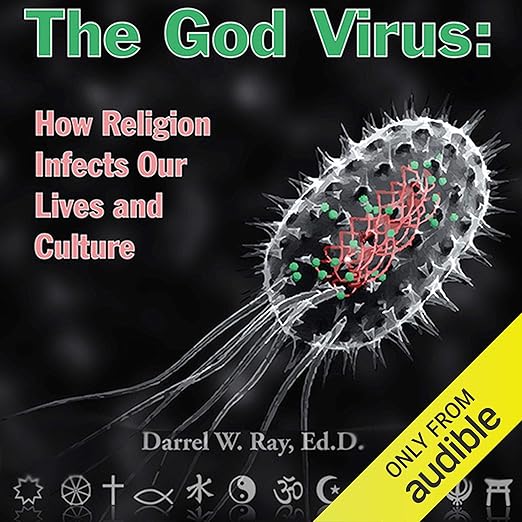
Quick Take
- Narration: Darrel Ray narrates his own work, and his background as a psychologist gives the delivery an analytic calm that prevents the provocative thesis from feeling like polemic.
- Themes: Religion as memetic contagion, psychology of belief, institutional self-protection in religious organizations
- Mood: Measured and analytical, with moments of uncomfortable specificity about familiar religious dynamics
- Verdict: An accessible and rigorously structured application of viral and memetic frameworks to religious psychology; most valuable for listeners who want analytic tools rather than simple atheist arguments.
I came to The God Virus already familiar with Richard Dawkins’s concept of memes as units of cultural transmission, which is the theoretical foundation Darrel Ray builds on here. What I did not expect was how specifically Ray would apply that framework, moving from the broad analogy of religion as a mental virus into granular case studies: the psychology of fallen megachurch ministers, the mechanisms by which religious organizations protect clergy who abuse their authority, the function of survivor guilt in sustaining belief across generations. The book is more precisely argued than its title might suggest, and considerably more uncomfortable than a broad-stroke atheist polemic would be.
Ray is a psychologist, not primarily a philosopher or a polemicist, and that disciplinary background shapes both the content and the tone throughout. He is interested in how religious belief functions behaviorally and institutionally, in what mechanisms sustain and spread it, and in what the viral framework explains that conventional critiques of religion do not. The audiobook runs just under seven and a half hours and is narrated by the author himself, published through Dogma Debate LLC, which Ray founded after decades of professional practice in psychology.
The Viral Analogy and Its Explanatory Power
The book’s central claim is that religion operates similarly to a biological virus in identifiable and traceable ways: it has infection strategies, it exploits existing psychological vulnerabilities, it has mechanisms that prevent competing beliefs from gaining purchase once a host is infected, and it uses the behavior of its hosts to propagate itself across generations and social networks. Ray traces this analogy with care rather than looseness, drawing distinctions between how different religious traditions implement the same basic viral dynamics in culturally specific forms.
One reviewer described the idea as funny in its aptness while finding it very true: once a host is infected by one religious virus, competing religious viruses typically cannot enter the brain. This is not a new observation about exclusive belief systems, but the viral framing gives it analytic precision. Ray uses it to explain phenomena that theological critique and political analysis typically handle less well: why people maintain faith in the face of evidence that appears to contradict it, why specific religious communities produce specific behavioral patterns, and why attempts at rational argument so rarely succeed in changing deeply held religious belief in adults.
From Abstract Framework to Specific Cases
The book’s most consequential section is its analysis of institutional religious organizations rather than individual belief. Ray examines how religious institutions develop self-protective mechanisms, and his treatment of clergy sexual abuse cases as a systemic rather than individual phenomenon is both carefully argued and deeply uncomfortable to listen to. The viral analogy holds here in a specific way: institutions that have evolved to survive and propagate will develop behaviors that protect the institution’s survival even at the cost of individual members, and Ray traces this pattern consistently across denominational lines and geographic contexts.
One reviewer praised the organization and presentation as very well written, noting that Ray gives countless examples to support his thesis throughout the book. Another called the book enlightening and somewhat scary, a response that captures how the mechanistic framework strips away the protective familiarity of talking about religion in purely spiritual or cultural terms. When you apply the language of epidemiology to belief systems, the resulting analysis has a clinical quality that can feel genuinely disorienting even for readers who approached the subject with some skepticism about religion already in place.
What Ray’s Self-Narration Adds
Author narration in nonfiction is a gamble. The argument for it is that nobody understands the material better or knows which emphases matter most. The argument against is that most authors are not trained to perform prose for audio delivery. Ray is a credible exception because his professional background is in oral communication: he has lectured, counseled, and podcasted for years before this recording. The result is a delivery that has the quality of an informed lecture rather than a performed text, which suits the analytical register of the material particularly well.
The book owes an acknowledged debt to Dawkins and to the broader tradition of scientific critique of religion. Ray is explicit about this debt and clear about where he believes he extends the framework rather than simply restating it. The personalization of the viral concept, the movement from abstract theory to specific case studies of recognizable religious dynamics, is his genuine contribution. For listeners who have already read Dawkins or Hitchens and want the next level of analytic specificity applied to psychology and institutional behavior, The God Virus is a natural and substantive extension of that conversation, delivered with the measured calm of a researcher who has spent decades thinking through the evidence.
Audience Fit and the Framework’s Limits
The God Virus carries a 4.6 rating across 559 listeners, which is notably strong for a book whose central thesis will be immediately alienating to a substantial portion of the general public. The rating reflects a self-selected audience of readers who arrived already open to the framework and found Ray’s execution of it rigorous and illuminating. One French reviewer called it indispensable for understanding how religions function as mental viruses, referencing both Dawkins’s meme theory and the book’s accessibility for readers approaching the subject without prior background. The book is most useful for people who want to understand why religion is so persistent and powerful without defaulting to theological or purely political explanations. It is not the right tool for listeners seeking a philosophical debate about whether religious claims are true. Ray is not interested in that question. He is interested in how the belief spreads, sustains itself, and protects its own transmission. That distinction is the key to understanding whether this book is for you.
Frequently Asked Questions
Is The God Virus primarily an argument against religion or an analysis of how religion functions?
Primarily the latter. Ray is a psychologist applying a specific analytic framework to religious phenomena rather than a philosopher making a theological argument. The tone is analytic rather than polemical, and the book’s value lies in its explanatory precision rather than in persuasion.
Does The God Virus require prior familiarity with Richard Dawkins’s concept of memes?
Ray introduces the relevant concepts without assuming prior knowledge, though familiarity with Dawkins’s The Selfish Gene or The God Delusion will give listeners additional context. The viral analogy is explained carefully enough that listeners new to the framework can follow the argument without prior exposure.
How does Darrel Ray’s background as a psychologist affect the content of The God Virus?
His disciplinary background shapes the book substantially. Rather than engaging in philosophical debate about the truth claims of religion, Ray focuses on behavioral mechanisms, institutional dynamics, and psychological processes. This makes the book more useful as an analytic tool and less useful as a theological argument.
Is this audiobook appropriate for listeners who are religious or who come from religious backgrounds?
Ray’s tone is analytic rather than contemptuous, and he is careful to distinguish between religious individuals and the institutional dynamics he critiques. One international reviewer found the framework illuminating without finding it hostile. That said, the core thesis treats religion as a viral phenomenon, and listeners who hold faith claims to be beyond psychological or sociological analysis will find the framework fundamentally incompatible with their prior commitments.