- Narrator: Nicholas Coleridge narrates his own memoir and does celebrity impressions, Kate Moss to Prince Charles, that a hired narrator simply could not replicate.
- Subjects: Magazine publishing, celebrity access, British media history
- Tone: Gossipy, warm, and occasionally scattered
- Bottom line: A rich, name-dropping insider memoir that works better in audio than in print, best suited to listeners already curious about the Wintour-Brown magazine era.
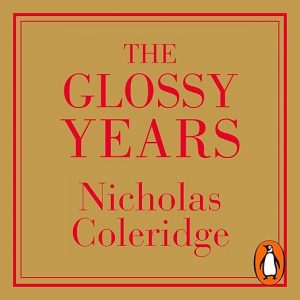
Nicholas Coleridge's Glossy Years earns its long runtime through pure access rather than tidy structure, and that trade-off is worth making. Thirty years inside Conde Nast gave Coleridge a front-row seat to Princess Diana's anxieties, Mohamed Al-Fayed's temper, and a surreal weekend spent with Bob Geldof and William Hague, and he narrates his own audiobook with the same relish he clearly brought to collecting these stories in the first place.
Written and read by Coleridge himself, this thirteen-hour-and-thirty-five-minute audiobook, brought to listeners by Penguin, holds 4.2 out of 5 from 332 ratings on Audible, a solid validation for a British-industry memoir that assumes some familiarity with names like Tina Brown and Anna Wintour going in.
Coleridge's Delivery Softens Too Many Names
The book's real subject is the glamorous world of glossy magazines itself as much as Coleridge's own career inside it, and the synopsis's own promise of 'astonishing candour' mostly holds up. He moves fluidly between fashion, journalism, museums, Coleridge later chaired the Victoria and Albert Museum, and the wider sweep of British society, with figures like David Bowie, Philip Green, Kate Moss, and Beyonce passing through as supporting characters in a life that treats access as its own kind of narrative engine. The memoir works best read as a collection of vivid encounters rather than a single throughline, which is both its charm and its structural weakness.
Reviewer Matthew Kennedy put his finger on a real tension: the book is 'a little bit less than the sum of its parts,' with stories that end abruptly and, in his words, 'too many lists of names.' That is a fair criticism of the prose on the page. What the audio version does, though, is soften exactly that flaw, since Coleridge's own delivery gives even the list-heavy passages a conversational momentum that print cannot replicate.
The title itself is doing quiet double work. 'Glossy' names the physical stock magazines are printed on, the industry's own shorthand for itself, while also carrying a faint edge of superficiality, the surface shine of a world Coleridge is simultaneously celebrating and gently interrogating. That tension between affection and clear-eyed distance runs through the whole book: he clearly loved this world, and just as clearly saw its absurdities up close.
The synopsis's own phrase, that Coleridge writes 'with relish,' is an accurate description of the book's actual tone. This is not a memoir written with the reluctant remove of someone slightly embarrassed by the glamour they witnessed; Coleridge is openly enjoying the telling, and that unguarded relish, rather than false modesty, is a large part of why the audiobook version in particular works as well as it does. A performer holding back or apologizing for the material would undercut exactly what makes his delivery compelling.
Impressions of Kate Moss to Prince Charles
The impressions are the audiobook's real argument for existing over the printed page. Kennedy singles out Coleridge's 'impressions of everyone from Kate Moss to Prince Charles' as the thing he enjoyed most, and that is consistent with what self-narration adds here: a memoir built on decades of watching powerful, famous people up close becomes measurably richer when the narrator can actually do their voices rather than just describe their mannerisms in prose. This is a case where hiring a professional narrator, however skilled, would have quietly subtracted the book's best trick.
Victoria Taylor Allen calls the prose itself clear and full of intelligence, and points specifically to how plainly Coleridge conveys his love for his education, work, and friends, which lands differently in audio, where warmth is carried in tone as much as word choice. For listeners interested in publishing history specifically, the insider view of Vogue, Vanity Fair, and Tatler under Wintour and Brown's respective reigns offers a level of texture that outside journalism about the same era rarely captures, since Coleridge was inside the rooms where those decisions were made.
Coleridge's proximity to Diana, Princess of Wales specifically carries a particular historical weight beyond simple celebrity gossip. The synopsis singles out her anxieties as one of the book's throughlines, and an editor who watched the tabloid machine up close during that era offers a genuinely different vantage point than the many outside biographies and documentaries already covering the same period, one rooted in firsthand industry proximity rather than after-the-fact reconstruction.
Filed Under Education, Built From Decades of Access
This is a memoir for listeners who already know, or want to learn, who Tina Brown, Anna Wintour, and Philip Green are. Reviewer gammyjill, an American reader, admits upfront that she cannot offer a simple reason for a fellow American audience to pick this up, beyond Coleridge himself having lived 'a very interesting life.' That is an honest signal: the book assumes a British-media-literate audience, or at least one willing to look up unfamiliar names as they come up, rather than building that context in for outsiders.
Kennedy's structural complaint is worth taking seriously too. Stories genuinely do end abruptly here, and the sheer volume of names, useful as raw material, occasionally overwhelms the narrative thread. At over thirteen hours, listeners wanting a tightly plotted single narrative rather than an anecdote-driven mosaic should adjust expectations before starting, since this plays closer to decades of dinner-party stories than one sustained arc.
One data quirk worth flagging for browsers: this title is filed under an education and publishing-craft category in some listings, which undersells what the book actually is. This is a personal memoir built from decades of access, not a how-to guide for magazine editors or aspiring journalists, and listeners hoping for career advice on breaking into publishing should adjust expectations toward anecdote and access rather than instruction.
Insider-Access Readers Over Tight Narrative Seekers
Anyone with a genuine interest in magazine publishing, British media history, or the Wintour-Brown-era fashion world will find this rewarding, especially in audio where Coleridge's mimicry does real work. Listeners who enjoy insider-access celebrity memoirs generally, the kind built on decades of proximity rather than a single dramatic event, are the natural audience, as are longtime readers of Vogue, Tatler, or Vanity Fair curious what things looked like from the editor's chair rather than the reader's.
Skip this if you need a tightly structured narrative arc rather than an anecdote collection, or if you have little baseline interest in British publishing and celebrity culture from the 1980s through the 2000s. Readers outside that world, per gammyjill's own honest admission, may need Coleridge's charm alone to carry them through, and that charm, while real, works better in short bursts than across the full runtime.
Good to Know
Does Nicholas Coleridge narrating his own audiobook actually add anything over a professional narrator?
Considerably. Reviewers specifically call out his impressions of figures like Kate Moss and Prince Charles as a highlight, something no outside narrator could reproduce from the page alone.
Is The Glossy Years audiobook more of a structured narrative or a collection of anecdotes?
Closer to a mosaic of anecdotes than one throughline. A reviewer notes some stories end abruptly and the book leans on long lists of names, a real trade-off for the sheer access on display.