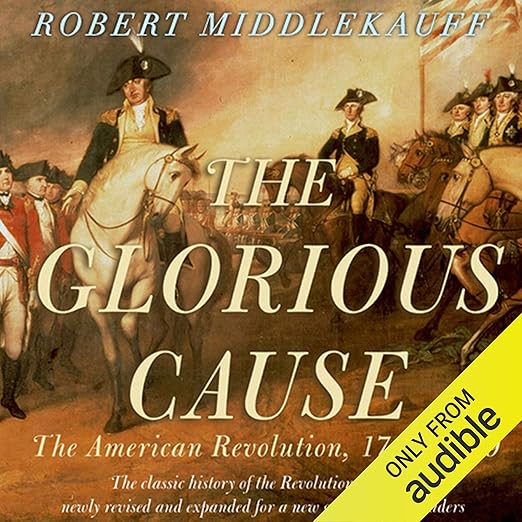
I came to The Glorious Cause after several years of reading around the American Revolution in smaller pieces, specific biographies, military histories, focused treatments of particular battles or constitutional moments. What I had not done was read the whole period in one sustained, comprehensive account, from the French and Indian War through the ratification of the Constitution. Robert Middlekauff's volume, the inaugural entry in the Oxford History of the United States and a Pulitzer Prize finalist, is the book for that purpose, and the audiobook narrated by Robert Fass gave me the form in which I finally committed to doing it properly.
Nearly 27 hours is a significant investment of time in any single text, and it is worth being straightforwardly honest about what The Glorious Cause demands of its listener: sustained attention, some prior orientation to the period and its major figures, and a genuine willingness to engage with a work that prioritizes comprehensive analysis and intellectual depth over pure narrative propulsion. What it returns on that investment is the fullest account of the Revolutionary period available in a single volume, the kind of work that gives you not just the sequence of events but the texture of how colonists actually perceived those events, the beliefs that shaped their responses, and the genuine contingency of outcomes that seem inevitable only in retrospect.
First, the Big Picture
The book begins not with 1776 but with the French and Indian War, and this choice is deliberate and analytically important. Middlekauff's argument is that the Revolution cannot be honestly understood without grasping the transformed relationship between Britain and its American colonies that the earlier war produced, the new fiscal pressures on the British crown, the new military confidence and political consciousness of American colonists, and the first significant tensions over taxation and representation that followed in the war's wake. The period from 1763, when the book's subtitle begins, to the shot heard round the world is treated with a patience that some listeners will find slow and others will recognize as the only intellectually honest way to build the argument.
The military history, when it arrives, is handled with the same analytical care as the political and social material. Middlekauff does not allow the drama of specific battles to overshadow the larger strategic picture, but he also understands that battles are fought by individuals under specific conditions of fear, exhaustion, cold, and moral conviction, and he brings those individual experiences into the narrative at precisely the right moments to prevent the analysis from becoming abstract.
Why Listen to The Glorious Cause: The American Revolution: 1763-1789
What sets The Glorious Cause apart from more narrative-driven accounts of the Revolution is Middlekauff's sustained and serious attention to how colonists perceived their situation as it unfolded. The importance the colonists assigned to the events of their struggle, as the synopsis frames it, is not merely background context but the central analytical concern of the entire book. Middlekauff is deeply interested in why the ideas that drove the Revolution were so compelling to the people who held them, what traditions of English political thought they drew on and transformed, and how those ideas shaped their responses to specific British actions in ways that were neither inevitable nor simply reactive.
This intellectual dimension is what gives the book its enduring value as both scholarship and as a reference for serious readers. Reviewers consistently note that it functions as an outstanding starting point for the Revolutionary era, not a book you read once and shelve, but one you return to when a specific question about the period or a specific figure demands context. One reviewer called it impossible to put down and essential for every home, which may overstate the case for casual listeners but accurately reflects the experience of a serious history reader who has been looking for precisely this level of treatment.
A Few Reservations
The Oxford History series description calls Fass's narration engagingly casual in warmth, and this is exactly the quality that makes the audiobook work at this extraordinary length. Fass reads like an intelligent person who has genuinely engaged with the material and has something to say about it, rather than like a voice actor performing a text they encountered professionally in a recording booth. His pacing is calibrated to the varying density of the argument, he does not rush the analytical passages but maintains the narrative sections at a pace that prevents the listener from losing the thread across hours of complex material.
Twenty-seven hours of any narration will test a listener's endurance, and Fass is consistent enough throughout the full runtime that the later sections, the Constitutional period, the debates over ratification, the arguments about the nature of the republic being formed, do not feel like an endurance exercise. He brings the same quality of presence and attention to the final hours that he brings to the first, which is a genuine achievement in long-form nonfiction narration.
The Right Listener for The Glorious Cause: The American Revolution: 1763-1789
The Glorious Cause is not the right starting point if you are new to the Revolutionary period and want an accessible, shorter introduction. For that purpose, something more narrative-driven and compressed would serve better as a first approach. But if you already have the background and are looking for the best comprehensive audio treatment of the period available, the kind of account that will serve as a foundation for all your subsequent reading about the founding era, this Pulitzer Prize finalist at $0.00 on Audible is the obvious choice. It is the kind of history audiobook that serious listeners return to over years.
Frequently Asked Questions
Is The Glorious Cause appropriate for listeners new to the American Revolution, or does it assume prior knowledge?
Middlekauff provides substantial historical context and explains key figures and events as they arise. However, at nearly 27 hours of dense analytical history, it is better suited to listeners with some prior familiarity who want comprehensive treatment rather than a first introduction. New students of the period might benefit from a shorter narrative account first.
The Oxford History of the United States has multiple volumes, does The Glorious Cause require reading the other volumes alongside it?
No. Each volume in the series stands independently. The Glorious Cause covers the period from 1763 to 1789 comprehensively and does not require knowledge of the other volumes. The series numbering refers to chronological position in American history, not a reading prerequisite.
How does the 2005 updated edition used in this audiobook differ from Middlekauff's original 1982 publication?
Middlekauff substantially revised the text for the 2005 second edition, incorporating subsequent scholarship and addressing weaknesses in the original. This Audible Studios audiobook from 2011 is based on the updated edition, which is the standard version for both academic and general readers.
Is The Glorious Cause available as a free audiobook on Audible?
Yes, it is currently listed at $0.00 on Audible. At nearly 27 hours of serious historical scholarship, this represents significant listening value. Check the Audible listing for current availability, as pricing on free audiobooks can change.