Quick Take
- Narration: Mark Whitten reads Rodrik’s argument-driven prose with clarity and appropriate gravity, handling the economic history sections without letting them become dry.
- Themes: The limits of hyperglobalization, national sovereignty vs. international markets, the impossible trilemma of open economies
- Mood: Scholarly and engaged, occasionally pointed, never polemical
- Verdict: One of the most rigorously argued cases for rethinking global trade architecture available in audio form.
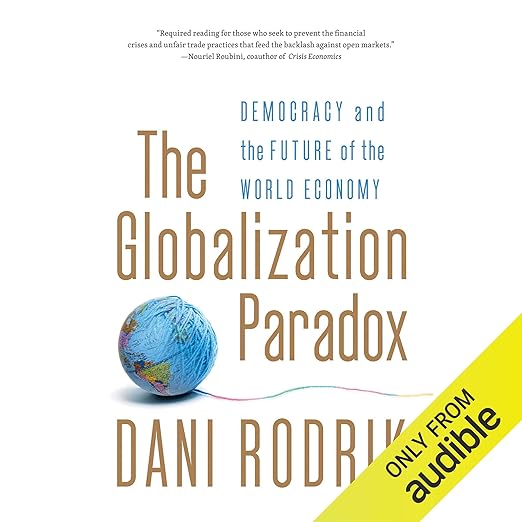
I returned to The Globalization Paradox recently after reading a stack of newer books on trade policy and economic nationalism, and what struck me immediately was how well Dani Rodrik’s central argument has aged. The book was published in 2011, and the decade and a half since have provided a series of tests for his framework that he could not have anticipated but that his analysis seems almost designed to explain. That is the mark of a genuinely good economics argument: it does not just describe what has already happened, it helps you understand what keeps happening.
Rodrik is a Harvard economist who has spent most of his career working on the relationship between trade, development, and national institutions. He is not an anti-globalization polemicist. He is something more interesting and more difficult to categorize: a free-trade economist who believes that the ideological form globalization has taken in recent decades has outrun both its theoretical justifications and its practical sustainability. His central contention is that democracy, national sovereignty, and deep economic integration form an impossible trinity. You can have two of the three, but not all three simultaneously, and the consequences of pretending otherwise are what he calls the globalization paradox.
The Impossible Trinity and Why It Matters Now
The analogy Rodrik draws from Robert Mundell’s triangle of impossibility, the famous economic trilemma that says you cannot simultaneously maintain a fixed exchange rate, free capital flows, and an independent monetary policy, is intellectually elegant. He applies the same logic to a broader set of constraints: when democratic polities and supranational economic institutions come into direct conflict, something gives. The question is what, and who decides. His historical case studies, which run from the gold standard era through Bretton Woods to the current WTO regime, are the backbone of the argument and the part of the book that most rewards close attention.
One reviewer, who described having been involved in the Uruguay round of GATT negotiations, noted that Rodrik provides a well-studied treatment of issues that must not be ignored if free trade is to operate effectively. That response is interesting because it comes from someone with direct professional investment in the framework Rodrik is critiquing. The book’s ability to engage even committed free-traders seriously, rather than dismissing them, is one of its genuine virtues. Rodrik writes with what another reviewer called good-natured critique, and that description is accurate: he is not trying to demolish globalization but to make it sustainable.
Rodrik’s Historical Method
The most consistently praised element of the book in reviews is the use of historical case studies to ground abstract economic arguments. Japan’s Meiji restoration industrialization, China’s unorthodox path to export competitiveness, the Asian developmental state model, the Latin American experience with capital account liberalization: all of these get substantive treatment as examples of how the relationship between markets and institutions actually plays out rather than how orthodox theory says it should. One reviewer, clearly a graduate student in economics, described the constant references to historical experience as the book’s greatest strength and praised the coherent argumentation and informative footnotes.
Rodrik’s prose is accessible without being dumbed down. He explains Mundell’s triangle to readers who may not know it, but he does so briefly and moves on rather than over-explaining. The audiobook format suits the essay-argument structure of the chapters, each of which develops a distinct component of the overall case. At nearly eleven hours, the runtime reflects the genuine scope of the intellectual project, and the material holds attention throughout because the argument builds rather than repeating itself.
Mark Whitten and an Argument-Driven Text
Mark Whitten reads Rodrik’s argument-driven prose with the kind of steady authority that economics and policy writing requires. He does not make the material more exciting than it is, which would be a mistake: the book’s persuasiveness comes from the accumulation of evidence and the precision of the logic, not from rhetorical fireworks. Whitten handles the transitions between historical narrative, economic theory, and policy prescription smoothly, which matters in a book that moves between registers as frequently as this one does. The passages that involve direct quotation of economic history, or the summaries of specific policy debates, are all rendered with appropriate clarity.
One reviewer summarized the book as playing on at least two levels of understanding, with a surface that reads easily and a sub-surface of subtleties that rewards rereading. The audio format captures the surface level excellently. The subtleties may require a second pass for listeners who want to fully absorb the policy implications of specific sections.
Who Navigates This Paradox
Graduate students and advanced undergraduates in economics and political economy will find this essential reading in the sense that it presents a coherent heterodox challenge to mainstream trade theory in a rigorous and historically grounded form. Policy professionals and interested general readers who follow trade debates in the news will find it provides intellectual scaffolding for understanding why specific trade conflicts keep happening. Listeners who want a straightforward case for or against globalization will find Rodrik’s nuanced position frustrating. He is not offering simple answers, and his proposed framework of moderate globalization within a light architecture of international rules will satisfy neither free-trade absolutists nor economic nationalists. That dissatisfaction from both sides is probably an indication that he is onto something.
Frequently Asked Questions
Is The Globalization Paradox accessible to listeners without an economics background?
Yes, with some effort. Rodrik explains technical concepts like Mundell’s impossible trinity and the economics of capital account liberalization in accessible terms. The historical case studies are the most immediately readable sections, and readers with a general interest in global economics and trade policy will follow the main argument without specialized training.
How has Rodrik’s central argument held up since the book was published in 2011?
The argument has aged remarkably well. The subsequent decade of trade nationalism, Brexit, and WTO disputes has provided extensive evidence for the tensions Rodrik describes between democratic polities and supranational trade institutions. The framework predicts the kind of backlash that has emerged from hyperglobalization better than most mainstream trade economics.
Does Rodrik advocate for deglobalization, or is his position more nuanced than that?
His position is considerably more nuanced. He argues for a moderate, customizable form of globalization supported by light international rules that leave room for national policy experimentation, particularly for developing economies. He is not arguing against trade or global markets but against the ideological form of deep economic integration that leaves no space for democratic national priorities.
What is the impossible trilemma at the book’s core, and why does it matter for everyday economic policy?
Rodrik’s trilemma states that hyperglobalization, national sovereignty, and democratic politics cannot all coexist simultaneously. Pushing for deep global economic integration inevitably constrains either democratic policy-making or national institutions. This matters practically because it explains why trade agreements keep generating political backlash: they require nations to give up policy tools that democratic electorates are not willing to surrender.