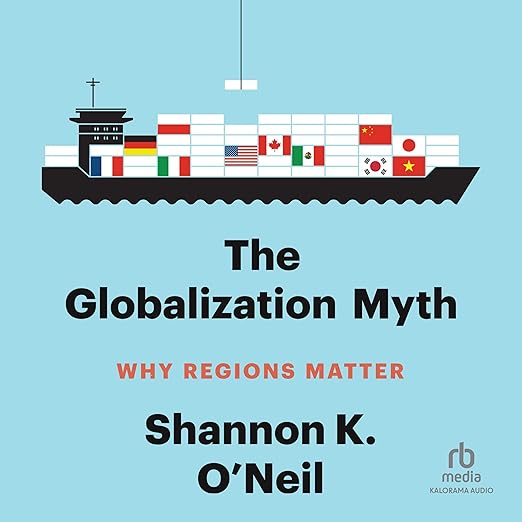
Quick Take
- Narration: Suzie Althens handles O’Neil’s data-heavy prose with crisp clarity, keeping economic analysis from becoming dry.
- Themes: Regionalization vs. globalization, North American economic integration, US trade competitiveness
- Mood: Brisk and analytical, counterintuitive and timely
- Verdict: A compact, well-argued corrective to forty years of globalization mythology that lands especially hard right now.
I picked this one up on the recommendation of a colleague who covers trade economics, and I will admit I expected the usual mix of policy advocacy dressed up as research. I was wrong. Shannon K. O’Neil has written something genuinely revisionary in The Globalization Myth, and Suzie Althens’s narration makes the economics feel accessible rather than medicinal. I finished the 7-hour-and-42-minute listen on a transatlantic flight, which felt appropriately ironic given the subject matter.
O’Neil’s central argument is deceptively simple: what we have called globalization for the past four decades was, in most cases, actually regionalization. Companies, capital, and supply chains did not spread uniformly across the globe. They clustered. Europe integrated into Europe, Asia organized around China and Japan, and North America built deep production networks between the US, Canada, and Mexico. The truly global economy is less real than the headlines suggest, and understanding that distinction has urgent implications for American policy.
Our Take on The Globalization Myth
What makes this book more than a policy brief is O’Neil’s command of the historical and structural evidence. She traces how the EU’s single market, the ASEAN frameworks, and NAFTA all created regional production ecosystems that are qualitatively different from a world where goods simply cross any border freely. The stat she returns to repeatedly is striking: the average Mexican import is roughly 40 percent made in the United States. That is not a global supply chain. That is a deeply integrated regional one. And American political discourse has systematically failed to understand it.
One reviewer described O’Neil’s enthusiasm for the subject as jumping off every page. That is accurate. There is a quality of genuine intellectual conviction here that distinguishes this from the competent-but-joyless trade economics books that dominated my reading in graduate school. O’Neil clearly believes this argument matters, and she makes it with enough concrete examples that the abstract economic concepts stay grounded.
Why Listen to The Globalization Myth
Suzie Althens is a strong narrator for this kind of material. She reads with the cadence of someone explaining rather than reciting, which helps when the author is walking through comparative data across three regional blocs. The audiobook does not include charts or tables, of course, but O’Neil’s writing is designed to carry the argument verbally. A reviewer who called this book the one to read in 2022 was surprised by how accessible it was, coming from a foreign policy background rather than economics. That accessibility translates well to audio.
The book’s structure is clean: Part One establishes the regionalization thesis with evidence from Europe, Asia, and North America. Part Two turns to implications for the United States, specifically arguing that Washington has consistently underinvested in its relationships with Canada and Mexico relative to what those partnerships economically warrant. The second part is somewhat more polemical, but it earns that stance through the groundwork laid in Part One.
What to Watch For in The Globalization Myth
Pay attention to the NAFTA analysis, which runs counter to both left and right narratives about the agreement. O’Neil argues that NAFTA created more American jobs than it destroyed by enabling Mexican manufacturers to use American-made components at competitive volumes. A reviewer from a European background noted being struck by the US tendency toward short-term thinking on trade, and O’Neil diagnoses that tendency with some precision. Her critique lands harder if you listen to the NAFTA section before moving to the book’s second half.
The book was published in late 2022, which means it predates several significant developments in US-China trade tensions and the reshoring debates of 2023 and 2024. But rather than making the analysis feel dated, those subsequent events have largely validated O’Neil’s framework. Regionalization is now the dominant vocabulary of US trade policy, even if it took a few more years for the terminology to catch up with the underlying reality she was describing.
Who Should Listen to The Globalization Myth
Anyone who has followed trade debates in the news and felt that the dominant narratives were missing something will find O’Neil’s reframing clarifying. This works well for business professionals trying to understand supply chain strategy, policy wonks who want a rigorous alternative to free-trade-versus-protectionism binaries, and general readers curious about how the modern economy actually operates. Those seeking purely granular economics with extensive modeling will want supplementary reading, but as an introduction to the regionalization framework, this is efficient and genuinely persuasive.
Frequently Asked Questions
Does the book address China’s role in global trade, or is it focused only on the three major regional blocs?
China features significantly in the Asia section, specifically as the regional hub around which East and Southeast Asian production networks organize. O’Neil analyzes China’s role as a regional anchor rather than a purely global actor.
Is this book relevant if you already have a background in international economics?
Several reviewers with economics and foreign policy backgrounds found it added genuine new framing rather than repeating conventional wisdom. The regionalization argument is sharper and more empirically grounded than most popular economics books.
How does Suzie Althens handle the denser economic data sections?
She reads through data clearly and without rushing, giving listeners time to absorb figures. The audiobook flows well even when O’Neil is presenting comparative trade statistics.
Does the book take a partisan position on US trade policy?
O’Neil’s second half argues for deeper North American integration, which cuts across both party lines. She is critical of both Democratic and Republican approaches to NAFTA and its successor agreement, USMCA.