Somebody's verdict on a set of bed sheets is sitting in the reviewer-name field of this audiobook listing, and the comment attached to it is the only one that mentions the recording. The stray text praises a bedding order for arriving as described at a good price and fitting a queen bed, and it occupies the slot where a display name should be. The comment underneath it, filed in January 2026, notes that the author reads the audiobook, which its writer usually prefers, and signs off on great book, great reading. That is the entire body of performance evidence on a page that has partly confused itself with a linen order.
The Family Functioned, Just Not Through the Adults
Alcohol is the hinge the whole memoir turns on, and the description refuses to soften any of it. Sober, the father was brilliant and charismatic, teaching his children physics and geology and how to embrace life fearlessly. Drunk, he was dishonest and destructive. The mother is described as a free spirit who abhorred the idea of domesticity and did not want the responsibility of raising a family. Those two sentences hold the entire mechanism of the book: children handed an education and denied a childhood by the same two people.
Jeannette Walls reads this herself, and on a memoir that is not a neutral production decision. February 2010's five-star identifies the quality that makes the choice pay off, describing an account of childhood neglect delivered casually, much as the child herself appears to have taken it at the time, with strikingly few moments of self-pity. A voice that declines to editorialize is hard to fake and easy to hear. An author reading her own restraint is a different proposition from a performer approximating it.
Six hundred and twenty-five minutes is what Simon and Schuster Audio gave the book, and pacing matters more than usual for a memoir assembled from episodes rather than from chapters of argument. The children are described as feeding, clothing and protecting one another, which is the structural fact everything else rests on: the family functioned, just not through the adults inside it. That inversion is what stops the account collapsing into a catalog of grievances, and it is why the episodes accumulate into something instead of merely repeating.
Walls Reads Her Own Restraint Aloud
Love is the complication, and December 2021's five-star, written from Germany, puts it more precisely than the English comments manage. The relationship between the author, her siblings and their parents is shaped as much by love as by despair and outright hatred, that comment says, and the parents nonetheless succeeded in passing on humane values and turning their children into fighters. That is the reading the book earns. It is also the reading most summaries flatten out.
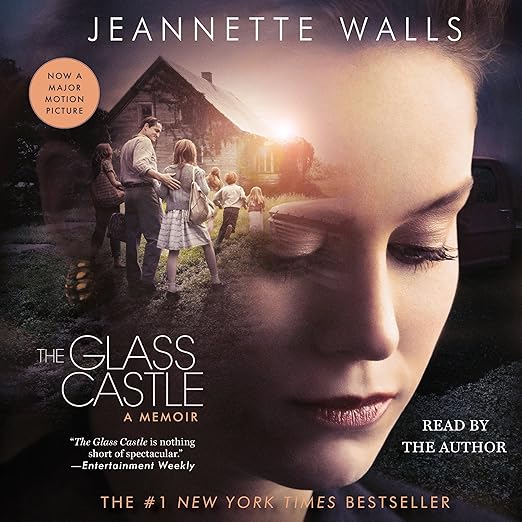
Self-pity is the standing trap in this genre, and its absence is what carried the memoir as far as it went. The copy calls the family deeply dysfunctional and uniquely vibrant in the same breath, which reads like marketing until you notice that the book holds both halves in view at once. Entertainment Weekly's line, quoted at the head of the description, calls the result nothing short of spectacular. Blurbs are blurbs, but that one praises the handling rather than the material, which is the correct distinction to draw here.
Hearing a memoirist read her own account of a father who taught her physics sober and wrecked things drunk changes the weight of individual sentences. Nothing is being performed at you, and the person who lived it decides where to pause. That is the strongest argument for choosing this format over the print edition, and the single audio-aware comment on the page endorses it in its own brief and unspecific way.
A Header That Points to a Different Book
Christopher Award, New York Times Notable Book, three years at number one: those are the claims January 2024's four-star makes on the book's behalf, alongside the names of two siblings and the author's place as second oldest of four children. Some of that is checkable and none of it appears on the listing itself. Treat reader-supplied credentials as reader-supplied. The same comment reports finishing the memoir in three days, which is the more practical piece of information for anyone weighing a listen of this length.
Hang the Moon is the title stamped across the top of this description, inside a header announcing that the memoir comes from the author of that other book. On a paperback jacket that is ordinary cross-selling. At the head of a listing for a different title it makes an odd first impression, and it is the only place the copy points at any other work. Everything after it concerns this family, which is the right proportion. The header simply arrives first and points somewhere else.
Behind the 4.6 sit forty-seven grades, while the five comments carrying text include one four and nothing lower, landing well above it. Those five come from three countries and describe at least two different objects, since March 2025's five-star opens by reporting that the memoir arrived in great condition, which grades a parcel rather than a reading. Count honestly and exactly one comment in five concerns this recording. The badge is measuring a memoir; what you are buying is a performance of it.
A Poverty Narrative Before a Literary One
Memoir listeners who want the form at its least self-indulgent should start here, and so should anybody who works with children in difficulty, because the book describes neglect from the inside without once asking to be pitied for it. The record files it under biographies and memoirs with an art and literature tag, which undersells the thing considerably: this is a poverty narrative and a family narrative long before it is a literary one. Listeners who valued other accounts of educating yourself out of chaos will recognize the territory within minutes.
The reason to avoid this is not quality. Listeners who cannot spend most of a working day with child neglect, hunger and parental alcoholism should not attempt it, and the copy is honest enough about all three that the decision can be made before purchase rather than halfway through. Taken as a document rather than as entertainment, it repays the time it asks for, and taken as an author's own account delivered in her own voice, it is about as unmediated as published memoir gets.
Good to Know
Is the audiobook the unabridged memoir?
The record gives a runtime and never uses the word abridged in either direction, which is the usual state of affairs on a listing of this age. Simon and Schuster Audio released it in September 2010. A file of this length for a memoir of this size is consistent with a complete reading, but the page does not confirm it.
Was The Glass Castle made into a film?
Yes, and the description says so at the very bottom: a 2017 Lionsgate release starring Brie Larson, Woody Harrelson and Naomi Watts. That is the full extent of what the listing tells you about it. Nothing on the page compares the two, and the recording predates the film by seven years.
Why is a memoir about poverty tagged under Art and Literature?
Art and Literature is what occupies the tag field, under a biographies and memoirs category. It is a poor fit for a book whose subject is hunger, alcoholism and homelessness, and it means the title will not surface for anyone browsing family, addiction or social history. The category is right; the tag beneath it is not.
Does the audiobook follow the children into adulthood?
It does. The copy describes the Walls children eventually finding their way to New York, and then their parents following them there and choosing to be homeless while their children prospered. That later movement is part of the book rather than an epilogue, and it is where the memoir stops being a survival story.