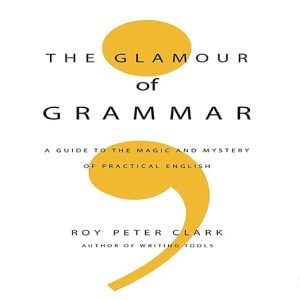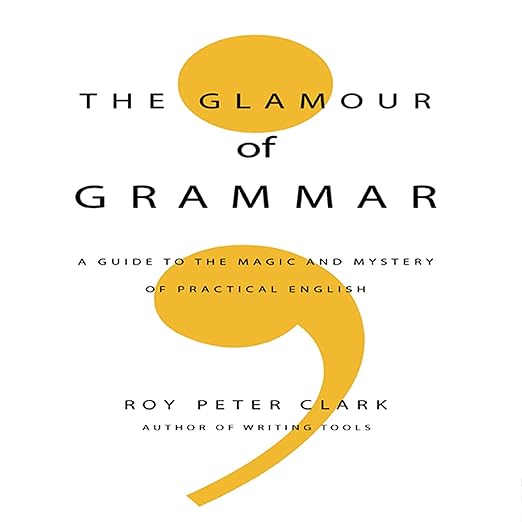
Roy Peter Clark opens The Glamour of Grammar with a genuine etymological surprise: in early English history, "glamour" and "grammar" were the same word, both linked to enchantment and magical spells. That connection - between mastery of language and a kind of power - is the governing idea of the audiobook, narrated by Clark himself, and it sets up his argument neatly. Clark, one of the more influential writing teachers in American journalism and a senior scholar at the Poynter Institute, is not interested in grammar as a set of rules to enforce but as a set of tools to deploy. The 50 chapters that follow, covering everything from the properties of individual parts of speech to the rhythmic possibilities of punctuation, are built around that reframe. The runtime of 8 hours and 55 minutes suits the breadth without feeling bloated.
Grammar as Toolbox, From Word to Style
Clark organizes The Glamour of Grammar in a structure that reviewer Anne Mills describes accurately as a toolbox rather than a rule book: it starts with the single word, works up through punctuation, then to words in use, then sentences, and finally to the level of style and purpose. That progression from small to large is pedagogically sound and makes the audiobook navigable even for listeners who come with significant gaps in their grammar knowledge. Clark never assumes you remember what a dangling modifier is, but he also never condescends to someone who does. His lessons on the power of concrete nouns and active verbs are among the most clearly argued in any book on prose craft. The chapter on the verb "to be" and why effective writers should befriend rather than avoid it challenges a piece of received writing advice that most listeners will have encountered before. Reviewer Richard Weaver, who holds a doctorate and describes himself as someone who has studied grammar since high school, found the book genuinely extending his understanding rather than reviewing what he already knew. That combination - accessible to the listener who slept through English classes and substantive for the practiced writer - is not easy to achieve, and Clark manages it through the quality of his examples and the depth of his attention to how language creates effect.
Clark Narrates Fifty Chapters Built for Commutes
Clark narrating his own work is the right arrangement for this book. He has spent decades teaching writing, and the audio format reproduces something close to what a Poynter seminar must feel like: a teacher who loves his subject, who reaches for the right example quickly, who pauses at the points where he knows the lesson will need a moment to settle. The 50-chapter structure, each chapter short and focused, makes this audiobook particularly well-suited to audio: you can work through a single lesson in a short commute and return to the next without losing the thread. Reviewer who describes catching up on missed English classes finds the breakdown and explanation flowing easily and the humor keeping it genuinely fun - both accurate observations about Clark's classroom manner, which the narration preserves. For anyone writing in any professional or creative context - the book explicitly addresses novels, memos, emails, and blog posts - the tools Clark teaches apply immediately. He designed them to be usable the day you encounter them, not after years of study. The historical material Clark weaves in - the etymology of "glamour," the roots of English punctuation, the evolution of the semicolon - adds context that enriches the practical instruction without weighing it down.
Depth Sacrificed for a Writer's Toolkit
The toolbox framing that makes this audiobook appealing to writers is also its honest limitation for language enthusiasts who want depth. Reviewer Anne Mills, describing it as better for aspiring writers than for language mavens, captures the calibration accurately. Clark covers a great deal of ground in 50 chapters, which means individual topics receive attention proportionate to their practical importance for writers rather than their linguistic complexity. Listeners who want historical depth on any given grammatical phenomenon, or who want the full descriptive linguistics picture rather than a writer's toolkit, will find the treatment lighter than they might hope. The section on avoiding hyper-grammar - Clark's term for the overzealous application of prescriptive rules - is one of the more nuanced passages in the book but is brief given how contested that territory is. While the audiobook works well as a linear listen, the print version's organization as a reference to return to repeatedly is somewhat harder to replicate in audio: jumping to the chapter on semicolons when you need it is more natural in a physical book than in a 9-hour audio file.
Self-Narration Is the Book's Clear Asset
This audiobook rewards writers at any stage who want to think about grammar as a resource rather than a constraint. The 50-chapter structure means it works as a listen-through course and as periodic revisiting when a specific grammatical question is live in your writing. Clark's teaching voice makes the subject genuinely appealing - this is the book most likely to change how you think about a semicolon or a concrete noun rather than just adding another rule to a list. The self-narration is a clear asset: Clark's classroom warmth is preserved in the audio in a way that a professional narrator reading someone else's enthusiasm for punctuation would not guarantee. Skip this if you want a linguist's grammar - descriptive depth, historical evolution, theoretical frameworks - rather than a writer's grammar. And skip it if you need a quick reference for specific rules rather than a conceptual education in how language creates effect.
Key Details
- Performance: Roy Peter Clark narrating his own grammar guide is the ideal arrangement - his teacher's instincts shape every pause and emphasis, and the warmth of his voice makes the subject feel inviting rather than corrective.
- What it covers: grammar as creative tool rather than rulebook, the history and magic of English language, practical writing craft
- Feel: Warm and intellectually playful, like a great college seminar on language
- Our call: Clark rehabilitates grammar as a writer's ally in 50 sharp chapters - the audio format suits the lesson-style structure, and the author's narration is a genuine asset throughout.
Before You Listen
Does The Glamour of Grammar audiobook work for someone who has no grammar background?
Yes - one reviewer describes having slept through grammar classes and finding the audiobook's explanations flowing easily with the humor keeping it engaging. Clark teaches from first principles and explains each concept before applying it, so prior formal grammar knowledge is not required. The teaching voice is accessible without being remedial.
How does Roy Peter Clark's own narration shape the audiobook experience of The Glamour of Grammar?
It is genuinely the right choice. Clark has taught writing for decades and his classroom manner is preserved in the audio - the pauses, the enthusiasm for particular examples, the warmth of a teacher who finds the subject inexhaustible. Reviewers note that the humor comes through clearly, which a standard narrator reading someone else's jokes would not guarantee.
Does The Glamour of Grammar audiobook go deep enough on individual topics to satisfy someone already knowledgeable about language?
Probably not as a specialist resource - the 50-chapter scope across under 9 hours means each topic is treated with writer-utility depth rather than linguistic rigor. One reviewer describes it as more useful for aspiring writers than for language mavens. Practitioners looking for historical or theoretical depth on specific grammatical questions will find the treatment introductory.