Quick Take
- Narration: Meggan Watterson narrates her own work, and the intimacy of that choice pays off completely. Her voice carries both scholarly authority and raw personal conviction, shifting between registers with no seams visible.
- Themes: feminist theology, reclaiming spiritual authority, hidden scripture and patriarchal canon-making
- Mood: Reverent and urgent, intellectually rich with emotional undercurrent throughout
- Verdict: For listeners drawn to the intersections of women’s history, early Christianity, and personal liberation, this is a rare book that earns every one of its five-star reviews.
I started this one on a gray Tuesday morning, headphones in while making coffee, and I did not make it past the introduction before I had to sit down. There is something about Meggan Watterson’s voice delivering her own prose that creates an immediate intimacy, as if she is thinking out loud directly to you. By the time she introduced the figure of Thecla, a teenage girl sitting at a window in the first century, refusing to look away from a world that told her to stay small, I was fully arrested. The coffee went cold.
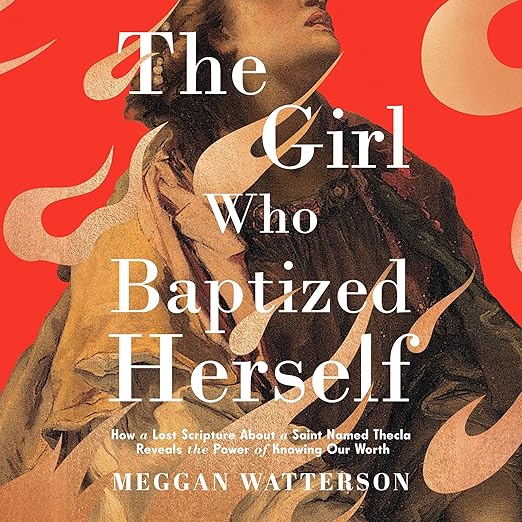
The Girl Who Baptized Herself is built around The Acts of Paul and Thecla, an early Christian text deliberately excluded from the New Testament canon by male church authorities in the fourth century. Watterson, a Harvard-trained feminist theologian, reconstructs Thecla’s story with a blend of scriptural analysis, memoir, and political clarity. The result is a book that functions simultaneously as a work of scholarship and a deeply personal reckoning with power and self-worth. One reviewer describes it as a book that stirred, awakened, and clarified things within them. That language is strong, but in this case it is not overstatement.
Our Take on The Girl Who Baptized Herself
What Watterson does here is genuinely difficult to pull off. She synthesizes the academic and the autobiographical without letting either mode flatten the other. The historical argument is sharp: early Christianity, before institutional codification, offered women far more spiritual agency than the church that replaced it. Thecla was not a footnote. She was a figure so threatening to patriarchal order that her story had to be buried for nearly two millennia. Watterson makes that erasure feel urgent, not merely historical.
The personal memoir threads woven throughout give the scholarship a specific emotional weight. Watterson returns again and again to the idea that so many of us have learned to define our worth through external approval, through what others need us to be. Thecla’s act of baptizing herself, claiming the sacred rite without waiting for anyone’s permission, becomes a metaphor for every moment a woman refuses to let someone else name her value. That framing never feels forced. It accumulates slowly and lands hard by the final chapters.
A second reviewer, describing Watterson as ‘an extraordinary current day spiritual teacher,’ notes the connection to figures like Julian of Norwich and Teresa of Avila, women whose spiritual experiences were so profound that the church powers of their eras had to manage rather than simply dismiss them. Thecla sits in that lineage, and Watterson is deliberate about making that lineage visible.
Why Listen to The Girl Who Baptized Herself
The audiobook format serves this material particularly well. Watterson’s narration is calm but not detached. You can hear the places where the material is personal to her, where the scholar and the spiritual seeker overlap and sometimes press against each other. Several reviewers noted that they ordered the hardcover immediately after finishing the introduction because they knew they would want to underline passages and return to them. That impulse makes complete sense: this is a book that wants annotation, that earns rereading.
Arianna Huffington’s blurb about Watterson writing with a prophet’s vision and a mystic’s heart is more accurate than such endorsements usually are. The writing is careful but not cold, scholarly but never airless. Watterson has clearly thought about the difference between illuminating an ancient text and using it instrumentally, and she consistently chooses illumination.
What to Watch For in The Girl Who Baptized Herself
The structure blends several registers, and listeners who prefer a single-mode approach, either pure scholarship or pure memoir, may find the weaving disorienting initially. Stick with it. The integration becomes clearer and more purposeful as the book progresses, and by the final chapters the movement between Thecla’s ancient voice and Watterson’s contemporary one feels seamless rather than assembled.
The downloadable PDF of additional resources mentioned in the product description is a genuine supplement worth exploring after listening. It extends the scholarly conversation for those who want to go deeper into the primary texts, the Gospel of Mary, the Acts of Paul and Thecla as a complete document, and the broader question of what was excluded from the canon and why. It is not necessary for the audiobook experience, but it adds dimension for the curious.
Who Should Listen to The Girl Who Baptized Herself
This belongs in the library of anyone curious about early Christianity’s lost voices, feminist theology, or the history of women’s spiritual authority. It will also speak directly to listeners going through any period of reassessing where their sense of self-worth comes from, regardless of religious background. Those seeking a straightforward narrative history without personal essay elements, or who are uncomfortable with a spirituality-meets-feminism framing, will find less traction here. But for its intended audience, it delivers something genuine and lasting. One reviewer ordered the hardcover mid-listen. That is the best measure I know.
Frequently Asked Questions
Do I need a background in theology to appreciate this audiobook?
Not at all. Watterson explains the historical and scriptural context as she goes, making the material accessible to curious listeners without a religious studies background. The memoir elements keep the book grounded in personal, relatable experience throughout.
Is The Acts of Paul and Thecla a well-known text, or is Watterson introducing it to most listeners?
For most listeners, Thecla will be entirely new. The text was excluded from the New Testament canon in the fourth century and has remained largely outside mainstream awareness. Watterson’s entire project is to restore that awareness, so the book works as both discovery and argument.
How does Watterson’s self-narration compare to what a professional narrator might bring to this material?
It works exceptionally well here. Because the book weaves scholarly analysis with personal memoir, having the author read her own words adds a layer of authenticity that a third-party narrator could not easily replicate. You hear her conviction and her vulnerability in equal measure.
Does the book advocate for a specific religious tradition, or is it more broadly spiritual?
Watterson’s framework is rooted in Christianity, specifically early pre-institutional Christianity, but her argument about self-worth and inner authority translates across traditions. Listeners who are skeptical of organized religion but open to feminist spirituality will find plenty here that speaks to them.