Before You Press Play
- Voice: P.J. Ochlan brings measured authority to the primary text and distinguishes clearly between the voices of four very different pilots, maintaining historical gravitas without melodrama.
- Big ideas: War from the other side, chivalry in aerial combat, complicity and conscience under authoritarian command
- Atmosphere: Sober and absorbing, occasionally revelatory
- Worth it?: A rare primary-source document for WWII aviation history enthusiasts, genuinely valuable for its candor about serving under Nazi leadership.
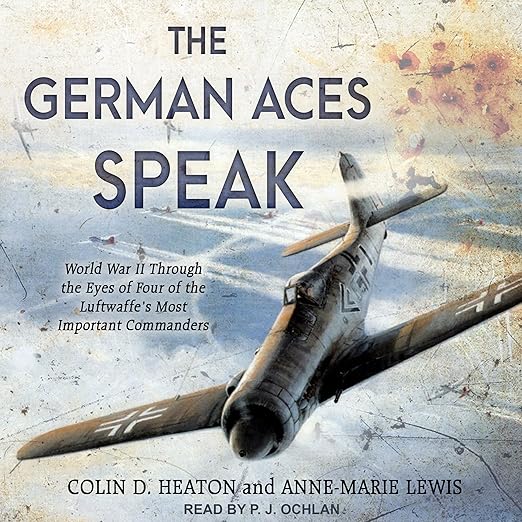
I listened to the bulk of this one during a long weekend when I had been working through a stretch of Pacific theater books, so arriving at a Luftwaffe perspective felt like turning the map over entirely. That disorientation is, I think, exactly the point of what military historian Colin Heaton built here. The German Aces Speak is not a defense of the men it profiles. It is something more complicated: a record of what four highly decorated pilots actually said, in their own words, about a war they fought on the wrong side of history.
The four pilots at the center of this book are Walter Krupinski, Adolf Galland, Eduard Neumann, and Wolfgang Falck. All four are drawn from the upper tier of Luftwaffe achievement, and all four were directly interviewed by Heaton. That distinction matters. This is not a reconstructed narrative or a secondary synthesis. These are men speaking about their own experiences, and the candor with which they address the Nazi leadership they served under, particularly Hermann Goring and Adolf Hitler, gives the book a texture that academic histories rarely achieve.
Where This One Lands
P.J. Ochlan is well cast here. His narration has the kind of controlled authority that military history demands without tipping into reverence, which would be the wrong note entirely for material this morally complicated. He navigates the structural format of the book, which proceeds chapter by chapter through each pilot's account, with enough variation to keep four distinct voices readable across nearly eleven hours. The content itself provides most of the dramatic weight, and Ochlan is wise enough to stay out of the way of it.
One reviewer noted a structural peculiarity worth flagging: because this is a companion to a prior volume and because the four pilots' wartime experiences overlapped, certain events are recounted from multiple perspectives across the chapters. Some readers found this repetitive. I found it illuminating in the way that any court record is illuminating when witnesses corroborate or subtly diverge. The gaps between how these men remembered the same incident tell you something that neither version alone would reveal.
Why The German Aces Speak Works as an Audiobook
The appeal of this book rests on a genuine historiographic gap. As one reviewer observed, Western readers are accustomed to accounts from Allied pilots. The RAF and USAF aces they know from documentaries and popular histories tended to claim twenty-odd kills as high totals, where Luftwaffe aces started at one hundred. That numerical disparity is not just a detail. It says something about the intensity, duration, and geographic scope of what these men experienced on the Eastern Front in particular, and about how the war looked from a vantage point that English-language publishing rarely foregrounds.
What I found most genuinely surprising was the commentary on aerial chivalry. Multiple reviewers referenced it, and one WWII veteran quoted a specific example: a case where opposing pilots, rather than finishing each other off, allowed safe passage. The narrator's measured tone in these passages is exactly right. The chivalry was real, and it existed simultaneously with the horror of everything else. Holding both of those truths without collapsing one into the other is one of this book's genuine accomplishments.
What Gives Us Pause
The pilots' accounts of serving under Goring and Hitler are the sections that will most reward careful listening. These men were not Nazi ideologues, at least not in any way they acknowledged to Heaton, and their retrospective assessments of the leadership they served carry a complicated mix of professional contempt and self-exculpation that is itself historically interesting. Whether that self-exculpation is fully credible is a judgment each listener will need to make independently. The book does not make that judgment for you.
The runtime of nearly eleven hours is appropriate for the material. This is not a book to rush. The chapter structure by pilot, rather than chronologically across the war, means you will sometimes find yourself losing the thread of a linear timeline. A basic familiarity with the European theater's major campaigns and dates will help considerably.
The Right Listener for The German Aces Speak
Ideal for WWII history listeners who feel they have thoroughly covered the Allied perspective and are ready for something that demands more active moral engagement. Also well suited to readers interested in oral history methodology and the complexities of first-person military testimony. Skip it if you want a straightforward linear narrative of the air war, or if you find the repetition of overlapping accounts across chapters frustrating rather than informative. This is a book for patient, curious readers, not for those looking for clear heroes.
Common Questions
Is this book a companion to another volume, and do I need to read that first?
Yes, this is essentially a second volume of interviews. Several reviewers noted it works as a companion to a prior book covering some of the same pilots. You can listen independently, but readers familiar with the first volume will have useful context for the relationships between these men.
Do the four pilots defend their service under Nazi leadership, or are they critical of it?
The accounts are nuanced. None of the four were Nazi party members, and they are candid about their contempt for aspects of Goring and Hitler's command decisions. However, they are also self-serving in ways that warrant critical listening. The book records what they said rather than adjudicating it.
How does P.J. Ochlan handle the German names and technical aviation terminology?
Cleanly. Ochlan handles the pronunciation of German names and Luftwaffe rank titles with authority, and he does not stumble over the operational terminology. For a military history audiobook with this level of technical specificity, that consistency matters over an eleven-hour runtime.