At a Glance
- Read by: Malcolm Hillgartner reads with measured authority that suits the gravity of the Manhattan Project without becoming dry, a strong performance across 14 hours.
- At its heart: Scientific collaboration under pressure, the moral weight of the bomb, the partnership between institutional power and intellectual genius
- Vibe: Tense and absorbing, the slow accumulation of an enormous decision
- Short version: One of the more balanced and accessible accounts of Groves and Oppenheimer's partnership, recommended for history listeners who want depth without academic density.
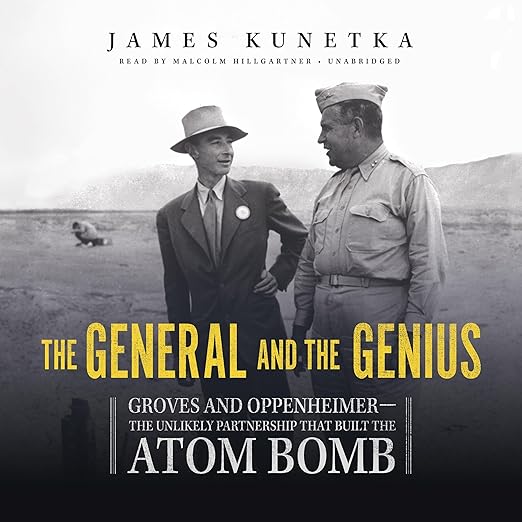
The Manhattan Project has generated a remarkable body of literature, from Richard Rhodes's exhaustive The Making of the Atomic Bomb to Kai Bird and Martin Sherwin's Pulitzer-winning American Prometheus, and a reader coming to James Kunetka's The General and the Genius might reasonably wonder what space remains to occupy. What I found, listening to Malcolm Hillgartner's narration across fourteen hours on a series of long evening sessions, is that Kunetka has found it: a book specifically focused on the working relationship between Leslie Groves and J. Robert Oppenheimer, and on what made that relationship both improbable and indispensable. It is not the most comprehensive account of the bomb's development, but it may be the most human.
Groves built the Pentagon on time and under budget before being handed the largest, strangest, most secretive scientific enterprise in history. Oppenheimer was a chain-smoking, martini-drinking theoretical physicist with communist associations that should have made him a security liability, and by almost every institutional measure, he was. Kunetka's central argument is that Groves understood something that the bureaucratic apparatus around him did not: that Oppenheimer was not just the most qualified person for the job, he was the only person capable of managing the particular combination of scientific brilliance and personal ego that the project required. Understanding that bet, and watching it play out across three years on a remote New Mexico mesa, is the book's core pleasure.
The Review
Kunetka's great skill here is calibration. One reviewer noted the book's balance with precision: it provides enough technical detail about the physics and engineering to make the complexity tangible without getting mired in it, and it balances the institutional story with the human one. Groves and Oppenheimer are given genuine interiority, their anxieties, their ambitions, their very different ways of processing the moral implications of what they were building. The book does not shy away from those implications, but it also does not editorialize excessively. It trusts the facts to carry their own weight.
The supporting cast is handled well. Los Alamos was populated by an extraordinary collection of minds, Fermi, Teller, Szilard, Bohr, and Kunetka includes enough of their stories to convey the culture of the place without losing the central focus. One reviewer who had read extensively on the subject found new material here despite prior familiarity with the territory, particularly around the day-to-day management of what amounted to a small city of difficult, secretive, brilliant people under military authority. That management dimension is where the Groves-Oppenheimer dynamic becomes most interesting, and Kunetka develops it with patience.
The Best Parts of The General and the Genius
Hillgartner's narration is a genuine asset. The material is dense, the physics, the politics, the wartime urgency, the moral reckoning, and Hillgartner navigates it without letting any one register overwhelm the others. He reads the technical sections with clarity and the personal sections with appropriate restraint, never pushing the emotion to a pitch the text itself hasn't earned. At fourteen hours, the audiobook rewards sustained listening over shorter sessions: the accumulation of detail is part of how Kunetka builds his argument, and listening in large chunks lets that structure do its work.
For listeners who saw Christopher Nolan's Oppenheimer in 2023 and found themselves wanting a more granular account of the actual scientific and logistical work, as opposed to Oppenheimer's personal story and subsequent security hearing, this is an excellent companion. Kunetka keeps the scientific achievement in the foreground while Nolan's film necessarily keeps the drama there, and the two pieces of work illuminate different aspects of the same history.
The Caveats
Listeners who come to this book expecting it to be primarily a study of Oppenheimer as a psychological subject may find themselves wanting more. One reviewer noted that the book reads more as "a standard history of the A-bomb" than a deep character study, and that observation has merit: Kunetka is more interested in what the two men accomplished together than in the interior lives of either. For the richest psychological portrait of Oppenheimer, Bird and Sherwin's biography remains the standard. But Kunetka offers something complementary: the view from the collaboration itself, which those longer works can sometimes neglect in favor of the more dramatic story of Oppenheimer's later persecution.
The book ends with the Trinity test and the bombings of Hiroshima and Nagasaki, and the moral weight of those events is addressed seriously but not exhaustively. Readers looking for a sustained ethical reckoning with the bomb's use will want to supplement this with other sources. Kunetka is writing a history of creation rather than a philosophy of destruction, which is a legitimate scope choice but one worth knowing in advance.
Who Should Pick Up The General and the Genius
History listeners with an interest in World War II, science, or the origins of the nuclear age will find this essential. It is particularly well-suited to listeners who want serious depth without the density of academic history, Kunetka writes clearly and the access is broad. Also recommended for anyone who came to the subject through the Nolan film and wants to understand the scientific and institutional dimensions more fully. Less necessary for those who have already read American Prometheus or Rhodes's work, though even that audience will find Kunetka's relational focus adds something distinct to their understanding.
Frequently Asked Questions
Does the book address what happened to Oppenheimer after Los Alamos, the security hearing and the stripping of his clearance?
Only briefly. Kunetka's focus ends essentially with the successful deployment of the bombs in 1945. The security hearing of 1954 is mentioned in context but is not a major part of the book's scope. Listeners interested in that chapter of Oppenheimer's life should look to Bird and Sherwin.
How does Malcolm Hillgartner handle the more emotionally weighty sections, particularly around Hiroshima and Nagasaki?
With appropriate gravity and restraint. Hillgartner does not editorialize through vocal inflection, he lets the material speak. The sections covering the use of the bombs are read with the same measured authority as the rest of the book, which feels like the right choice given how Kunetka himself approaches those events.