Key Details
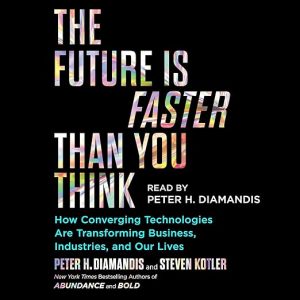
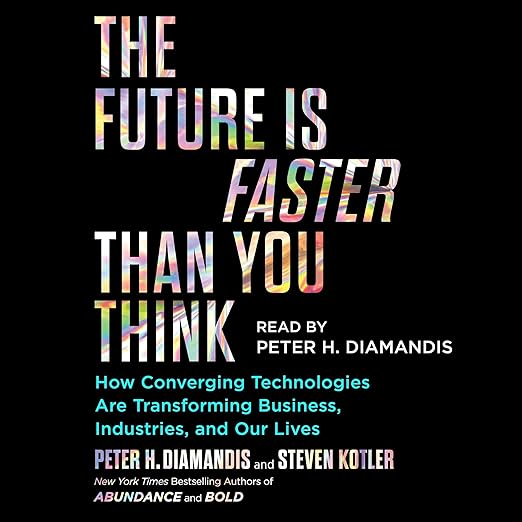
- Read by: Peter Diamandis narrates his own book, giving the content a first-person urgency that a third-party reader could not replicate - though the delivery is more TEDx speaker than trained narrator.
- At its heart: Technological convergence, exponential growth curves, industrial disruption
- Vibe: Optimistic and energizing, with a relentless forward momentum
- Short version: A well-organized survey of converging exponential technologies that functions best as a framework for thinking rather than a predictive document.
I started The Future Is Faster Than You Think during a stretch of flights where I was feeling particularly anxious about technological change - the specific anxiety of someone who follows developments closely enough to feel perpetually behind. Diamandis and Kotler are the right antidote to that anxiety, not because they minimize the disruption ahead, but because they reframe it as something navigable. By the time I landed, I had filled two pages of notes and felt, if not exactly calm, at least oriented.
This is the third book in Diamandis and Kotler's sequence following Abundance (2012) and Bold (2015). Where Abundance focused on grand global challenges and Bold examined exponential entrepreneurs, The Future Is Faster Than You Think concerns itself with convergence - what happens when AI, robotics, virtual reality, digital biology, 3D printing, blockchain, and gigabit networks collide with each other and with legacy industries simultaneously. The answer, according to the authors, is transformation at a pace and scale that dwarfs anything in the previous hundred years of industrial history.
Is The Future Is Faster Than You Think Worth Your Time?
The book's central insight is also its core methodological claim: that technology does not disrupt industries linearly but exponentially, and that convergence between independently accelerating technologies multiplies that disruption further. Diamandis and Kotler walk through transportation, retail, advertising, education, health, entertainment, food, and finance - in each sector mapping how multiple technologies are arriving simultaneously and interacting in ways that make sector-specific analysis insufficient. Reviewer A. Menon described this as "a solid overview" while noting the language is "at times exaggerated," which is a fair characterization. The book is written for a general audience, not a technical one, and the examples are sometimes chosen for drama over nuance.
For listeners already familiar with exponential technology discourse - Kurzweil, Harari, the Santa Fe Institute complexity literature - the frameworks here will feel accessible rather than revelatory. The value is less in the individual technology descriptions, which date quickly, than in the convergence model itself, which remains useful as an analytical lens. Reviewer Robert, who has re-read the book multiple times, emphasizes that it "tells the story of amazing technologies that are here and on the way without the need to highlight the doom and gloom." That optimistic framing is deliberate and distinguishes Diamandis's work from the more dystopian strand of technology commentary.
The Best Parts of The Future Is Faster Than You Think
The author-narrated production includes an audio bonus: exclusive conversations with Diamandis that extend the book's content beyond the printed text. That addition justifies the audio format as a distinct product rather than a simple reading of the print edition. Diamandis's delivery is energetic and confident - the voice of someone who has given these arguments in TED talks and XPRIZE presentations many times. The slightly lecture-y quality is appropriate given the content; this is not a reflective memoir but an argument, and it benefits from being presented with conviction.
At nine hours and fifty-three minutes, the runtime is substantial without being exhausting. The chapter structure maps clearly to the industry-by-industry analysis, which means the book is easy to re-engage after breaks or skips - useful for listeners who want to return to specific sections rather than consuming it linearly.
Before You Commit to The Future Is Faster Than You Think
Published in January 2020, this book went to press before the COVID-19 pandemic dramatically accelerated some of the technology adoption curves Diamandis describes, particularly in health technology and remote work. Some predictions look prescient in retrospect; others have been overtaken by developments the authors could not have anticipated. The book is best read as a framework for understanding convergence dynamics rather than as a literal forecast, since the specific timelines are already showing their age in places. The AI section, in particular, reflects the state of the field in 2019 rather than the landscape that has since transformed the industry's expectations entirely.
Should You Listen to The Future Is Faster Than You Think?
Business leaders, entrepreneurs, and policy thinkers who want a structured introduction to exponential technology convergence will find this accessible and well-organized. Readers who have already absorbed the core arguments from Abundance or Bold may find the coverage less novel, though the convergence framing is genuinely distinct. Skeptics of techno-optimism will find Diamandis's framework frustratingly resistant to downside scenarios - the book engages with disruption almost entirely as opportunity rather than risk. Those willing to accept the optimistic premise as a starting point, and engage critically from there, will get the most value.