Key Details
- Narrator: Griffin Dunne takes the microphone himself, an actor's timing applied to an actor's family
- Subjects: A Hollywood childhood, a sister's murder and its trial, a father remade by grief, friendship with Carrie Fisher
- Tone: Wry and quick on the surface, with a hard center it never dodges
- Bottom line: Worth twelve hours if you can take the famous names as a biography rather than an inventory.
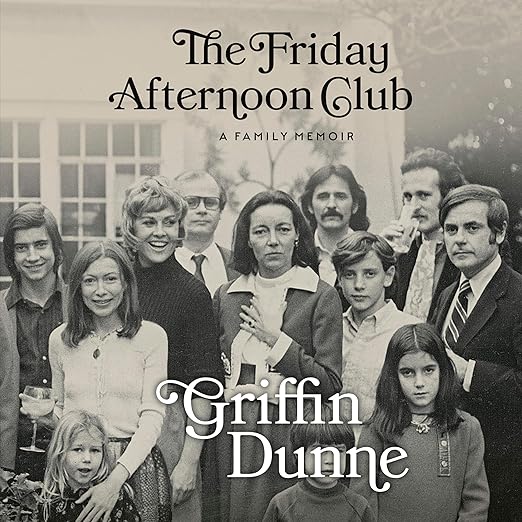
Griffin Dunne appears twice on this audiobook's record, once as the author and once as the narrator, and for a memoir about a life spent being looked at, that is the least surprising line in the file. Twelve hours and nineteen minutes, Penguin Audio, published June 2024. What repays attention before you buy is not the casting, which is obvious, but everything stacked in front of the description: five best-of-the-year citations and four quoted endorsements, arriving ahead of a single sentence about what actually happens in the book.
What the description eventually says is more interesting than the praise stack. For all its boldface cast, the copy insists, this is no mere celebrity memoir but a family story, down to its bones, about loveable, infuriating, funny, moving characters, its author most of all. Publishers say that about every celebrity memoir. The difference here is a subject beyond proximity to fame: Dunne's twenty-two-year-old sister Dominique, a rising star, was strangled to death by her ex-boyfriend, and the trial that followed became one of the most public of the 1980s. Everything else in the description orbits that fact.
At eight, Sean Connery pulled him out of the water. At thirteen, hoping to meet Janis Joplin, he turned up at his aunt Joan Didion and uncle John Gregory Dunne's launch party for Tom Wolfe's The Electric Kool-Aid Acid Test. At sixteen he was expelled from boarding school, ending his formal education for good. In his early twenties he shared an apartment in Manhattan's Hotel Des Artistes with Carrie Fisher while she filmed Star Wars and he sold popcorn at Radio City Music Hall. The copy builds itself out of these, one age at a time, and the effect lands somewhere between astonishing and exhausting.
The Beat Only Dunne Himself Can Hold
Penguin Audio put the author behind the microphone, which for this particular book is a structural choice rather than a courtesy. Dunne produced and starred in After Hours under Martin Scorsese and knows exactly how long to hold a beat. A memoir whose comedy depends on the gap between what a family said and what it meant needs someone who can place that gap, and the person who lived inside it has an advantage no hired reader can manufacture. The corresponding risk is the one every author narration carries: a voice trained for the camera is not automatically a voice built for twelve consecutive hours.
Dominique's murder is why this memoir is not interchangeable with the dozen others published the same season. The description handles it carefully, giving the fact, the age, the verdict and the consequence: her father Dominick Dunne turned the travesty of that outcome into a second career as a crime reporter for Vanity Fair and an advocate for victims' rights. A book that can hold Sean Connery and a courtroom inside the same twelve hours has a tonal problem to solve, and the copy's phrase for the solution, wicked humor and glimmers of light in even the most painful circumstances, is at least an honest statement of intent.
The Same Two Adjectives, Over and Over
Every one of the five written responses reaches for the same two adjectives, funny and poignant, in one order or the other. One describes a look behind the curtain, from a reader a year older than Dunne who recognized every celebrity in it. Another knew little of the family beyond their names and found the telling wonderful regardless, which is the more useful signal, because it suggests the book does not require you to arrive already interested. A third calls it a roller coaster through the seventies and eighties that leaves you laughing and crying.
Four Point Four From Six Votes That Won't Add Up
Four point four is the displayed rating and it cannot be correct. Six votes are recorded, and an average of six whole-star ratings has to land on a multiple of one sixth. A 4.5 qualifies. So does 4.33. A 4.4 does not, under any rounding convention anyone uses. The five visible responses carry stars of five, four, five, five and three, so the written column and the headline figure are plainly not drawing on the same pool. None of which tells you anything about the writing. It tells you the number at the top deserves less weight than the paragraphs underneath it.
Hollywood memoirs live or die on whether the names are doing work or merely appearing, and this is where the book's own admirers divide. The description alone drops Connery, Joplin, Didion, Fisher, Wolfe and Scorsese before it reaches the sister, at a rate of roughly one per sentence. If that reads to you as a life rather than a guest list, twelve hours will be a pleasure. If it reads as a guest list, the same twelve hours will feel like a party where you know nobody. The copy is not concealing the density. It is selling it.
Sue D. Mackenzie's three-star note is the most useful thing on the page precisely because it is the least enthusiastic. Fast living lifestyles of rich and famous families, it opens, before arriving at the objection: at times the habit of name dropping gets a bit tedious. That is the honest limit of the form, and it comes attached to an observation nobody else makes, that the author always ends up alone, which reads the book more sharply than any of the five-star notes manage. One further absence worth recording: not one of the five mentions Dominique or the trial, though the description puts both at the center.
The Name Cascade Is the Price of Admission
Memoir readers who like Hollywood from the inside, and specifically from the vantage of somebody born into it rather than arriving at it, have the clearest reason to press play. So do listeners drawn to the Dunne family as a subject in its own right, since Dominick Dunne's crime reporting for Vanity Fair grew directly out of what happened here. And anyone who prefers an author's own delivery to a professional one gets twelve hours of it from a narrator who has been performing for a living for decades.
Twelve hours is a real commitment, and two kinds of listener should think twice. Anyone who finds famous names tiring will find them relentless, since the density belongs to the life rather than to any flaw in the telling. Anyone expecting a straight true-crime account of the trial should understand this is a family memoir containing one, not the reverse. Everyone else gets a Hollywood childhood, a friendship with Carrie Fisher run out of a shared apartment, a murdered sister, and a father who rebuilt himself around the loss, all narrated by the one person it happened to. The name cascade is the price of admission, and it is worth paying.