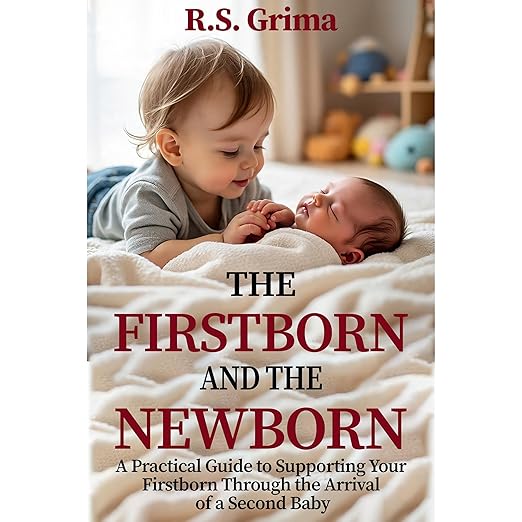
Quick Take
- Narration: Virtual Voice generates the audio here, which for a practical parenting guide produces a functional if affectively flat listen, the content survives the format better than emotional or therapeutic material would.
- Themes: sibling transition management, toddler regression normalization, new family routine building
- Mood: Practical and low-stakes, designed for tired parents who need clear steps rather than theory
- Verdict: A concise and usable guide for parents expecting a second or third child, the short runtime is a feature, and the Virtual Voice narration is manageable for step-based content.
I listened to this one at a specific remove: I was doing research into the short-form practical parenting guide market, curious about what the under-two-hour format can actually accomplish for parents who don’t have time for a full-length parenting audiobook. At an hour forty-two, The Firstborn and the Newborn makes its scope explicit in the runtime. This is not a comprehensive child development text. It is a focused intervention guide for a specific and almost universally stressful transition, and at that narrower ambition, it largely succeeds.
R.S. Grima uses a Virtual Voice narrator, which is worth naming directly because it shapes the listening experience in ways that matter. Virtual Voice text-to-speech renders the content clearly enough for step-by-step practical advice, which is what this book primarily contains. The regression normalization sections, the bonding moment suggestions, the routine-building frameworks, all of these survive the format reasonably well because they are structured as information transfer rather than emotional support. Where Virtual Voice typically fails most severely is in content that depends on warmth, intimacy, or therapeutic resonance. This book is practical enough in register that the synthetic narration doesn’t undermine it the way it would a memoir or a grief companion.
The Regression Curve No One Warned You About
The book’s most useful section is its treatment of firstborn regression: the toddler who suddenly wants a bottle again, the six-year-old who becomes clingy, the behaviors that feel like steps backward but are actually predictable responses to a fundamental change in family structure. A reviewer whose six-year-old started demanding a bottle again after the baby arrived found the book’s normalization of this pattern actively reassuring. That kind of specific utility matters in a short-form guide: you don’t need 300 pages to understand why your older child is acting like a different child. You need someone to tell you it is documented, predictable, and temporary.
The strategies for preparing toddlers and preschoolers before the birth are concrete enough to implement immediately, and the framing consistently emphasizes inclusion rather than displacement. Making the older child a participant in the new sibling’s arrival rather than a bystander to it is the core behavioral logic throughout, and the tactics Grima offers are consistent with that goal: age-appropriate involvement, language that emphasizes role rather than competition, deliberate one-on-one time scheduled around the chaos of a newborn home.
What a 102-Minute Format Can and Cannot Do
The book is honest about its scope by necessity. At under two hours, Grima cannot address every variation. The only child who has been an only child for seven or eight years faces a different transition than a two-year-old, and while the book acknowledges the broad range of firstborn ages, the tactics are most specifically calibrated for the toddler-to-preschool range. The reviewer who describes her daughter as recently turned three found the timing perfect; readers with older firstborns may find the advice requires more adaptation.
The section on the first two months post-birth adds useful value without straining the format. Questions about routine adjustment, sleep disruption, and maintaining emotional connection with both children during the survival phase of new parenthood are exactly what exhausted parents need concise guidance on. The 35 ratings at 4.8 average is meaningful signal that this serves its specific use case well.
For Whom This Is Designed
This is a resource for parents expecting baby number two or three who want specific tactics more than theoretical grounding. Grandparents who want to support a son or daughter through the transition, as one reviewer describes, will find it equally applicable. The reviews are from people who bought it for themselves or as a gift precisely at the moment of need, which is the correct use case: listen to this in the weeks before the birth, not in the abstract planning years before.
Frequently Asked Questions
Does the Virtual Voice narration significantly reduce the book’s usefulness, given that it is a parenting guide?
For this particular book, the Virtual Voice narration is more tolerable than it would be for emotional or therapeutic content. The guide is structured as practical steps and behavioral strategies rather than as supportive narrative, and that structure survives text-to-speech rendering relatively well. The lack of warmth in the delivery doesn’t undermine tactical parenting advice the way it would undermine a grief memoir or a mindfulness program. It is not ideal, but it is manageable for content in this register.
Is the book primarily for parents of toddler-age firstborns, or does it address a range of ages?
The tactics are most specifically calibrated for toddler and preschool-age firstborns, which is also the most common scenario for a second pregnancy. The book acknowledges a broader age range including early grade-schoolers, but the language strategies, bonding-moment suggestions, and regression normalization content are most directly applicable to the two-to-five age range. Parents of older firstborns will need to adapt more of the guidance, though the core framework about inclusion and role assignment translates upward.
How does the book handle the adjustment period after the baby is actually home, not just the preparation phase?
Grima includes a section on navigating the first two months after birth, covering routine adjustment, maintaining emotional connection with both children, and managing the chaos variables of the newborn period. It is not exhaustive at this runtime, but it provides a practical framework for the immediate post-birth adjustment rather than stopping at delivery. The focus is on sustainable routines and deliberate attention to the firstborn during a period when the newborn’s demands dominate.
Is there a companion workbook or worksheet resource with this audiobook?
No companion PDF or workbook is noted for this title. The content is delivered as a straightforward audio guide without supplementary materials. Given the practical, action-oriented structure of the book, listeners may want to take notes on the specific strategies as they listen, particularly the preparation language suggestions and the routine-building frameworks, since these are the sections most useful to have in accessible form when you are actually navigating the transition.