In Brief
- Performance: Mike Lenz reads a text dense with drug names, acronyms and committee procedure, where first-pass clarity matters more than color.
- What it covers: Regulatory history, medical catastrophe and reform, cancer drug approval, institutional trust.
- Feel: Grim, methodical, quietly gripping.
- Our call: Excellent institutional history for curious general listeners, provided you want the system explained rather than prosecuted.
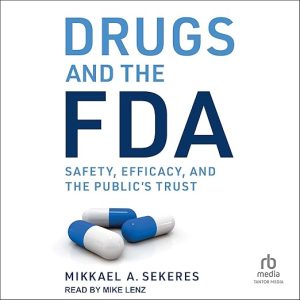
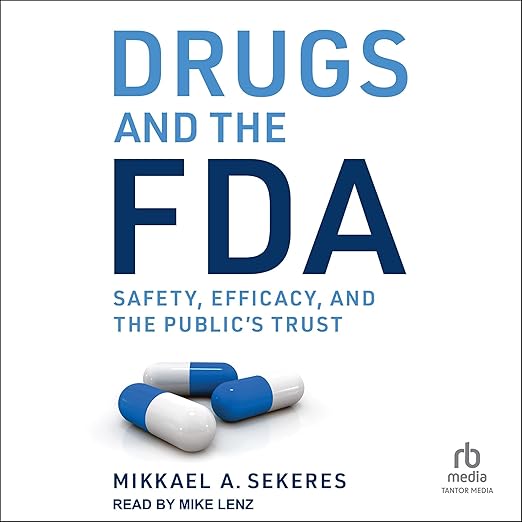
Mikkael Sekeres sat on the FDA advisory committee whose most contested hearing forms the spine of this audiobook, and that fact shapes everything about how it should be listened to. Tantor Audio published the recording in April 2023, read by Mike Lenz, running eight hours and forty minutes. What you get is institutional history written from inside the room, by an oncologist who voted, which is both the strongest thing about the book and the reason to keep one eyebrow raised.
Every Safeguard Here Has a Body Count
Before the agency existed, anyone could sell any potion, claim treatment of any ailment, and print any promise on a label. The book builds its history out of the catastrophes that ended that freedom one law at a time: children poisoned by contaminated vaccines, an early antibiotic mixed with antifreeze, a drug given for morning sickness that left babies disfigured, and access to AIDS treatments restricted to a handful of trials while thousands of people died waiting. Each disaster produced a rule, and the rules accumulated into the regulator the book calls the most trusted in the world. Patient advocacy sits alongside the catastrophes as the second engine of change, which is a useful corrective to the assumption that regulation only ever arrives from above. That structure gives the material a grim momentum, since you learn early that every safeguard has a body count behind it, and that the interval between a harm and a law is measured in years rather than weeks.
Running underneath is the 2011 hearing on the breast cancer drug Avastin, where Sekeres served on the panel. Someone writing on October 7, 2022 reads the book as the story of a social institution acquiring authority and then evolving into a public and private partnership with a different relationship to safety and efficacy than it started with, which is a sharper summary than the marketing manages. That reading treats the book as institutional analysis rather than as advocacy, and it is the most useful frame available for deciding whether the subject is for you.
Lenz Narrates Acronyms Without a Glossary
Narration here is a more technical assignment than the category suggests, and Mike Lenz is the narrator of record. Drug names, agency acronyms, committee procedure and clinical trial vocabulary arrive continuously, and a listener needs each one landing cleanly the first time because no glossary exists to flip back to. Tantor put eight hours and forty minutes behind it, which is a sensible length for a book with this much sequence in it. The chronological spine helps enormously in audio, since each crisis sets up the law that follows, and the structure keeps you oriented without any need to check where you are. Books that alternate between a present-day thread and a historical one usually pay a penalty in this format, and the Avastin framing here is regular enough to avoid it.
Filed February 5, 2023, a five-star calls it one of the best books of that year and singles out the Avastin material, saying the account of the initial approval drama played like watching a movie. That is the register the book reaches at its best. Regulatory history sounds like the least cinematic subject imaginable, and the reason it works is that every decision has a patient on one side and a probability on the other, which is exactly the shape of a thriller even when the setting is a committee room.
Sekeres Was Both a Panelist and the Author
Balance is the word a five-star from April 21, 2023 reaches for, praising the treatment of opportunities and challenges in the cancer drug approval system, and grounding that praise in the author's own service on the oncology advisory committee. Worth noting that this response garbles the agency's initials and trails off into a scrambled closing clause, which makes it harder to read than it should be. The substance survives, and it points at the real tension: a panel member writing the history of a hearing he voted in is both the book's authority and its limitation. He was there, so the detail is first-hand. He was also a participant, so the account of what the panel got right is not a neutral one.
Set expectations about the argument too. This is not a takedown, and anyone arriving with a settled hostility toward drug regulation or the pharmaceutical industry will find the framing unfriendly, since the book's stated position is that the agency became the most trusted regulator anywhere. Nor is it a consumer guide: nothing here helps you evaluate a prescription you have been handed. The subject is how the system came to work the way it does, and the closest thing to practical advice is a better sense of what an approval actually certifies.
Vaccine-Approval Skeptics Get the Missing Backstory
Writing on February 9, 2023, a five-star identifies the audience precisely, observing that the FDA is an agency everyone has an opinion about, and crediting the book with lifting a veil of mystery for people who hold those opinions without much information underneath them. It also praises the way a physician presents the material in terms a layperson can follow, which matters for a book whose subject is technical by nature. That is the promise being made here: informed opinion replacing inherited opinion, over the course of a single week of listening.
Reach for it if you followed vaccine approvals during the pandemic and realized you did not know how any of it worked, or if you work anywhere near medicine and want the institutional history behind procedures you follow daily. The February 28, 2025 response goes further and suggests every household should own a copy, which is enthusiastic but points at something true: this is general knowledge dressed as specialist knowledge. Give it a miss if you want the pharmaceutical industry indicted rather than examined, or if committee procedure sounds like a poor use of nine hours. Anyone who came to the subject through pandemic-era argument should be warned that the book answers a different question than the one those arguments were about.