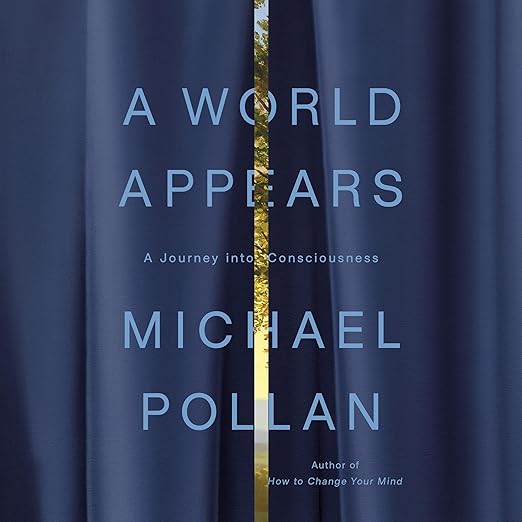
Consciousness has no outside view, which is the trouble Michael Pollan sets himself in this audiobook and then reads aloud in his own voice. Eight hours and forty-six minutes on the one subject where the instrument and the object of study are the same equipment, from a writer who has twice now caught a cultural shift on its way in. Penguin Audio published it on February 24, 2026, into an audience that has been waiting since the last book and is proving harder to satisfy than the enthusiasm suggests.
The Badge Shows 4.4, the Responses 4.8
Pollan moves through positions rather than defending one. Neuroscientists who began asking in the early 1990s how three pounds of tissue produces a point of view; researchers now entertaining less materialist accounts than that question assumes; plant neurobiologists hunting a first flicker of awareness in organisms with no brain at all; engineers attempting to build feeling into artificial systems; novelists and psychologists trying to catch the texture of the stream itself. Worth registering before you read the reception: the badge shows 4.4 across 119 ratings, while the five written responses add up to twenty-four stars between them, a visible mean of 4.8. Those are two different populations, and the quieter one is harder on the book than the one that bothered to write.
Release day itself produced the most revealing response in the sample. It comes from a listener who had a mystical experience with psychedelics in late 2020, recognized it as close to a state reached in a ten-day silent retreat two years earlier, could not reconcile the two, and went looking for an explanation. That search led to Pollan's earlier work and eventually into the research world around the subject, as a resident of the same university town where much of it happens. This new book lands on an audience that has already been rearranged by the last one, and that is worth knowing when you read how warmly it has been received.
Proust, Huxley, and Shulgin as Reference Points
Author-read nonfiction is often a marketing decision. Here it is closer to structural, because the reporting is done in the first person and several of the reported experiences are the author's own. Bringing in an outside voice would mean performing someone else's interior life, and the argument of the book is precisely that interior life does not transfer cleanly between people. A response dated March 8, 2026 names the quality that makes this work, praising the combination of consulting a wide range of experts and visibly struggling with the ideas in person. That struggle is audible in a way it cannot quite be on the page, and it is the strongest reason to take this in audio.
Range is the other attraction. A March 10, 2026 five-star arrives from a reader who reaches for Proust, Huxley's Doors of Perception and Alex Shulgin's layman writing as reference points, and who was still midway through the closing chapter on the self when they stopped to write it. The book is pitched at exactly that reader: someone who wants the neuroscience and the literature in one conversation and does not need the philosophy simplified first. It also means the demands shift chapter to chapter, from laboratory reporting to something closer to an essay on attention.
Scrubbing to the End Is Harder in a Recording
Sharpest in the sample is the four-star from March 5, 2026, which reports buying the book, skipping straight to the last chapter, and finding everything it needed in a few short pages. It calls the intervening material an exercise in deep theory building about mind, self and consciousness, conducted through interviews with academics who pontificate on the nature of the self, while still crediting the author as an outstanding writer and a serious researcher. Take that seriously as a structural warning, because the move it describes is far easier to execute on a page than in audio. Jumping to a final chapter in a recording means scrubbing a timeline with no headings in view, and a listener who suspects the payoff sits at the end has a worse time getting there than a reader does.
One more thing worth registering about the marketing. The blurb the publisher chose to lead with, from The Atlantic, spends its praise on the author's instinct for where the culture is heading and includes the concession that the book addresses artificial intelligence only intermittently. That is unusual candor inside a jacket quote, and it does useful work: if the AI angle is what drew you in, the description is telling you to adjust. The same applies to the psychedelic material, which is one route into the subject here rather than the destination it was last time.
A Subtitle This Listing Does Not Carry
One five-star, filed March 17, 2026, gives the book a subtitle the listing does not carry, calling it A World Appears: A Journey into Consciousness, and describes ordering it the day it was announced, then rationing it and rereading passages. Anyone intending to work that way should know the title field here shows no subtitle at all, which makes this record harder to match against the print edition than it needs to be. The same response praises the ability to make complex material understandable, comparing the effect to scientific poetry, and that quality is what carries a book like this across a general audience without thinning the ideas.
Listen if you liked How to Change Your Mind and want the successor question rather than a sequel, or if consciousness has been nagging at you and you want a guide who takes the mystics, the neuroscientists and the plant biologists equally seriously. Approach with caution if you want a settled answer, because the book is an inventory of competing accounts and says so in its own description. Readers who found the earlier work too personal will meet the same authorial presence here, only now it arrives as a voice in your ears for the better part of nine hours, which magnifies the effect in both directions.
Is this audiobook a sequel to How to Change Your Mind?
No, though it grows from the same soil. The publisher positions it as an exploration of consciousness itself, with psychedelics as one route in alongside neuroscience, philosophy, literature and spiritual practice. Familiarity with the earlier book helps but is not assumed anywhere in the description.
How much of the audiobook is about artificial intelligence?
Less than the framing might suggest. The blurb the publisher features says outright that the book addresses AI only intermittently, and the description places machine feeling as one strand among plant cognition, neuroscience and literary accounts of the stream of consciousness.
Is the science accessible without a background in neuroscience?
Yes. The book is built as a tour of competing positions rather than a technical treatment, and the science arrives through reporting and interview rather than through equations. A few philosophical stretches are demanding, though no chapter expects you to have studied neuroscience or the philosophy of mind beforehand.
Does the title carry a subtitle, and why does that matter here?
The listing shows none, while at least one buyer refers to the book as A World Appears: A Journey into Consciousness. If you are matching the audio against a print copy or a library catalog record, that gap is worth knowing before you assume you have found two different editions.