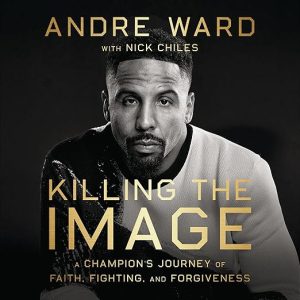
Above the marketing copy, above the championship record and the walk-away story, this audiobook opens its description with four words: Read by the author. Publishers normally bury that line at the bottom, among the credits, once the pitch has finished working. Harper Horizon put it first, ahead of the news that Andre Ward was the undefeated light heavyweight champion of the world, ahead of the Olympic gold and the retirement nobody in boxing expected. Six hours and nine minutes, out November 14, 2023. The placement functions as a claim in itself: whatever else this turns out to be, it is Ward telling it.
Kathleen Orozco's Response Breaks Off at Anointing
One hundred and twenty people have rated this at 4.9, which puts the withheld stars somewhere between seven and eighteen across the full column. The five written responses on display are fives without exception. Whatever the dissent consists of, it sits entirely in the silent portion, unexplained and unreachable. That gap is worth holding onto, because a memoir by a devout athlete gathers two audiences with very different tolerances for the same material, and only one of those audiences reliably writes anything down. The visible sample is warm to the point of unanimity. The arithmetic behind it is not, and a buyer weighing whether the spiritual frame will suit them is being shown the friendlier half of the room.
Kathleen S Orozco's January 2024 response is the oddest item in the sample and the most useful. It arrives from inside the story: the writer attends the same church as Ward and his wife, knows his mother personally, and describes the family before saying anything about the pages. Proximity of that kind would normally be a reason to discount a review, and here it does something more interesting instead, confirming from outside the text that the faith material is a life rather than a publishing posture. It also warns you what sort of book this will be. The response then breaks off mid-thought, cut short at the word anointing, one clause before it would have explained why.
The Career Is the Least Interesting Part
Ward's career turns out to be the least interesting thing in the book, which is what the description argues and what the sample confirms. The Olympic gold, the undefeated light heavyweight run, the decision to stop while still holding the belts, the friction with managers and promoters: all of it is present, and all of it is framed as the smaller fight. The larger one is a broken childhood, an anger that had to be dismantled rather than aimed at somebody, teenage fatherhood arriving in the middle of an amateur career, and the question of what a person does with an inheritance nobody chose for themselves.
Boxing listeners get the technical thread anyway. A December 2023 five-star picks out the recurring pattern of Ward meeting opponents with more natural talent than his own and answering it with discipline, an observation that comes from somebody who followed the fights rather than the headlines. The same response maps the arc it valued most: anger carried out of a broken home, escape from self-made conflict, teenage fatherhood managed rather than survived, and the resolve that produced the record. It stops mid-sentence on the page, one word into the discipline point, which is unlucky given that discipline is the book's real thesis and the fights are only its evidence.
The One Question the Six Hours Never Answer
None of the five written responses says a word about the recording. Not the pacing, not the delivery, not whether an athlete with no professional reading background can hold six hours of prose together. They discuss reading: what was learned, what was inspiring, what to pass along. Across a hundred and twenty ratings on a self-narrated memoir, the single question that belongs only to the audio edition has gone unasked, so a listener choosing between formats gets nothing from the page and has to take the sample on trust.
Faith is load-bearing here, and the description makes no attempt to soften that. Biblical truths, living out belief without compromise, breaking destructive generational bonds, the ring name Son of God carried through a professional career: the spiritual frame holds the structure up. A December 2024 response describes Ward as overlooked throughout his career, never boisterous, never the fighter you tuned in to hear talk, and that restraint is exactly what makes the book land for one kind of listener and stall for another. Anyone expecting a boxing memoir in the trash-talk tradition has picked up something much closer to a testimony, delivered at conversational volume.
Testimony Rather Than Tape Is the Transaction
Fight followers who never understood the retirement will get the reasoning from the person who made the call, at length, with the promoters and managers still in the frame. Listeners who come to sports memoirs for psychology rather than round-by-round reconstruction will find the childhood chapters carrying far more weight than the championship ones, and that imbalance is deliberate. The faith audience is being addressed directly and will know it within twenty minutes, particularly anyone working through forgiveness toward a parent, since the description sets that out as an explicit aim instead of burying it in subtext. Listeners raised inside church culture will recognize the register within a page, and the ones who were not can still follow the argument, because the emotional mechanics underneath it are secular enough to travel on their own.
Readers wanting an unsentimental sports book should look elsewhere, because a spiritual reading of every setback is the organizing principle rather than an occasional aside. Pass on it too if you need a chronological fight-by-fight record, since the structure is thematic and the ring works as a setting more than a subject. One of the five responses on display runs to three words in total, which is a fair measure of how much a buyer can actually extract from the sample. Six hours and nine minutes of a fighter narrating his own formation is the product on offer, and for the testimony rather than the tape, that is the right transaction.
Quick Take
- Performance: Author-read, which on a memoir this personal is the format decision that matters more than any other.
- What it covers: A broken childhood and generational anger, faith carried into professional sport, retiring undefeated and on purpose
- Feel: Plainspoken and devotional
- Our call: Strong on formation and forgiveness, thin as a fight history, and the Christian frame is not an optional layer.