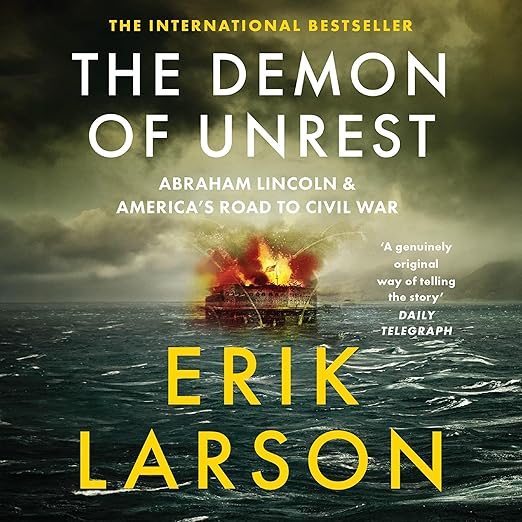
Seventeen hours on five months of American history is either precisely what you wanted or considerably more than you bargained for, and The Demon of Unrest audiobook does not meet you halfway. Erik Larson takes the stretch between Lincoln's election on November 6, 1860 and the Confederate shelling of Fort Sumter and slows it almost to a standstill, working on the theory that the interesting part of any catastrophe is the interval when it could still have been called off.
Major Anderson's Contradiction at the Center of Sumter
Framing is the argument. Everything happens in the gap between a contested election and the first shot, with one state after another seceding and a president-elect who has no power to stop any of it. The passions of North and South converge, improbably, on a lonely federal fortress in Charleston Harbor, and the book is finally about how a national rupture came to hinge on a resupply question at one installation. Larson's own inventory of the period, tragic errors and miscommunications, inflamed egos and craven ambitions, personal tragedies and betrayals, doubles as an accurate table of contents.
Real verification turns up in exactly one response, filed on the United Kingdom storefront on January 27, 2026, and it is the rare account that went and looked. It calls the book well written and genuinely dramatic while holding strictly to the historical record, then reports looking up some of the primary sources afterward and finding that Larson had, if anything, underplayed them. The same account rates the book very accessible for somebody with no prior knowledge, which counts for a lot on a subject where most of the shelf assumes you have already read three others.
The cast is where the seventeen hours go. Major Robert Anderson holds Sumter as a former slave owner sympathetic to the South and loyal to the Union, a contradiction the book declines to resolve on anybody's behalf. Edmund Ruffin appears wherever secessionist feeling needs stirring, vain and bloodthirsty by the copy's own description. Mary Boykin Chesnut, married to a prominent planter, is conflicted about both her marriage and slavery and sees the parallel between them. Lincoln, meanwhile, spends the period managing a duplicitous Secretary of State in William Seward while trying to avert a war he already fears is inevitable.
Not One Response Mentions the Recording Itself
The November 2025 five-star supplies the best short description of the experience anyone on the page manages: like watching a slow moving train wreck. That response calls it an excellent behind-the-scenes account of the lead-up, well researched and well written, and then spends the remainder of its space on present-day politics rather than on the book, which is worth knowing if you are scanning for craft notes rather than for opinions about the present.
Will Patton takes the reader credit, and no written response on the page mentions the recording in any way. On a seventeen-hour commitment with a named narrator attached, that silence costs a buyer something concrete. Nobody has told you whether the delivery suits a book assembled from diaries, secret communiques, slave ledgers and plantation records, where a great deal of the pleasure depends on documents being read with the right amount of restraint. Sample it before you commit, because the page itself offers no help at all on that question.
The structure is strictly chronological, which is what makes the length survivable. Larson moves forward as the crisis narrows, so the book always knows what date it is, and that hands a listener the one thing a long history usually withholds: a clear sense of where you are. Seventeen hours spread across five months of calendar time works out to a great deal of attention per week of the crisis, and that density is the design rather than an accident of research.
A British Edition Filed as Memoir, Not History
The lowest grade on the page is also the most useful thing on it. A two-star from February 2026, written by somebody who admires Larson's style and clarity from other books, finds the events preceding the attack fascinating and their treatment thin: scant background, scant context, and then a book that ends promptly with ceremonies at Sumter following the war. Unsatisfying, that account concludes, like reading a few chapters of a much longer work. Anyone arriving here for a history of the Civil War has that exact disappointment waiting.
The rest of the pool needs a caveat attached. Among the five entries, one is the two-word verdict great book and another consists of the phrase as promised, filed at five stars, which is a note about an order arriving rather than an opinion about seventeen hours of narrative history. Both are folded into the 4.5 average across a hundred and twenty-one ratings. Three of the five say anything substantive at all, and the two that go furthest disagree about scope rather than about quality, which is the more interesting argument anyway.
One edition problem is worth noticing here. The publisher on this entry is William Collins, and the description keeps British spellings and British single quotation marks throughout, so American buyers are reading copy prepared for a different market. The entry is also filed under biographies and memoirs alongside history and politics, and it is neither a biography nor a memoir. This is narrative history built around four or five people, which is a distinction that matters when you are deciding what you are buying.
Newcomers Are a Disputed Case on This Page
This is for listeners who already like the shape of Larson's books, where an enormous event gets approached through a handful of people who could not see it coming. It suits anyone drawn to how institutions fail in slow motion, and anyone who wants the months before a war rather than the war itself. Newcomers are the disputed case on this page, where the two substantial accounts land on opposite sides of how much context the book supplies, and my read is that the answer depends on what you want context about. The five months are covered exhaustively. The decade behind them is not.
Avoid it when you want a survey, because this is a deep core sample of one interval and it will not tell you how the war went or how it ended. Avoid it too when seventeen hours of political maneuvering, telegrams and misread intentions sounds like an obligation rather than a pleasure, since the tension here is entirely procedural: everybody is waiting on a supply ship and reading each other wrong. If that prospect appeals, the running time will not feel like seventeen hours.