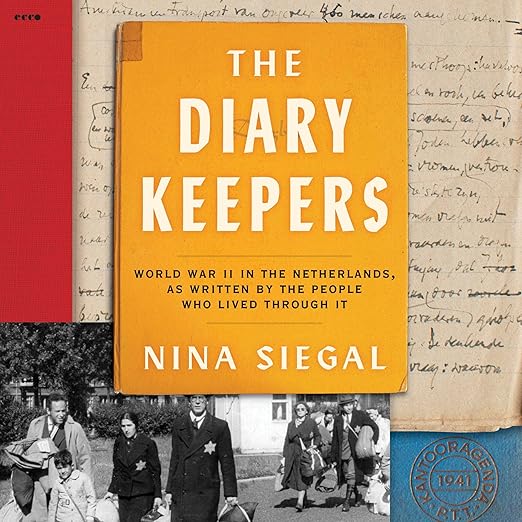
Nina Siegal grew up hearing her family's Holocaust survival stories told as moral fables, shaped for American assimilation, stripped of the details that might complicate the lesson. When she moved to Amsterdam as an adult and raised a Jewish child there, the questions she had suppressed came back with force. Among them: why did seventy-five percent of Dutch Jews perish in the war, a proportion dramatically higher than in other Western European countries, when the narrative of Dutch resistance had been told with such consistency and pride? The Diary Keepers, this extraordinary audiobook running seventeen hours and narrated by the author, is her attempt to answer those questions honestly, through the words of ordinary people who wrote down what they saw.
Siegal, a journalist and longtime Amsterdam resident, found her way into a Dutch government archive that holds more than two thousand wartime diaries, collected by a government-in-exile that foresaw even before the war ended that first-person testimony would be the most durable form of historical evidence. From that archive she selected seven diarists whose perspectives represent the full spectrum of Dutch wartime experience: Jewish men and women, a Nazi-sympathizing police officer, a Dutch Nazi, a Jewish journalist who documented daily life at a transport camp. The result is not a unified narrative but something more complex and more honest.
What makes The Diary Keepers formally distinctive is Siegal's refusal to stand above her sources as an omniscient narrator. She positions herself as a reader of diaries who is also writing her own, which means the book contains her ongoing interpretation of what the diaries reveal, where they contradict each other, where they confirm what she feared, and where they surprise her. That layered structure, diary within contemporary reflection within historical analysis, creates a reading experience closer to essayistic memoir than to conventional history. Siegal is not summarizing the diaries; she is thinking through them in front of the listener.
The most disturbing and most necessary of the diarists is the Nazi-sympathizing police officer. Siegal does not withhold his testimony or contextualize it into insignificance. She lets it sit next to the Jewish diarists' accounts of the same period, the same streets, the same deportations, and asks what it means that ordinary bureaucratic cooperation from people like him made the Dutch death toll so catastrophically high. One reviewer described the book as raising ideas about the writing of proper history based on first-person accounts and questioning why it took so long after the war for certain truths to emerge. That question is exactly what the Nazi sympathizer's diary forces into the open.
Siegal's Fluent Dutch Reads as Cultural Recognition
Siegal's self-narration is the audiobook's most significant asset. She is fluent in Dutch and has spent years immersed in Amsterdam's cultural geography, and that fluency is audible in the way she handles the street names, the institution names, the Dutch-language idioms that appear throughout the source texts. A professional narrator working from a script would have produced accurate phonetics; Siegal produces cultural recognition. The difference is felt throughout, but particularly in the passages drawn directly from the diaries, which she reads with the care of someone who has spent months with these specific sentences.
At seventeen hours, the audiobook is a genuine commitment, and it rewards that commitment with the density and complexity that the subject demands. One reviewer noted that the language flows well and that the book draws you in even at the ten-percent mark. That early engagement is a testament to Siegal's skill as a prose stylist: she writes analytically but never drily, and her personal stake in the questions she is investigating keeps the book from ever settling into the distanced neutrality of academic history.
How Nations Process Guilt Through Selective Commemoration
The most intellectually productive passages in the book are those where Siegal examines how the postwar Dutch narrative of resistance was constructed and maintained. The discrepancy between that narrative and the statistical reality of the Jewish death toll is not merely a historical puzzle; it is a case study in how nations process guilt through selective commemoration. Siegal does not moralize about this, but she does not allow easy consolation either. She wants to understand why the true history was suppressed, not to condemn the suppressors but to understand what forgetting costs.
The supplemental PDF mentioned in the production notes accompanies the audiobook and contains materials that support the text. Listeners engaging primarily through audio should be aware that certain references to documentary materials may be enhanced by accessing that companion document, though the audiobook is fully coherent without it. The physical geography of Amsterdam and the documentary geography of the archive are both navigated clearly enough in Siegal's narration that the PDF functions as enrichment rather than necessity.
Beyond Anne Frank, Primo Levi, and Viktor Frankl
Readers who have engaged with the standard WWII memoir canon, Anne Frank, Primo Levi, Viktor Frankl, and who are ready for a work that interrogates the construction of that canon rather than simply adding to it will find The Diary Keepers an essential and sometimes uncomfortable companion. Historians, documentary filmmakers, and anyone interested in how archives function as both preservation and interpretation will find Siegal's methodology as interesting as her conclusions. Listeners who appreciate long-form essayistic nonfiction in the tradition of Emmanuel Carrere or Susan Sontag will recognize and value the form she has chosen.
Those who prefer their Holocaust history in conventional biographical or chronological narrative form may find the book's essayistic structure more demanding than they expected. The intellectual rewards are substantial, but they require patience with a writer who follows her questions wherever they lead rather than toward a predetermined destination.
Quick Take
- Voice: Nina Siegal reading her own work brings an extraordinary intimacy to a book about bearing witness; her fluency with the Dutch names and wartime Amsterdam context is audible and authoritative.
- Big ideas: memory and commemoration, complicity and resistance, the function of ordinary testimony
- Atmosphere: Absorbing and ethically serious, with the slow-accumulating weight of primary source history
- Worth it?: The Diary Keepers is among the most important WWII historical works in recent memory, and Siegal's self-narration makes the audiobook the definitive way to encounter it.
Does Nina Siegal narrating her own audiobook make The Diary Keepers a better listening experience?
Significantly so. Siegal's fluency in Dutch and her deep familiarity with Amsterdam's wartime geography and culture produce an authority in the narration that no professional reader could fully replicate. The passages drawn directly from the diaries benefit especially from her sense of the specific weight those words carry.
How does The Diary Keepers audiobook handle the Nazi sympathizer diaries without normalizing collaboration?
Siegal juxtaposes the Nazi-sympathizing police officer's diary with the Jewish diarists' accounts of the same period without editorializing the contradiction away. The effect is to force the listener to hold the coexisting perspectives simultaneously, which is more morally demanding and more historically honest than a filtered summary would be.
Do I need to be familiar with Dutch history or WWII history to follow this audiobook?
Basic familiarity with WWII and the Holocaust will help, though Siegal provides substantial historical context throughout. No specialized knowledge of Dutch history is required. Her exploration of why the Dutch Jewish death toll was disproportionately high is itself a central argument of the book rather than assumed background.
At seventeen hours, is The Diary Keepers audiobook appropriate for a single extended listen or better taken in sections?
The book's essayistic structure, moving between diary readings, historical analysis, and Siegal's personal reflection, makes it well-suited to extended sessions for engaged listeners but also easy to pause and return to. The diarists' threads carry forward clearly enough that listeners who take breaks will not lose the thematic threads.