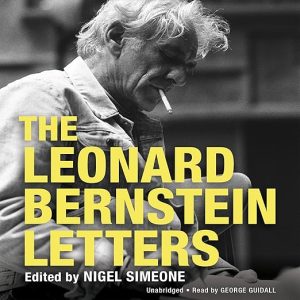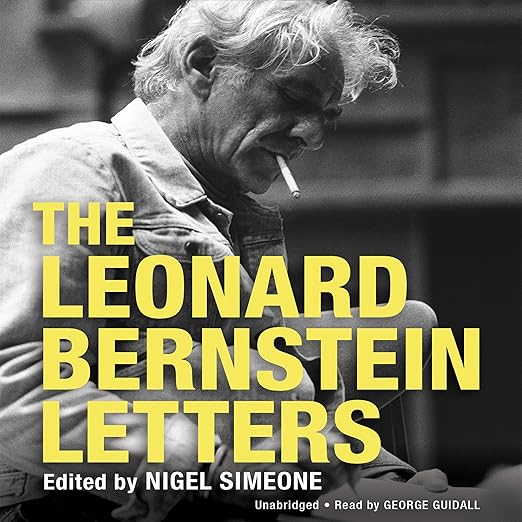
Leonard Bernstein wrote letters the way he conducted: with full commitment, no apparent self-editing, and a quality of attention that made the recipient feel like the most important person in the room. The Leonard Bernstein Letters is the audiobook adaptation of Nigel Simeone's edited collection of that correspondence, read by George Guidall over twenty-three hours and forty-one minutes. I came to this project already knowing the broad strokes of Bernstein's biography , the Koussevitzky mentorship, the West Side Story years, the turbulence of his personal life. What I was not prepared for was how different it feels to encounter this material as letters rather than as retrospective biography, written in the moment rather than organized in hindsight.
A Relationship With Copland the Letters Make Vivid
The selection Simeone assembled is remarkable for its breadth. Bernstein's correspondents here include Aaron Copland (a relationship whose warmth and complexity the letters make vivid), Stephen Sondheim, Jerome Robbins, Thornton Wilder, Boris Pasternak, Bette Davis, Adolph Green, and Jacqueline Kennedy Onassis, along with family members including his wife Felicia and his sister Shirley. The majority of these letters were previously unpublished, which gives the collection its primary claim on your attention. You are not reading something that has been processed and contextualized by a biographer. You are reading Bernstein writing in the heat of the moment, complaining about schedule, celebrating a performance, navigating his complex sexuality, lobbying for musical causes, grieving, strategizing, joking.
The Humphrey Burton biography, which reviewer SerenityNow cites as a long-admired predecessor, provides the narrative skeleton that contextualizes what the letters flesh out. This collection does not replace that kind of structured life account. What it does instead is give you access to the register that biographies cannot replicate , the offhand remark, the sentence that reveals how Bernstein actually thought about a rival, a mentor, or a piece of music he was trying to finish against impossible time pressure. His constant struggle to find time to compose, which the synopsis identifies as a recurring theme, surfaces across multiple decades of correspondence with the quality of genuine frustration rather than managed narrative.
George Guidall Keeps Public and Private Distinct
George Guidall is one of the most experienced narrators in the audiobook world, with a catalog that spans decades and genres, and his performance here is calibrated to the particular demands of epistolary content. Letters are not prose designed for oral delivery. They shift register, interrupt themselves, oscillate between formal and intimate within the same paragraph. Guidall handles these transitions without making them feel like technical obstacles. His voice carries both the public-platform Bernstein , formal letters to Boris Pasternak, correspondence about civic musical life , and the private Bernstein, letters to Copland that reveal a friendship of exceptional depth, without homogenizing them into a single register.
The twenty-three-hour runtime is substantial, and it is worth being honest about what that means for listening strategy. Reviewer T. Fisher notes that this collection only begins to scratch the surface of Bernstein's actual output, which is a staggering thought given the size of what is here. What Simeone has curated is already an anthology of considerable density, and as an audiobook it rewards measured engagement over marathon sessions. The letters are organized chronologically, which gives the audiobook the cumulative quality of watching a life unfold. The young Bernstein writing to Copland in the late 1930s is recognizably continuous with the older Bernstein writing to Sondheim decades later, but the changes are visible in real time.
Candor About Bernstein's Complex Personal Life
A few things to know before committing to the full runtime. This is not an audiobook about the music itself. It is about the man who made it, and while musical discussion appears throughout the correspondence, listeners hoping for analytical engagement with Bernstein's compositional technique will find the letters more interested in the human and logistical dimensions of creative work. The complexity of his sexuality, his political activities, and what the synopsis describes as his turbulent and complex personal life are present throughout and handled with the candor Bernstein himself deployed in the letters. This is not sanitized biography, and it should not be.
The collection also assumes some familiarity with the mid-twentieth century American cultural landscape. References to specific productions, political contexts, and musical figures will be richer for listeners who already know something about the postwar American arts scene. That said, Simeone's editorial apparatus provides enough context that the letters are accessible even without deep specialist knowledge. A musician who was personally befriended and encouraged by Bernstein left a review calling the letters absolutely fascinating for anyone interested in this extraordinary man, and that openness of the material to different levels of background knowledge is one of its genuine strengths.
In His Own Words, Fully Unguarded
This audiobook is designed for listeners with a serious interest in Bernstein specifically, in twentieth-century American music more broadly, or in the genre of epistolary biography and what private correspondence reveals about public figures. Fans who have read the Burton biography or encountered any of the significant writing about West Side Story, the Young People's Concerts, or the Age of Anxiety will find this collection deepens everything they thought they knew.
Casual listeners or those without prior engagement with Bernstein's work may find twenty-three hours of correspondence a steep investment without that context. But for anyone who has ever heard the Chichester Psalms or watched footage of Bernstein conducting and wondered what the man was like when the cameras were off, this is the closest answer available , in his own words, at full and unguarded length.
Do I need to know Bernstein's biography before listening to this audiobook?
Some background helps considerably. Simeone provides editorial context, but the letters assume familiarity with the key figures and moments of Bernstein's life. Listeners who have read the Humphrey Burton biography or have some knowledge of his major works and relationships will find the correspondence richer and more immediate.
How does George Guidall's narration handle the variety of voices and registers across this audiobook?
Guidall is one of the most experienced narrators in the business, and he handles the challenge of epistolary material , which shifts constantly between formal and intimate registers within single letters , with steady authority. He does not attempt to impersonate different correspondents, but his tonal range across formal and private letters is persuasive across the full twenty-three hours.
Is this audiobook appropriate for listeners primarily interested in West Side Story or Bernstein's Broadway work?
Yes, though the collection is much broader than any single project. Broadway collaborators like Stephen Sondheim and Jerome Robbins appear in the correspondence, and letters from the West Side Story period are part of the selection. The audiobook also covers his symphonic work, his conducting career, his political life, and his personal relationships , it is a full portrait, not a Broadway retrospective.
At nearly 24 hours, how should listeners approach the audiobook's length?
The chronological organization helps , each period of Bernstein's life has its own character, and the letters accumulate meaning the way a life does, gradually. Most listeners will find shorter, focused sessions more rewarding than marathon listening. The collection is dense enough that it rewards the kind of attention you bring to reading rather than background audio.