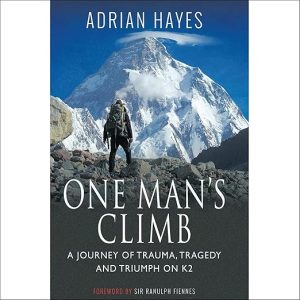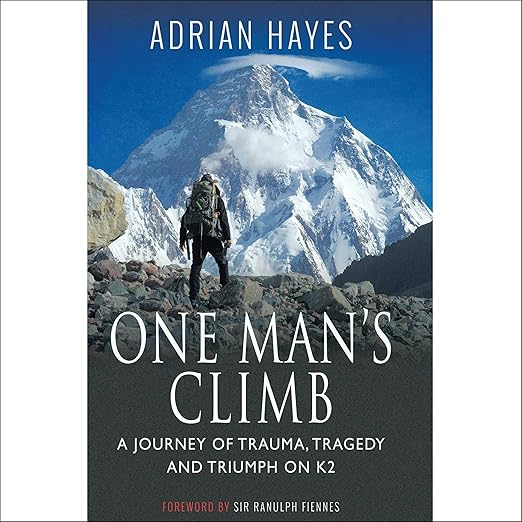
K2 produces a specific kind of memoir, because K2 produces a specific kind of experience. At 8,611 meters on the China-Pakistan border, with a fatality rate for summit attempts historically approaching one in four, the Savage Mountain does not permit the narrative tidiness that lower-altitude adventure writing sometimes manages. Adrian Hayes's One Man's Climb, in which he narrates his own two attempts on K2 in 2013 and 2014, is an audiobook shaped by that refusal. It does something more difficult than reporting success: it documents the texture of attempting something that may not be achievable, and then doing it again. Eight hours and twenty minutes of that kind of honesty makes for uncomfortable and rewarding listening.
Not a Trophy but a Sustained Test
Hayes is an explorer with genuine credentials. He holds several world records and has previously written about trekking the Empty Quarter of Arabia, mirroring the route of British explorer Wilfred Thesiger. The K2 context matters here because Hayes approaches the mountain not as a trophy but as a sustained test of something he is trying to understand about himself. The 2013 attempt and the 2014 return give the book its structure: each iteration adds information about what the mountain actually requires and about what Hayes himself is capable of and willing to endure under conditions that approach the limits of human physiology.
The self-reflective dimension the synopsis points to is real and distinguishes this book from pure summit-or-bust mountaineering narrative. Hayes is attentive to what altitude and exhaustion do to perception, decision-making, and emotional state. He writes about fear with precision rather than drama, about the specific quality of physical suffering at extreme altitude, and about the deaths that occur on K2 during the periods he is there, not as backdrop but as central events that change the nature and weight of what he is doing on the mountain. These passages are among the most affecting in the book and are handled with the kind of seriousness they deserve.
The critical reception reveals a genuine tension worth addressing directly. One reviewer described Hayes as too self-assured, finding the self-presentation too confident for the philosophical territory the book attempts. Another called it stunning and praised its depth and ability to inspire. This divergence is not accidental. Hayes writes from a position of significant confidence in his own capabilities and perspectives, and that confidence is simultaneously what enables him to attempt K2 twice and what can register as arrogance in the more reflective passages. Readers who find self-assurance in adventure memoir irritating will encounter it here. Readers who find it appropriate given the undertaking will find it a fair representation of the person making these choices.
Hayes's Voice, Reporting From Inside the Experience
The self-narration is the critical choice for this audiobook format. Hayes's voice, carrying a particular quality of someone reporting from inside an experience rather than at a composed remove from it, gives the altitude sections an immediacy that professional narration would struggle to replicate. When he describes the decision calculus around a summit push in deteriorating weather, or the conditions at a high camp during a storm, you hear the knowledge of someone who was physically present at those altitudes. The exhaustion and the fear are not performed.
One listener described the book as deeply touching and absorbing, praising Hayes's life lessons, jokes, and humor as elements that prevent the memoir from becoming relentlessly grim even when the circumstances are deadly serious. Another described it as stunning. Both responses point at what the eight-hour runtime achieves: the space to develop both the physical narrative and the interior reflection without forcing either to be abbreviated. Hayes does not rush toward the summit or away from failure. He stays in the experience, which is where the book's value lies.
A Different Relationship With the Same Mountain
The deaths that occur during Hayes's time on K2 are not treated as atmospheric detail. Hayes confronts them as events that require moral and emotional reckoning, and the sections dealing with loss on the mountain are among the most affecting in the book. This is not a memoir that aestheticizes summit fatalities or uses them as narrative stakes to heighten the protagonist's drama. The weight is real and is treated as real.
The K2 literature is considerably less crowded than Everest writing, and Hayes's dual-attempt structure is unusual within it. Most high-altitude memoirs are organized around a single expedition and its outcome. Having two attempts, with the interstitial period of preparation and decision-making between them, gives One Man's Climb a richer sense of what sustained commitment to an extreme objective actually costs. The second attempt is not simply a repetition of the first with a different outcome. It is a different relationship with the same mountain, informed by everything the first attempt revealed.
Testing Yourself Against Something Uncontrollable
Adventure memoir listeners with an interest in high-altitude mountaineering will find this account substantive, honest, and structurally unusual enough to occupy its own space in the literature. Hayes's expedition background distinguishes his perspective from first-time high-altitude climbers, and the dual-attempt structure gives the book a narrative shape that single-expedition accounts cannot replicate.
Listeners who prefer their adventure memoirs to conclude with triumph may find the book's reckoning with limitation and failure more challenging than they want from the genre. That challenge is precisely what makes One Man's Climb worth recommending: it is a memoir about what happens when you test yourself against something genuinely uncontrollable, and it does not resolve that test with the convenience that commercial adventure publishing often demands.
The Short Version
- Narrator: Adrian Hayes narrating his own story is the critical production choice here. His voice carries the fatigue and resolution of lived experience rather than an actor's approximation of it.
- Subjects: Human limits and the will to exceed them, the psychology of extreme risk, grief and endurance at altitude
- Tone: Intimate, physically intense, and honest about failure in ways that more polished adventure memoirs rarely are
- Bottom line: One Man's Climb is a K2 memoir that earns its emotional weight by refusing to romanticize either the mountain or the man attempting it.
Frequently Asked Questions
Does Adrian Hayes reach the summit of K2 in this audiobook?
The book covers two separate attempts in 2013 and 2014. The memoir is structured around the experience of attempting K2 and what it reveals about human limits, rather than simply recording a summit outcome, and the emotional weight reflects that framing.
How does Hayes's self-narration affect the One Man's Climb audiobook listening experience?
Significantly. Hayes narrating his own story gives the climbing sections an immediacy that professional narration would struggle to match. His voice carries the knowledge of someone physically present at altitude, which listeners note adds considerable depth to the more intense passages.
Is this audiobook suitable for listeners who are not themselves mountaineers?
Yes. Hayes writes reflectively about the experience in ways that do not assume technical climbing knowledge. The psychological and philosophical dimensions are as central as the physical narrative, making it accessible to readers drawn to extreme challenge memoirs rather than technical climbing guides.
How does the One Man's Climb audiobook handle the deaths of other climbers on K2?
Hayes treats the deaths that occur during his expeditions with genuine moral seriousness, not as dramatic backdrop. These passages are among the most affecting in the book and are handled with respect for both the people involved and the weight of the circumstances.