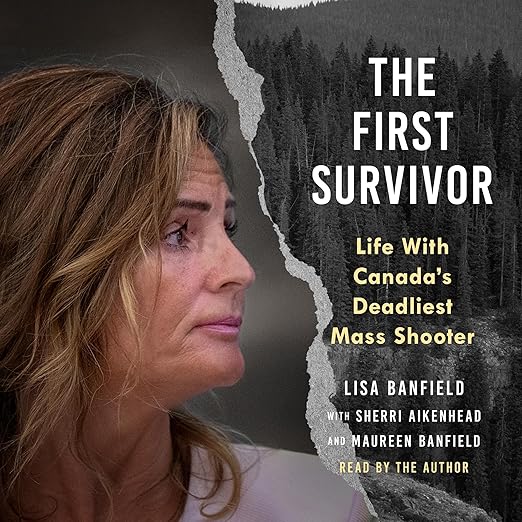
Nineteen years inside a controlling relationship end, in this audiobook, on the night of April 18, 2020, when Lisa Banfield escaped an assault by her partner and ran barefoot into freezing woods without knowing that the man behind her was beginning the deadliest mass shooting in Canadian history. Twenty-two people and an unborn child were killed before it ended. Banfield reads the memoir herself, and that single production decision shapes everything about how the recording lands, because the account it delivers has been publicly doubted, and here it arrives in the voice of the person being doubted.
Two Books Braided Together, and Uneven
The Canadian entry filed on January 24 caught the book at four days old and already at the top of the true crime list, then did the genuinely useful thing and quoted from it. Banfield writes that the what-ifs still haunt her, that she wonders whether those innocent people would be alive had she not escaped to the woods, and that survivor guilt is something she expects to carry permanently. In that entry the passage breaks off mid-sentence behind a run of stray characters left over from wherever it was copied, and even truncated it tells you more about the book than the publisher's summary does. Chart placement in true crime is part of the story too, because the shelf that made this book visible is the same shelf that treats a survivor's life as material, and Banfield spends real time pushing back against precisely that framing.
Banfield has really written two books braided together, and the braid is uneven. One of them is a close account of coercive control: how a relationship narrows, how grooming works on someone who was nineteen years younger when it started, how leaving becomes technically possible and practically unthinkable. The other is an argument about the machinery that surrounds a survivor afterward, the questions, the suspicion, the demand that she account for a man's actions. Seven hours is enough room for the first and barely enough for the second, and the recording gives the second less air than it needs. A linear file also hides the seam: a reader can see an argument coming in a chapter heading, while a listener simply notices at some point that the register has changed and the book has started making a case.
A Hired Reader Would Have Made It About Her
January 28 brought a response from Canada that named the thesis better than the jacket copy does: that society villainizes women who are victims of abuse, and that this memoir shows the process working in real time. That reader also named the two things worth carrying out of it, the kindness Banfield received from strangers and the bond with her sisters that made healing possible at all, and the recognition of what that entry called the loss of self that anyone who has been in such a relationship will know instantly. That recognition is the book's actual audience finding it.
Self-narration matters more here than on almost any memoir I can name. Banfield spent nineteen years having her perception managed by someone else, and the plain fact of hearing her set out the sequence in her own timing is not a performance choice so much as the argument itself. A hired reader would have made this a story about her. Read by the author, it stays a statement from her, which is the difference between testimony and true crime entertainment, and it is the difference the whole project depends on.
Whether This Voice Earns Your Trust
The column under this listing is not unanimous, and the disagreement is not about prose. The only dissent among the written responses, filed from the United States on January 21, accuses Banfield of having changed her story and of benefiting from a tragedy that took other families' relatives, questions the plausibility of the night in the woods by setting it against another survivor's hypothermia, and closes by telling people not to buy it. I cannot adjudicate that, and neither can a listener. What a buyer needs to know is that this is contested ground, that the contest sits inside the column itself, and that the recording gives you one side of it, at length, in the first person. My practical advice is to sample the opening before buying, because whether this voice earns your trust is the whole question, and no summary written by me or anyone else can settle it on your behalf.
Handle the content warnings as real. The book covers years of intimate partner violence including grooming and a violent assault, and then a mass casualty event in which twenty-two people and an unborn child died. Nothing about it is at a comfortable distance. Two record-level details are worth knowing as well: the audio edition is dated February 2026 while the written responses cluster around a print release the previous month, so what you are reading underneath the listing grades the book as a book. Sutherland House Books gives the recording six hours and fifty-nine minutes, which works out to four evenings for most people. I would not compress it further than that. The cumulative weight is the point of the book, but it does accumulate.
One Woman, Many Others, an Entire Country
One American five-star, filed on January 25, put the scope plainly: a real experience shared by one woman, and by many others involved, and beyond them by an entire country. Advocates, counselors, students of family violence and anyone who has been asked why she did not simply leave will find this a rigorous, first-hand account of why that question is malformed. Canadian listeners with any memory of April 2020 will hear a familiar public event from a vantage point very few people ever occupied.
Anyone for whom detailed accounts of coercive control are unsafe listening should approach with a plan, or not at all. True crime listeners hoping for an investigation of the shooting itself will be disappointed, since the killings are the horizon of this book rather than its subject, and the reconstruction they want is not on offer at any point in the book. Book clubs will find that it generates discussion instantly and heat almost as fast, which is either the reason to pick it or the reason to leave it alone. What this recording cannot do is settle the argument it walks into, and it never pretends to try.
Questions Listeners Ask
Does The First Survivor investigate the April 2020 shooting itself?
No. The killings frame the memoir rather than fill it. Banfield writes about the nineteen years that preceded that night, the assault she escaped, and the hours she spent hidden in the woods while the rampage unfolded. Readers wanting a reconstruction of the attack and its policing will need a different book.
Who narrates The First Survivor audiobook?
Lisa Banfield narrates her own memoir. The recording runs six hours and fifty-nine minutes and was published by Sutherland House Books in February 2026, with a single credited voice throughout and no second reader brought in for quoted material or supporting documents.
How difficult is this audiobook to listen to?
Difficult, and deliberately so. The material includes grooming, years of coercive control, a violent physical assault, and the deaths of twenty-two people and an unborn child. Audio removes the ability to skim ahead, so listeners who need distance from this subject should treat the length as seven hours of sustained exposure.
Does the audiobook address the public reaction to Lisa Banfield?
Yes, and it is one of the book's stated aims: to expose how society sees, supports and judges survivors. A March 2026 response from Canada answers that pressure directly, saying it cannot imagine what more anyone could ask her to say, which is the reception the memoir was written to provoke.