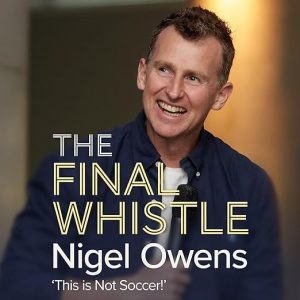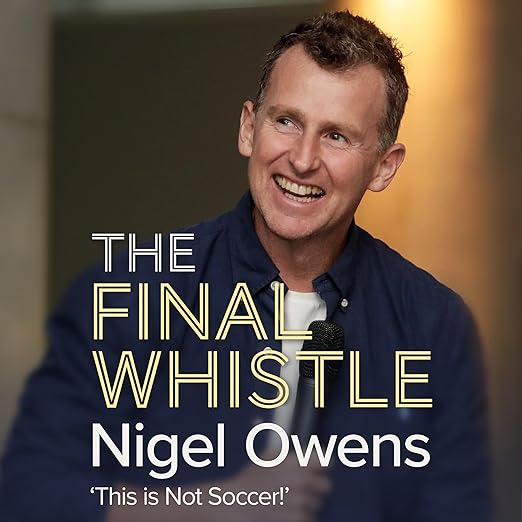
- Narration: Nigel Owens narrating his own story brings a directness and warmth that no hired reader could replicate, the Welsh cadences and the self-deprecating humor are entirely his.
- Themes: Coming out in a hypermasculine professional world, survival through public performance, the relationship between personal integrity and professional authority
- Mood: Warm and frank, with passages of genuine darkness that do not linger longer than they need to
- Verdict: A rugby memoir that transcends the sport, Owens is one of sport's more compelling lives, and he tells it without posturing.
Nigel Owens is probably the only referee in world rugby whose name fans of the opposing team both know and say without contempt. That is a remarkable position to occupy in any sport, let alone one as tribal as rugby union, and The Final Whistle is the story of how he got there, and at what personal cost. This audiobook begins where most sports memoirs would not dare: with a man who tried to take his own life, who then emerged from the darkest period of his life to become not only the best referee of his generation but the first openly gay leading figure in a sport that was not, by reputation, prepared to receive that news well.
The fact that Owens narrates this himself matters enormously. He has a Welsh accent and a precise timing for comic delivery that his famous on-field remarks, "This is not soccer" remains one of the most replicated referee clips in rugby history, make clear. But beyond the humor, there is a directness to his narration of the darker material that a professional reader would have handled more cautiously. Owens tells the story of his suicide attempt and the self-loathing that preceded it with the same matter-of-fact clarity he brings to a Heineken Cup final explanation of why someone just got yellow-carded. That tonal consistency is one of the audiobook's defining qualities.
Showing the Confusion Behind Disclosure
The foreword by Dan Carter signals the esteem in which Owens is held within the sport, and the memoir earns that esteem through a willingness to show its working. Owens does not present himself as a seamlessly heroic figure who overcame adversity through sheer strength of character. He shows the confusion, the professional calculation, the fear of disclosure, the relief when disclosure finally came, and the complexity of navigating a very public life in a sport whose culture was genuinely hostile to the kind of person he is.
One reviewer captured it simply: "A fascinating read detailing Nigel's early life, his progression through the refereeing ranks, a reminder of his struggles with accepting being gay and the high esteem he is clearly held in throughout the game." That summary is accurate, but the book is worth more than a summary. The progression from a young man in rural Wales trying to understand himself, through the refereeing career that gave him purpose and public identity, to the decision to come out and the aftermath, this is a coherent life narrative with genuine arc.
Two Strands Integrated, Never Separated
At 7 hours and 27 minutes, the audiobook is compact for a memoir that covers this much ground. Owens does not linger. The rugby content is present and substantial, his rise through the ranks, the major matches, the working relationships with players and coaches, but it never crowds out the personal material. The two strands are integrated throughout rather than separated into sections, which is the right structural decision. Owens the referee and Owens the man are the same person, and the memoir insists on that continuity.
The humor that made him a social media phenomenon translates well to audio. The anecdotes about player interactions during high-stakes matches are genuinely funny, and they sit alongside the heavier material without undermining it. This tonal range, the capacity to be warm and funny and also unflinchingly honest about dark experience, is what makes the book worth more than a standard sports biography.
What It Cost to Go First
Rugby knowledge is useful but not required. Owens explains his career's significant moments with enough context for non-specialists, and the sport is background to the personal story rather than its center. Listeners who know nothing about rugby union will be able to follow the career arc without difficulty; listeners who follow the sport will recognize the matches and appreciate an insider account of what it looks like from the middle of the pitch.
The book is not a clinical examination of homophobia in rugby union culture or an advocacy document. It is a personal story, and the cultural and institutional dimension is seen entirely through one man's experience. Readers wanting a systematic analysis of LGBTQ+ inclusion in professional rugby will need to look elsewhere. What the book offers instead is something harder to manufacture: a specific, embodied account of what it cost and what it felt like to be the person who went first.
An Unguarded Voice That Transcends the Genre
Rugby fans will find this essential reading about one of the sport's most distinctive figures. The ratings, 4.6 across more than 330 reviews, reflect a broad and loyal readership, and the consistency of the reviews suggests genuine quality rather than niche appeal. Sports memoir readers who are drawn to stories of personal courage alongside professional achievement will find it rewarding regardless of their familiarity with rugby.
The memoir also deserves an audience beyond sport. Owens's account of navigating identity in a hypermasculine professional environment is relevant to anyone who has had to calculate the cost of self-disclosure, and to anyone working in organizations trying to understand what genuine inclusion actually requires of institutional culture, not just stated policy.
The rating of 4.6 across more than 330 listener reviews reflects not just rugby fandom but genuine breadth of readership. The book has found an audience outside the sport, and the self-narration is likely part of why, Owens's unguarded voice in the darkest passages gives the audiobook a quality of honest testimony that transcends the biographical genre. You leave it with the sense of having listened to someone tell the truth about their own life without the softening that most memoir allows itself.
Frequently Asked Questions
Do you need to follow rugby union to appreciate The Final Whistle audiobook?
No. The rugby content is contextualized clearly for non-specialists, and the book's real subject is Owens's personal journey rather than match analysis. Listeners with no rugby background will follow the career arc without difficulty and will find the personal material fully accessible.
Does Nigel Owens narrate the audiobook himself, and how does his narration compare to a professional reader?
Yes, Owens narrates his own story, and the self-narration is one of the audiobook's strongest qualities. His Welsh voice, comic timing, and directness with difficult material, including his suicide attempt, produce an intimacy and authority that a professional reader would struggle to replicate.
How does the audiobook handle the darker sections, Owens's mental health struggles and suicide attempt?
Owens addresses these sections directly and without clinical detachment. The tone is honest rather than sensationalized, and he moves through the material with the same matter-of-fact clarity he applies to the rest of the memoir. Listeners who are sensitive to suicide-related content should be aware these sections are present and substantive.