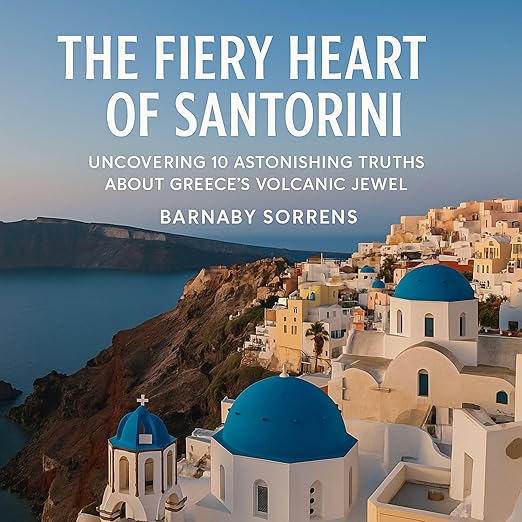
Quick Take
- Narration: Ashley Bourgeois delivers a polished, atmospheric performance well-suited to Sorrens’ lyrical descriptive passages.
- Themes: Geology as human story, the Minoan eruption and Atlantis myth, living in the shadow of catastrophe
- Mood: Richly descriptive and quietly marveling
- Verdict: A beautifully constructed short listen for anyone curious about what actually lies beneath Santorini’s famous postcard surface.
I put on The Fiery Heart of Santorini expecting something between a travel brochure and a geology lecture, and found instead a book that does something considerably more interesting: it uses the volcanic science as the foundation for a meditation on human adaptation and survival. At two hours and eighteen minutes, this is a short listen, but Barnaby Sorrens uses the runtime with genuine economy. There is nothing wasted here.
The book opens with the Minoan super-eruption, one of the most powerful volcanic events in recorded human history, which collapsed the island’s core and created the deep blue caldera that defines Santorini’s contemporary silhouette. Sorrens makes the argument, supported by historians, that this cataclysm may have been the origin of the Atlantis legend, which is a familiar claim but one he handles with appropriate epistemic care, presenting it as a plausible connection rather than settled fact. This sets the tone for the rest of the book, a willingness to weave myth and history together without confusing the two.
Our Take on The Fiery Heart of Santorini
Ten chapters cover the island’s geological formation, its architectural responses to volcanic conditions, its wine culture, and its still-active volcanic islands of Nea Kameni and Palea Kameni. The structural principle throughout is that every visible feature of Santorini, the whitewashed cliff houses carved into rock for protection and insulation, the distinctive blue domes, the vineyards where grapevines curl close to the ground to survive the wind and draw minerals from ancient ash, has a geological explanation that is also a human story. Sorrens is good at making that connection feel organic rather than forced. The wine chapter is one of the more memorable passages: the volcanic soil producing wines with what Sorrens calls an earthy, salt-and-smoke character is a genuinely evocative description, and one that will make you want to find a bottle. The geothermal hot springs chapter is one of the more unusual inclusions, and one of the more effective. Sorrens describes the springs within the caldera as evidence of the living power still flowing beneath the island, and the language he uses, the earth continuing to breathe in bursts of steam and sulphur, is the kind of precise sensory writing that travel nonfiction often gestures toward but rarely achieves. For a book this short, the density of specific detail is impressive.
Why Listen to The Fiery Heart of Santorini
Ashley Bourgeois handles the descriptive passages well. The prose is lyrical in places, and lyrical prose in audiobook form requires a narrator who can sustain pace without tipping into performance. Bourgeois finds that balance. The book reads as both pre-travel preparation and a substitute travel experience, and it works in both capacities. For listeners who have visited Santorini and want a framework for what they saw, this will recontextualize the experience considerably. For listeners who have not, it offers a complete, coherent picture of a place that is often reduced to its Instagram silhouette.
What to Watch For in The Fiery Heart of Santorini
There are no reader reviews available for this audiobook, so the only evidence we have of reception is the 5.0 average rating from 22 listeners. That is consistent with strong word of mouth in a niche audience rather than broad market penetration, and the book’s subject matter does skew specialist. At just over two hours, it functions more as an extended essay than a full-length audiobook, and expectations should be calibrated accordingly. If you are looking for narrative structure with character and plot, this is not that kind of book. It is closer to a feature documentary in prose form, and it is best engaged with that frame in mind.
Who Should Listen to The Fiery Heart of Santorini
Listen to this if you are planning a trip to Santorini and want more than a practical guidebook. Listen if you find geology compelling when explained through human consequence rather than technical terminology. Listen if you have two hours and want something that leaves you feeling you have learned something real. This is not a book for listeners expecting beach-read atmosphere. It is a book for people who look at a beautiful place and want to understand the forces that made it, and the people who chose to build a life on top of them.
Frequently Asked Questions
Is the Atlantis connection seriously argued in this book, or is it a hook for tourist appeal?
Sorrens treats it as a plausible historical hypothesis grounded in the scale of the Minoan eruption and its effects on the Mediterranean world, not as settled fact. The discussion is more serious than the cover marketing suggests.
Does the book require any prior knowledge of geology or Greek history?
No. Sorrens writes for general listeners and explains geological concepts in clear, accessible language. Greek historical context is provided as needed without assuming specialist knowledge.
Is this useful as a pre-trip listen before visiting Santorini?
Very much so. Several elements that visitors encounter, the architecture of the cliff houses, the volcanic beaches, the vineyards, the hot springs in the caldera, are explained in ways that will significantly enrich a visit.
How does Ashley Bourgeois handle the atmospheric descriptive passages?
Well. The narration is measured and clear, and it supports rather than overplays the lyrical moments in the prose. The pacing is appropriate for a book that moves between scientific explanation and sensory description.